

- Updated: December 28, 2025
- 5 min read
Introduction to Software Defined Radio (SDR) – A Comprehensive Overview
Software Defined Radio (SDR) Introduction: A Complete Guide for Hobbyists, Engineers, and Students
Software Defined Radio (SDR) is a technology that moves traditional radio‑frequency (RF) signal processing from dedicated hardware into flexible, programmable software, allowing anyone with a computer and a compatible radio front‑end to transmit, receive, and analyze wireless signals.
Why SDR Is the Hottest Trend in Modern Radio Hobbyism
From backyard radio enthusiasts decoding aircraft transponders to university labs prototyping 5G waveforms, SDR has become the universal sandbox for digital signal processing (DSP) experiments. Its open‑source nature, low entry cost, and ability to run on Python make it the perfect bridge between theory and real‑world radio projects.
A Quick Recap of the PySDR Introduction
The original PySDR tutorial (source) frames SDR as a learning pathway for anyone comfortable with Python and curious about RF. It covers:
- The fundamental distinction between software‑defined radio and traditional hardware radios.
- Core DSP concepts such as frequency domain analysis, IQ sampling, and digital modulation.
- Hands‑on examples with popular hardware like RTL‑SDR, HackRF, and USRP using Python libraries.
- Practical topics such as noise measurement, filtering, link budgets, and beamforming.
- Real‑time GUI development with PyQt for visualizing signals.
While the guide is thorough, many readers seek a more structured, SEO‑friendly overview that highlights the most actionable steps for getting started today. This article fills that gap.
Key Concepts Every SDR Learner Must Master
What Exactly Is Software Defined Radio?
At its core, SDR replaces analog mixers, filters, amplifiers, modulators, and demodulators with software algorithms running on a general‑purpose processor, FPGA, or GPU. The radio front‑end (often a USB dongle) digitizes the RF spectrum into IQ samples that your computer can manipulate in real time.
Digital Signal Processing (DSP) in a Nutshell
DSP is the mathematical engine behind SDR. It includes operations such as Fourier transforms, filtering, and modulation/demodulation. Mastering DSP lets you:
- Convert raw IQ data into audible sound or visual spectrograms.
- Implement custom modulation schemes (e.g., QPSK, OFDM).
- Apply noise reduction and error‑correction techniques.
The Power of the SDR Community
Open‑source projects like PySDR thrive on community contributions. Forums, Discord servers, and GitHub repos provide:
- Free tutorials and code snippets.
- Hardware recommendations for every budget.
- Collaborative troubleshooting and feature requests.
Engaging with the community accelerates learning and opens doors to collaborative research.
Visualizing the SDR Workflow
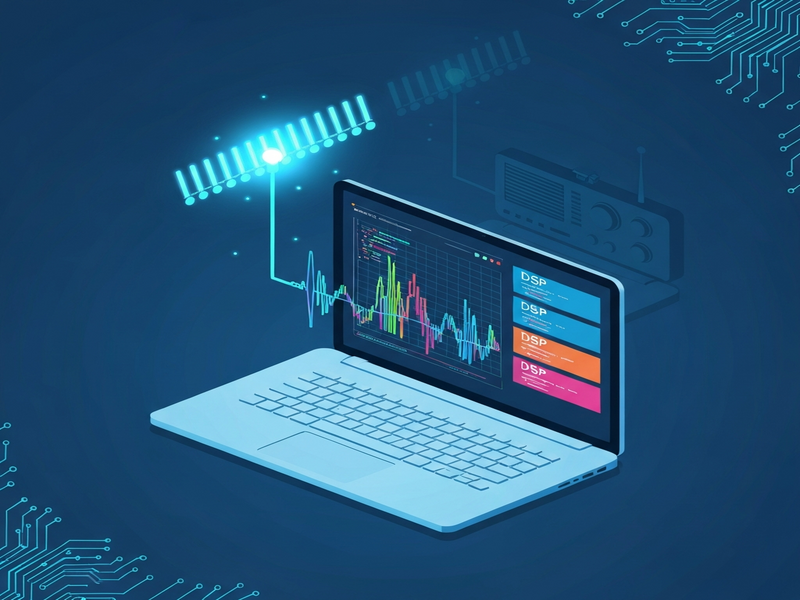
The diagram above (generated by UBOS AI) illustrates the typical SDR pipeline: antenna → RF front‑end → ADC → IQ samples → Python DSP chain → output (audio, data, or visual). Each block can be swapped or upgraded, showcasing the modular nature of SDR.
How UBOS Enhances Your SDR Projects
UBOS offers a suite of AI‑driven tools that can supercharge SDR development, from rapid prototyping to automated workflow orchestration.
UBOS platform overview
Explore a low‑code environment where you can integrate SDR data streams with AI models for real‑time analysis.
Web app editor on UBOS
Build interactive dashboards that visualize IQ data, spectrograms, and demodulated messages without writing a single line of HTML.
Workflow automation studio
Automate repetitive DSP tasks—like batch filtering or batch decoding—using visual flowcharts.
UBOS partner program
Collaborate with UBOS to co‑create SDR‑focused AI templates and get early access to new integrations.
UBOS pricing plans
Choose a plan that fits hobbyists, startups, or enterprise‑level SDR research labs.
UBOS templates for quick start
Kick‑start your SDR analytics with pre‑built templates like AI SEO Analyzer or AI Article Copywriter, which can be repurposed for signal classification.
Enterprise AI platform by UBOS
Scale SDR data pipelines to cloud‑based clusters for massive spectrum monitoring.
AI marketing agents
Leverage AI agents to automatically generate reports on detected RF events, perfect for commercial spectrum management.
Telegram integration on UBOS
Receive real‑time alerts from your SDR system directly to a Telegram channel.
ChatGPT and Telegram integration
Ask ChatGPT to interpret raw SDR logs on the fly via a Telegram bot.
OpenAI ChatGPT integration
Run advanced AI models on captured IQ data for automatic modulation classification.
Chroma DB integration
Store and query large collections of labeled SDR recordings with vector similarity search.
ElevenLabs AI voice integration
Convert decoded voice transmissions into natural‑sounding speech for accessibility demos.
Boost Your SDR Workflow with UBOS AI Templates
UBOS’s marketplace offers ready‑made AI applications that can be repurposed for SDR tasks. Here are a few that fit perfectly into a radio‑signal workflow:
- AI YouTube Comment Analysis tool – adapt its sentiment engine to classify decoded voice messages.
- AI Video Generator – create visual tutorials that explain SDR concepts.
- AI Audio Transcription and Analysis – automatically transcribe decoded audio streams.
- Generative AI Text-to-Video – turn your SDR experiment logs into engaging video summaries.
Read the Full PySDR Introduction
For a deep dive into the original curriculum, visit the official PySDR page: PySDR Introduction. The source material provides extensive code listings and downloadable notebooks that complement the concepts discussed here.
Take the Next Step in Your SDR Journey
Whether you are a seasoned radio hobbyist or a student eager to explore open source SDR, the combination of Python, community resources, and UBOS’s AI‑enhanced platform gives you a powerful, low‑cost laboratory at your fingertips.
Ready to build your first SDR application?
- Grab a cheap RTL‑SDR dongle and install the PySDR tutorial.
- Use the Web app editor on UBOS to create a live spectrogram dashboard.
- Connect the dashboard to a Telegram integration on UBOS for instant alerts.
- Scale up with the Enterprise AI platform by UBOS when you need to monitor multiple frequencies simultaneously.
Join the SDR community today, share your experiments, and let AI accelerate your learning curve. The sky isn’t the limit—it’s just the next frequency band to explore.