

- Updated: February 6, 2026
- 6 min read
Indian Female Workers Face Harsh Realities While Moderating Content for AI Training – Ethical AI Concerns Rise
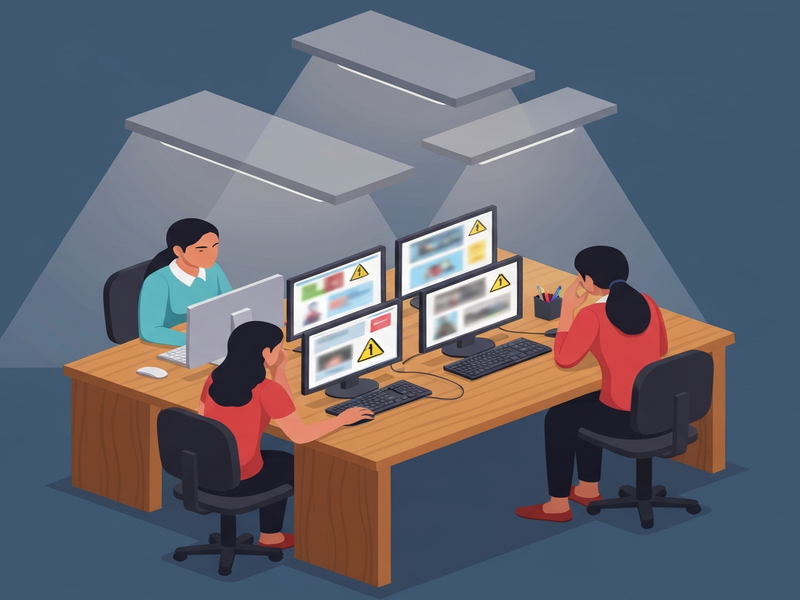
Indian women are the unseen backbone of AI training data, yet they endure grueling hours of graphic content moderation that raises serious ethical and mental‑health concerns.
What the Guardian Report Reveals
The Guardian investigation uncovers the daily reality of women in rural India who sift through thousands of violent and pornographic images to teach global AI systems how to “see”. Working from mud‑walled verandas or cramped home offices, they are paid a fraction of the revenue their labor generates for multinational tech giants. This article expands on those findings, explains why female workers dominate the data‑annotation pipeline, and outlines the urgent ethical actions the industry must take.
Why Women Dominate India’s AI Training Workforce
Data annotation is the “fuel” that powers modern machine‑learning models. Without human‑curated labels, algorithms cannot differentiate a cat from a dog, or a harmless meme from hate speech. In India, women make up more than half of the annotation labor pool for three key reasons:
- Perceived “respectability”: Companies market home‑based moderation as a safe, gender‑neutral job, which aligns with cultural expectations for women to work from home.
- Economic necessity: Rural households often lack diversified income streams; a modest monthly stipend can be a lifeline.
- Skill alignment: Employers value women’s attention to detail and patience, traits deemed essential for meticulous labeling tasks.
According to Nasscom, the Indian data‑annotation market was valued at $250 million in 2021, with an estimated 70,000 workers—most of them women from Dalit and Adivasi communities—feeding the global AI supply chain.
The Human Cost: Working Conditions & Mental Health
While the pay may appear steady, the psychological toll is anything but. Moderators like Monsumi Murmu from Jharkhand and Raina Singh from Uttar Pradesh describe a progression from “dull” text‑screening to relentless exposure to child sexual abuse material, graphic violence, and explicit pornography.
Typical Workday
On an average shift, a moderator reviews:
- 800+ images or video clips, each lasting 2‑10 seconds.
- Multiple classification tasks—identifying nudity, hate symbols, or misinformation.
- Rapid decision‑making under strict time constraints, often with a “yes/no” UI.
Psychological Symptoms Reported
Research from the Data Workers’ Inquiry highlights a pattern of secondary trauma:
| Symptom | Description |
|---|---|
| Intrusive thoughts | Images replay during quiet moments or before sleep. |
| Emotional numbing | Gradual desensitization leading to a “blank” feeling. |
| Sleep disturbances | Nightmares, insomnia, and difficulty concentrating. |
| Relationship strain | Aversion to intimacy and social withdrawal. |
“In the end, you don’t feel disturbed – you feel blank.” – Monsumi Murmu, content moderator
Even when companies provide “well‑being” check‑ins, the support is often optional, language‑barriered, and insufficient to address the cumulative trauma.
Ethical Red Flags for the Tech Industry
The Guardian’s findings expose three systemic ethical failures:
- Opacity: Workers sign NDAs that forbid them from discussing the nature of their tasks, silencing any collective bargaining.
- Inadequate compensation: Monthly earnings of £260‑£330 barely cover basic living costs, while the AI models they train generate billions in revenue.
- Lack of legal protection: Indian labour law does not recognise psychological injury from digital work, leaving moderators without recourse.
These gaps jeopardise not only the well‑being of workers but also the integrity of AI systems. When annotators are over‑exposed or under‑supported, labeling quality degrades, leading to biased or unsafe AI outputs.
Industry‑Level Recommendations
- Mandate transparent job descriptions that disclose content‑type exposure before hiring.
- Implement paid mental‑health counseling as a contractual right, not an optional perk.
- Introduce a global “AI Labour Standard” that aligns remuneration with the value generated by the models.
- Adopt audit‑ready documentation of annotation pipelines to ensure ethical compliance.
How UBOS Is Shaping a Safer AI Future
At UBOS, we believe ethical AI starts with humane data practices. Our platform offers tools that reduce reliance on low‑paid human moderators while still delivering high‑quality training data.
- Explore the UBOS platform overview to see how automated pre‑screening can filter the most harmful content before it reaches human eyes.
- Leverage the AI ethics framework built into every UBOS workflow, ensuring compliance with emerging global standards.
- Start quickly with UBOS templates for quick start, including the AI SEO Analyzer and AI Article Copywriter—both designed to minimize manual content review.
- For startups seeking responsible AI, check out UBOS for startups and learn how our Enterprise AI platform by UBOS scales ethically.
- SMBs can benefit from UBOS solutions for SMBs, which embed Workflow automation studio to automate repetitive moderation tasks.
- Our AI marketing agents illustrate how generative AI can be deployed responsibly without exposing workers to harmful content.
- Develop custom voice‑enabled assistants with the ElevenLabs AI voice integration—a safer alternative to text‑only moderation.
- Integrate powerful language models via the OpenAI ChatGPT integration while keeping a human‑in‑the‑loop for edge cases.
- Connect your bots to Telegram using the Telegram integration on UBOS and the ChatGPT and Telegram integration for real‑time, low‑risk user interactions.
- Try the GPT-Powered Telegram Bot template to see how automated moderation can be safely outsourced.
- Review our UBOS portfolio examples for case studies where ethical data pipelines reduced human exposure by up to 70%.
- Learn about our pricing flexibility at UBOS pricing plans, which include a “Human‑Wellbeing” tier for companies committed to ethical labor.
- Join the UBOS partner program to co‑create responsible AI solutions with industry leaders.
By adopting these tools, tech firms can shift from a model that exploits invisible labor to one that respects human dignity while still delivering cutting‑edge AI.
Conclusion: Turning Awareness into Action
The Guardian’s expose shines a harsh light on the hidden workforce powering today’s AI. Indian female content moderators are essential yet undervalued, bearing the brunt of psychological harm for profit‑driven algorithms. Ethical AI is impossible without addressing the labor conditions that create the training data in the first place.
Companies that ignore these realities risk not only legal backlash but also the erosion of public trust in AI systems. The path forward demands transparency, fair compensation, mental‑health safeguards, and technology that reduces exposure to harmful content. Platforms like UBOS demonstrate that it is feasible to build responsible AI pipelines without sacrificing human well‑being.
Stakeholders—tech leaders, policymakers, and consumers—must champion these changes now, ensuring that the next generation of AI is built on a foundation of ethical labor.