

- Updated: February 22, 2026
- 6 min read
Human Root of Trust: A New Framework for AI Accountability
The Human Root of Trust whitepaper defines a public‑domain framework that forces every AI agent to trace its actions back to a responsible human, establishing cryptographic accountability for autonomous systems.
Human Root of Trust Whitepaper: A New Era of AI Accountability
On February 2026, a coalition of security engineers, cryptographers, and legal scholars released the Human Root of Trust whitepaper (v1.0). The document is not a product, nor a formal standard; it is a principle‑driven architecture that makes AI accountability concrete. In a world where autonomous agents can sign contracts, move money, and manage infrastructure without a visible human, the framework offers a trust‑chain that links every machine action to a verifiable human principal.
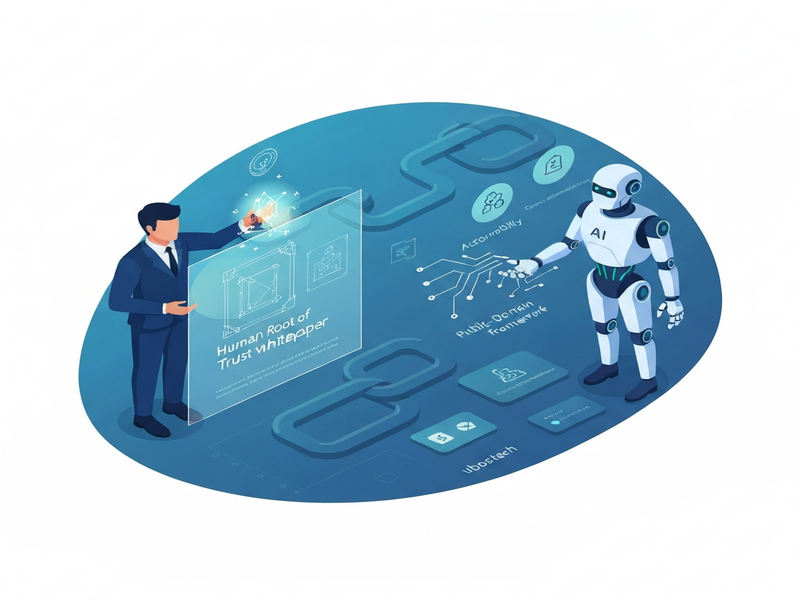
Overview of the Human Root of Trust Whitepaper
The whitepaper is organized around three pillars:
- Human Singularities: Every digital identity must be anchored to a single, accountable person.
- Cryptographic Traceability: Actions are signed, logged, and linked through immutable hashes.
- Open‑Domain Collaboration: The framework is released into the public domain, inviting global contributions.
The Trust‑Chain Architecture – Six Steps, One Principle
The core of the framework is a six‑step trust chain that can be visualized as a pipeline:
- Human Identity Registration: A verified human creates a cryptographic key pair.
- Agent Provisioning: The AI agent receives a delegated sub‑key bound to the human’s master key.
- Action Signing: Every autonomous operation is signed with the agent’s sub‑key.
- Chain Linking: The signature includes a reference to the parent human key.
- Immutable Logging: All signed actions are stored in a tamper‑evident ledger (e.g., blockchain or append‑only log).
- Audit Retrieval: Auditors can reconstruct the full lineage from action back to the human principal.
This architecture satisfies regulators, counterparties, and auditors alike, answering the critical question: “Who is responsible for this AI‑driven transaction?”
The Problem: AI Agents Lacking Human Accountability
Since the early days of the commercial internet, every system assumed a human at the other end. Bank accounts, API keys, and legal contracts were all built around the notion of a single accountable person. That assumption has fractured:
- AI agents can now browse the web, execute financial transfers, and sign digital contracts without a human in the loop.
- Existing identity checks (KYC, MFA) are designed for humans, not for autonomous software.
- Regulators are asking: “Who is liable when an AI bot breaches a contract?”
- Enterprises risk losing trust if they cannot prove a human is ultimately accountable.
Without a transparent chain of responsibility, organizations face legal exposure, reputational damage, and operational shutdowns. The Human Root of Trust framework directly addresses these gaps.
Proposed Solution: Trust‑Chain Architecture
The trust‑chain model transforms the abstract principle “every agent must trace to a human” into a concrete, implementable system. Below are the practical benefits:
Regulatory Compliance
Auditable logs satisfy GDPR, CCPA, and emerging AI‑governance regulations.
Operational Transparency
Teams can instantly trace any autonomous decision back to its human sponsor.
Risk Mitigation
Clear accountability reduces liability and insurance premiums.
Scalable Trust
Cryptographic delegation allows thousands of agents to operate under a single human key.
Implementation can be layered onto existing AI platforms. For example, the OpenAI ChatGPT integration on UBOS already supports token‑based authentication; adding a trust‑chain wrapper would bind each ChatGPT‑driven action to a verified human key.
Public‑Domain Framework and Community Invitation
The authors deliberately released the framework into the public domain—no rights reserved, no licensing fees. This openness invites a broad ecosystem to:
- Security engineers to discover and patch gaps.
- Cryptographers to formalize the protocol into provable security guarantees.
- Legal experts to map the architecture to jurisdiction‑specific regulations.
- Developers to build reference implementations and share best practices.
UBOS is already positioned to accelerate this collaborative effort. Our UBOS platform overview provides a low‑code environment where trust‑chain modules can be dropped into existing workflows. The Workflow automation studio lets you orchestrate human‑in‑the‑loop approvals before an AI agent executes a high‑risk action.
How UBOS Aligns with the Human Root of Trust Vision
UBOS’s product suite already embodies many of the whitepaper’s principles:
- Identity Management: The Telegram integration on UBOS demonstrates secure, human‑verified messaging channels that can be extended to AI agents.
- AI‑Driven Marketing: Our AI marketing agents operate under strict human‑ownership policies, ensuring every campaign can be audited back to a responsible marketer.
- Voice Interaction: The ElevenLabs AI voice integration adds a human‑like interface while preserving the underlying cryptographic traceability.
- Template Marketplace: Ready‑to‑use solutions such as the AI SEO Analyzer or the AI Article Copywriter can be wrapped with trust‑chain logic in minutes.
For startups, the UBOS for startups program offers discounted access to these trust‑enabled modules, while SMBs can leverage the UBOS solutions for SMBs to meet compliance without massive overhead.
Enterprises seeking a full‑scale deployment can explore the Enterprise AI platform by UBOS, which includes built‑in audit trails, role‑based access, and integration points for the Human Root of Trust framework.
Take Action: Join the Trust‑Chain Movement
If your organization is ready to embed human accountability into every AI decision, start by exploring the resources below:
- Read the full Human Root of Trust whitepaper (PDF available on the project’s GitHub).
- Visit the UBOS homepage to request a demo of trust‑enabled AI agents.
- Contact our experts via the UBOS contact page for a personalized integration roadmap.
- Explore pricing options in the UBOS pricing plans to find a tier that matches your compliance budget.
- Join the UBOS partner program to co‑develop extensions for the trust‑chain architecture.
Ready to make every AI action traceable? Reach out today, and let’s build a future where autonomous systems are as accountable as the humans who create them.
Conclusion
The Human Root of Trust whitepaper delivers a groundbreaking, public‑domain framework that addresses the pressing problem of AI accountability. By implementing the six‑step trust‑chain architecture, organizations can guarantee that “every agent must trace to a human,” satisfying regulators, auditors, and customers alike. UBOS’s suite of integrations—ranging from ChatGPT and Telegram integration to the AI Video Generator—provides ready‑made building blocks for embedding this accountability into real‑world products.
Adopting the Human Root of Trust is not just a compliance checkbox; it is a strategic advantage in an AI‑driven market. Companies that can prove a transparent, cryptographically‑secure link between actions and human principals will earn trust, avoid costly legal disputes, and unlock new opportunities for responsible AI innovation.
Stay informed, stay accountable, and let UBOS help you turn the promise of trustworthy AI into a measurable reality.
Explore more on our UBOS blog or discover the AI trust resources for deeper insights.
Andrii Bidochko
CTO UBOS
Andrii Bidochko is an AI entrepreneur and researcher focused on AI agents, reinforcement learning, and autonomous systems. He writes about the technologies shaping the future of machine intelligence, from frontier models and agent architectures to real-world AI applications.