

- Updated: March 11, 2026
- 6 min read
Claude AI Outage Sparks Heated Discussion on Hacker News – Status, Impact, and Solutions
Claude suffered a widespread outage on March 10 2026, causing login failures, OAuth time‑outs, and degraded performance for both Claude Chat and Claude Code, as reported by users on Hacker News.
What happened? An AI outage that shook the community
In the early hours of March 10, developers, AI enthusiasts, and business leaders reported that Anthropic’s Claude was inaccessible. The official status page briefly showed a green light, but users experienced 401 errors, OAuth token expirations, and a “timeout of 15000 ms exceeded” message when trying to authenticate. The incident quickly became a hot thread on Hacker News, where more than 60 comments dissected the symptoms, possible causes, and the broader implications for AI reliability.
This article provides a concise recap of the outage, examines the technical clues shared by the community, evaluates the impact on users and the AI ecosystem, and offers actionable guidance for teams that rely on Claude or similar large‑language‑model (LLM) services.
Claude in a nutshell
Claude is Anthropic’s flagship conversational AI, positioned as a “safer” alternative to OpenAI’s ChatGPT. It powers two main products:
- Claude Chat – a web‑based chat interface for general‑purpose conversation, brainstorming, and content creation.
- Claude Code – an IDE‑integrated assistant that helps developers write, debug, and refactor code directly inside editors like VS Code or Zed.
Both services rely on the same underlying LLM, but they expose different APIs and usage patterns. Because many enterprises embed Claude Code into CI pipelines or internal tooling, an outage can cascade into production delays, missed deadlines, and even revenue impact.
What the Hacker News thread revealed
The Hacker News discussion surfaced several recurring themes that help us understand the outage’s scope:
- Authentication failures – Users reported 401 and 500 errors when trying to obtain OAuth tokens. The error “OAuth token has expired. Please obtain a new token or refresh your existing token.” appeared repeatedly.
- Partial service degradation – While the Claude API remained operational, the web UI and Claude Code extensions suffered latency spikes, with some comments describing the experience as “molasses flowing uphill.”
- Inconsistent status reporting – The public status page showed a green light for several minutes before updating to “Investigating issues,” leading to confusion about the real‑time health of the service.
- Community troubleshooting – Developers shared workarounds such as clearing cookies, forcing a token refresh, or temporarily switching to alternative LLMs (e.g., OpenAI’s GPT‑4 or Anthropic’s older Claude‑2 model).
- Speculation on root cause – Some participants suggested a staged rollout gone wrong, while others pointed to possible thundering‑herd effects on authentication servers.
The thread also highlighted a broader sentiment: AI services are now mission‑critical, and any downtime is felt sharply across development teams, product managers, and even C‑suite executives.
Why the outage matters: impact on users and the AI ecosystem
The Claude outage illustrates three key risks for organizations that depend on AI models:
1. Productivity loss
Developers who rely on Claude Code for code generation or bug fixing reported idle time ranging from 30 minutes to several hours. In fast‑moving product cycles, this translates into missed sprint goals and delayed releases.
2. Financial implications
Many SaaS platforms bill customers based on AI usage. An outage forces teams to either pause billing (potentially losing revenue) or switch to a backup model, which may incur higher per‑token costs. Some commenters on Hacker News asked whether Anthropic would extend subscriptions as compensation.
3. Trust and reliability perception
Repeated or prolonged outages erode confidence in “AI‑as‑a‑service.” Enterprises start demanding SLAs, multi‑cloud redundancy, or on‑premise LLM deployments to mitigate risk.
For businesses that have already integrated AI into core workflows, the Claude incident serves as a wake‑up call to adopt a resilience‑first strategy—including monitoring, fallback models, and clear communication plans.
How UBOS helps you stay resilient during AI outages
At UBOS, we design platforms that keep your AI‑driven applications running even when a single provider falters. Below are some of our solutions that directly address the challenges highlighted by the Claude outage.
- UBOS platform overview – A unified environment for deploying, scaling, and monitoring AI models from multiple vendors.
- Enterprise AI platform by UBOS – Offers built‑in failover to alternative LLMs (e.g., OpenAI, Anthropic, local models) with zero‑downtime switching.
- Workflow automation studio – Automates token refresh, retries, and fallback routing without code changes.
- Web app editor on UBOS – Enables rapid prototyping of AI‑enhanced UIs that can toggle between Claude, GPT‑4, or custom models.
- AI marketing agents – Leverage multiple LLMs for campaign generation, ensuring continuity if one model goes offline.
- UBOS partner program – Gives early access to new model integrations and dedicated support for high‑availability use cases.
- UBOS pricing plans – Transparent pricing that includes multi‑model redundancy as a standard feature.
- UBOS templates for quick start – Pre‑built templates such as the AI SEO Analyzer or AI Article Copywriter that demonstrate how to embed fallback logic.
Whether you are a startup (UBOS for startups) or an SMB (UBOS solutions for SMBs), our platform gives you the tools to monitor AI model status in real time and switch providers automatically.
Looking ahead: monitoring AI model status and preventing future disruptions
The Claude incident underscores the need for robust AI model status monitoring. Here are three best‑practice pillars you can adopt today:
Real‑time health dashboards
Integrate status‑page APIs (e.g., Claude’s status API) into a centralized dashboard. UBOS’s Enterprise AI platform already provides a plug‑and‑play widget that visualizes latency, error rates, and token‑quota usage across providers.
Automated fallback routing
Use a routing layer that evaluates health checks before each request. If Claude returns a 5xx or a timeout, the request is automatically retried against a secondary model such as OpenAI ChatGPT integration or a locally hosted Chroma DB integration. This pattern eliminates single points of failure.
Transparent communication to stakeholders
When an outage occurs, a pre‑written incident‑response template should be sent to product owners, support teams, and customers. Include real‑time status links, estimated time to recovery, and any compensation policy. UBOS’s About UBOS page showcases a sample communication flow that you can adapt.
By combining these pillars, organizations can transform an AI service disruption from a crisis into a manageable event, preserving productivity and trust.
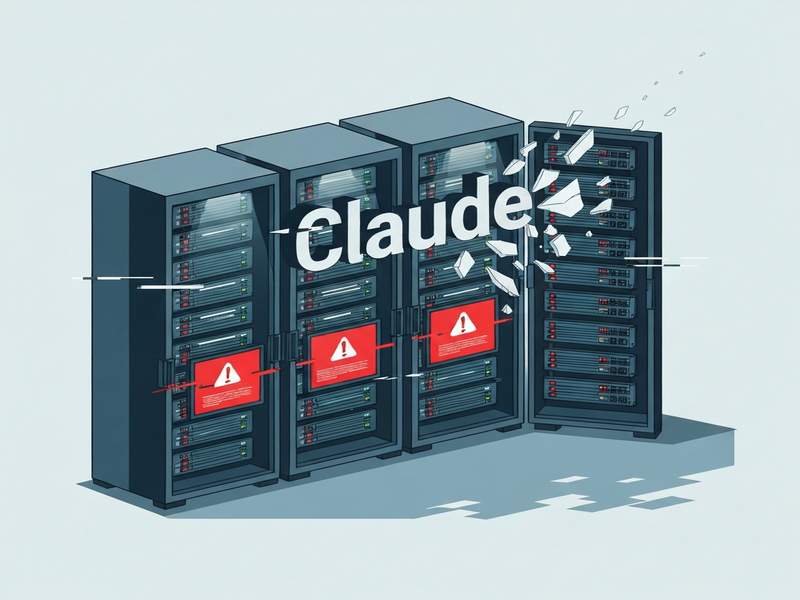
Illustration: the ripple effect of an AI outage on modern development pipelines.
Takeaway
The Claude outage of March 2026 was a vivid reminder that AI models, while powerful, are still services subject to the same reliability challenges as any cloud offering. By monitoring AI model status, implementing automated fallbacks, and leveraging platforms like UBOS, teams can safeguard their workflows against future disruptions.
Stay informed, diversify your model portfolio, and turn resilience into a competitive advantage. For a deeper dive into building fault‑tolerant AI pipelines, explore our UBOS portfolio examples and start experimenting with the AI YouTube Comment Analysis tool today.
Andrii Bidochko
CTO UBOS
Andrii Bidochko is an AI entrepreneur and researcher focused on AI agents, reinforcement learning, and autonomous systems. He writes about the technologies shaping the future of machine intelligence, from frontier models and agent architectures to real-world AI applications.