

- Updated: March 17, 2026
- 8 min read
Google Secures 2.7 GW Clean Power Deal for Michigan Data Center – UBOS News
Answer: Google is teaming up with Michigan utility DTE to secure 2.7 GW of clean power for its new Detroit‑area data center, leveraging a “Clean Transition Tariff” that blends solar, energy‑storage, and other renewable resources to boost data‑center efficiency and sustainability.
Google’s Data‑Center Power Strategy: How the DTE Deal Redefines Sustainability for Cloud Infrastructure
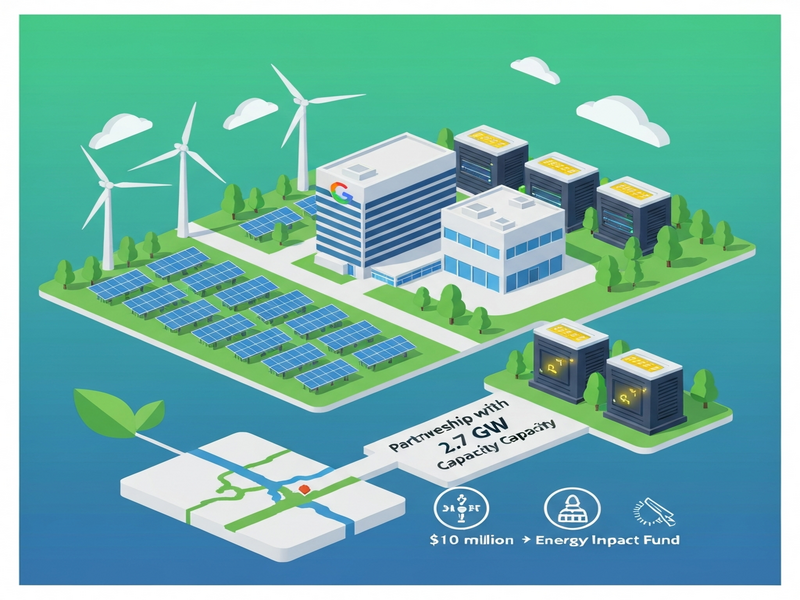
IT decision‑makers, cloud‑infrastructure managers, and sustainability officers are constantly hunting for real‑world examples of how the biggest tech giants turn climate ambition into concrete grid‑level actions. Google’s latest partnership with cloud infrastructure experts DTE Michigan is a textbook case—combining a massive renewable mix, a novel tariff structure, and a $10 million Energy Impact Fund to power a future‑proof data center while keeping the carbon footprint in check.
What the Google‑DTE Agreement Actually Looks Like
On March 17, 2026, Google announced a 2.7 GW power package for a new data‑center campus in suburban Detroit. The package is broken down as follows:
- 1.6 GW of solar generation – the largest single‑site solar commitment in the region.
- 400 MW of four‑hour battery storage – enabling rapid response to peak‑load events.
- 50 MW of long‑duration storage – designed for multi‑hour grid support.
- 300 MW of “additional clean resources” – a flexible bucket that may include wind, hydro, geothermal, or even nuclear.
- 350 MW of demand‑response capacity – allowing Google (or partner loads) to curtail consumption when the grid is stressed.
This blend mirrors Google’s earlier Google data center efficiency initiatives, but it is the first time the company has publicly tied a tariff to the mix. The “Clean Transition Tariff” (CTT) is a pricing mechanism that lets Google pay a premium for the exact clean resources it wants, while giving DTE a clear financial incentive to build those assets.
Renewable Mix & the Clean Transition Tariff: A New Playbook
The CTT is more than a contract clause; it is a market‑shaping tool. By specifying the technology mix, Google pushes DTE to diversify its generation portfolio, reducing reliance on any single source and smoothing out intermittency. Here’s why the tariff matters:
- Price Signal for Clean Tech: Utilities receive a higher, predictable revenue stream for solar, storage, or emerging resources, accelerating capital deployment.
- Grid Planning Alignment: The tariff is built into DTE’s long‑range planning, ensuring that the new resources are integrated with existing transmission and distribution upgrades.
- Risk Mitigation for Google: By locking in a clean‑energy‑specific price, Google shields itself from volatile wholesale markets while meeting its 24/7 carbon‑free energy (CFE) goal.
In practice, the CTT works like a “green‑premium” power purchase agreement (PPA) but with a regulatory overlay that makes the clean resources part of the utility’s baseline plan rather than a side project. This approach mirrors the OpenAI ChatGPT integration model, where a core platform is extended with specialized capabilities without creating a siloed add‑on.
How the Power Plan Boosts Data‑Center Efficiency and Sustainability
Google’s data centers already rank among the world’s most efficient facilities, thanks to custom cooling, AI‑driven workload balancing, and waste‑heat reuse. The DTE power package adds three new layers of efficiency:
1. Real‑Time Load Shaping with Demand Response
By participating in demand‑response programs, the Detroit campus can automatically throttle non‑critical workloads during grid stress, reducing the need for backup diesel generators and cutting emissions.
2. On‑Site Battery Buffering
The 400 MW of four‑hour storage acts as a “virtual UPS,” smoothing out solar variability and allowing the data center to run on renewable power even when the sun isn’t shining. This reduces reliance on external peaker plants and improves the overall capacity factor of the solar farms.
3. Long‑Duration Storage for Seasonal Balance
Fifty megawatts of long‑duration storage can store excess solar generation in summer and release it during winter peaks, aligning with Google’s Enterprise AI platform by UBOS that predicts workload spikes months in advance.
Combined, these measures are expected to push the data‑center’s Power Usage Effectiveness (PUE) below 1.10—a benchmark that rivals the most efficient hyperscale facilities worldwide.
TechCrunch’s Take on the Deal
“The DTE deal will also use Google’s Clean Transition Tariff, which it has been refining over the past year or so. The tariff was previously used in Google’s deal with Xcel Energy. It’s intended to allow Google to pay a premium to specify the types of power it wants deployed while also encouraging utilities to incorporate such technologies into their long‑range planning.” – TechCrunch
This quote underscores the strategic shift from ad‑hoc PPAs to a systematic, tariff‑driven approach that can be replicated across regions.
Why This Matters for Your Cloud Strategy
For enterprises evaluating where to host mission‑critical workloads, Google’s power model offers a clear decision framework:
- Predictable Energy Costs: The CTT locks in a clean‑energy premium, reducing exposure to market spikes.
- Carbon‑Free Guarantees: By tying the tariff to specific renewable assets, Google can certify 24/7 carbon‑free power for each workload.
- Scalable Sustainability: The modular nature of solar + storage + demand response can be scaled to any data‑center size, from edge sites to hyperscale campuses.
Companies looking to align their IT roadmap with ESG goals can draw inspiration from Google’s playbook and ask their utility partners about similar tariff structures. In fact, many of the tools that help model these scenarios are already available on the AI marketing agents platform, which can simulate cost‑and‑emission outcomes for different power mixes.
Leverage UBOS to Accelerate Your Own Green Cloud Journey
UBOS provides a suite of low‑code solutions that make it easy to integrate renewable‑energy data into your IT operations:
- Web app editor on UBOS – Build dashboards that visualize real‑time power consumption vs. renewable generation.
- Workflow automation studio – Automate demand‑response actions based on grid signals.
- UBOS templates for quick start – Deploy pre‑built templates like the “AI SEO Analyzer” or “AI Article Copywriter” to embed sustainability metrics into your marketing content.
These capabilities let you replicate Google’s data‑center efficiency gains without the need for a multi‑billion‑dollar power purchase.
Explore Related UBOS Resources
Whether you’re a startup or an established SMB, UBOS offers tailored solutions that align with the same sustainability principles:
- UBOS for startups – Fast‑track your AI‑driven product with green‑by‑design architecture.
- UBOS solutions for SMBs – Scale responsibly with built‑in energy‑efficiency modules.
- UBOS pricing plans – Transparent, usage‑based pricing that rewards low‑energy workloads.
- UBOS portfolio examples – See how other companies have cut carbon footprints using our platform.
- About UBOS – Learn more about our mission to democratize AI‑powered sustainability.
Future‑Facing Templates to Keep You Ahead
UBOS’s Template Marketplace hosts dozens of AI‑powered tools that can complement a green cloud strategy. A few highlights:
- AI SEO Analyzer – Optimize your website while tracking the carbon cost of crawling.
- AI Article Copywriter – Generate high‑quality content with minimal compute overhead.
- AI Video Generator – Produce marketing videos using server‑side rendering that leverages renewable‑powered GPU farms.
- AI Chatbot template – Deploy conversational agents that run on energy‑efficient inference nodes.
- AI for Turn-by-Turn Directions – Example of low‑latency AI that can be hosted on edge data centers powered by clean energy.
Take Action: Align Your Data Center with Clean Power
Google’s DTE partnership proves that large‑scale renewable procurement is no longer a “nice‑to‑have” but a strategic necessity. Here’s a quick checklist for IT leaders:
- Audit your current power mix and identify the carbon‑intensity of each workload.
- Engage your utility to explore tariff‑based clean‑energy contracts similar to the Clean Transition Tariff.
- Implement demand‑response automation using tools like Workflow automation studio.
- Leverage UBOS’s low‑code platform to build real‑time energy dashboards.
- Report progress to stakeholders using ESG‑aligned metrics.
By following these steps, you can replicate Google’s success, reduce operational costs, and meet the growing expectations of investors, customers, and regulators.
Conclusion
Google’s collaboration with DTE Michigan showcases a forward‑thinking blend of renewable generation, innovative tariff design, and demand‑response flexibility that sets a new benchmark for data‑center sustainability. The approach is scalable, financially sound, and directly aligned with corporate ESG goals—making it a compelling model for any organization that relies on cloud infrastructure.
Ready to power your own data center with clean energy? Explore the UBOS homepage to discover how our AI‑driven platform can help you design, automate, and monitor a carbon‑free cloud environment today.
Andrii Bidochko
CTO UBOS
Andrii Bidochko is an AI entrepreneur and researcher focused on AI agents, reinforcement learning, and autonomous systems. He writes about the technologies shaping the future of machine intelligence, from frontier models and agent architectures to real-world AI applications.