

- Updated: February 4, 2026
- 5 min read
Google Gemini Expands to Android Apps: What It Means for Developers
Google is rolling out Gemini AI integration that will tap into Android apps as live training data sources, giving developers a new way to boost AI capabilities while keeping user privacy intact.
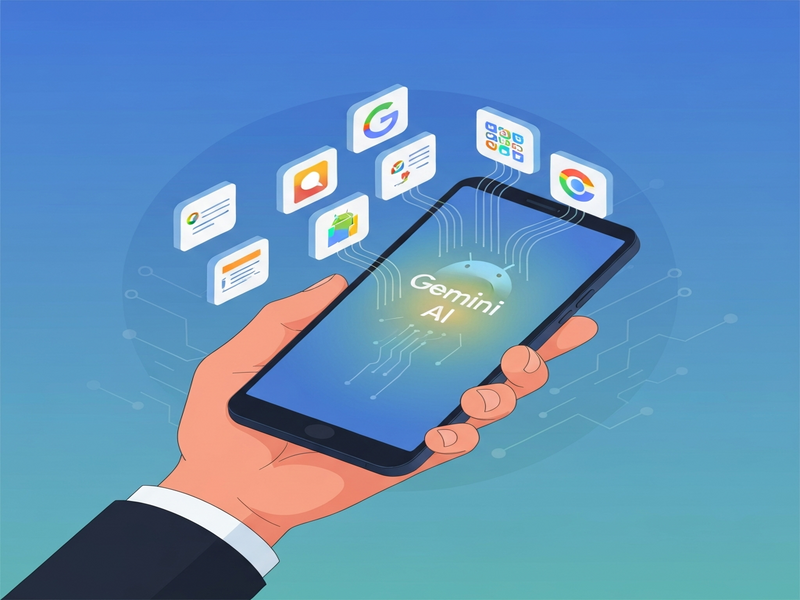
Google Gemini Meets Android: How the New AI‑Training Loop Will Transform Mobile Apps
In a bold move announced this week, Google revealed that its next‑generation generative model, Gemini, will start learning directly from the behavior of Android applications installed on users’ devices. The strategy, detailed by Android Police, promises richer, context‑aware AI experiences across the Android ecosystem while adhering to strict privacy safeguards.
For tech‑savvy professionals, mobile developers, and AI enthusiasts, this development signals a shift from static model updates to a continuous, on‑device feedback loop that could accelerate innovation in everything from smart assistants to personalized content recommendations.
What Is Google Gemini and Why It Matters
Gemini is Google’s answer to the rapidly evolving generative AI market, positioned as a multimodal powerhouse that can understand text, images, audio, and video in a single model. Built on the same infrastructure that powers Bard and PaLM, Gemini aims to deliver higher reasoning depth, lower latency, and tighter integration with Google services.
Key differentiators include:
- Multimodal reasoning across text, vision, and audio.
- Enhanced safety layers that filter harmful content in real time.
- Scalable training pipelines that can ingest billions of data points daily.
By leveraging Android apps as a data source, Gemini can learn from real‑world usage patterns, making it more adaptable to the nuances of mobile interactions.
Google’s Plan: Turning Android Apps Into Live Training Labs
Google’s roadmap outlines three core mechanisms for feeding Android app data into Gemini:
- Opt‑in telemetry: Users who enable advanced diagnostics will allow anonymized interaction logs to be streamed to Google’s training clusters.
- On‑device federated learning: Model updates are computed locally on the device and only the aggregated gradients are sent back, preserving raw user data.
- API‑driven feedback loops: Developers can embed OpenAI ChatGPT integration style hooks that surface user intent signals directly to Gemini without exposing personal content.
Google emphasizes that all data will be privacy‑first: identifiers are stripped, and the system complies with GDPR, CCPA, and Google’s own About UBOS privacy standards.
What developers need to know
Developers will receive a new Workflow automation studio plugin that simplifies the creation of data‑export pipelines. The plugin supports popular formats such as JSON, protobuf, and the emerging Chroma DB integration for vector storage.
Impact on Developers and End‑Users
The integration opens a spectrum of opportunities:
For Developers
- Access to a continuously improving AI model without frequent manual updates.
- Ability to embed AI marketing agents that adapt to user behavior in real time.
- Monetization pathways via the UBOS partner program, offering revenue share on AI‑enhanced features.
For End‑Users
- More accurate predictive keyboards, voice assistants, and recommendation engines.
- Personalized content generation—think on‑the‑fly summaries, translations, and image captions.
- Improved accessibility through tools like ElevenLabs AI voice integration that can read app content in natural‑sounding speech.
Early adopters can also leverage UBOS’s templates for quick start, such as the AI SEO Analyzer or the AI Article Copywriter, to prototype Gemini‑powered features within days.
Industry Insight
“Google’s decision to turn the Android ecosystem into a living lab for Gemini is a game‑changer. It democratizes AI training, letting even small‑scale developers benefit from the same data richness that powers Google’s own services,” says Dr. Maya Patel, AI research lead at a leading mobile analytics firm.
Patel adds that the federated approach mitigates privacy concerns while still delivering “real‑time model refinement,” a capability previously limited to large cloud‑only training cycles.
Take the Next Step with UBOS
If you’re ready to embed Gemini‑level intelligence into your Android portfolio, UBOS offers a complete stack:
- Explore the UBOS platform overview for end‑to‑end AI deployment.
- Kick‑start projects with the Web app editor on UBOS, which now supports Gemini‑compatible modules.
- Check out the Enterprise AI platform by UBOS for scalable, secure model serving.
- Browse real‑world success stories in the UBOS portfolio examples to see how other companies have accelerated AI adoption.
- Review the UBOS pricing plans to find a tier that matches your budget.
- Join the UBOS for startups program for mentorship and early‑access credits.
- Leverage ready‑made AI tools like the AI Video Generator or the AI Chatbot template to prototype Gemini‑driven experiences.
- Stay updated with the latest AI news from UBOS, where we regularly dissect Google’s AI roadmap.
Ready to experiment? Visit the UBOS homepage and start building the future of mobile AI today.
Source
The original announcement was reported by Android Police. For a deeper dive into the technical specifications, keep an eye on Google’s AI blog and the upcoming developer documentation.
Conclusion
Google’s Gemini‑Android integration marks a pivotal moment where AI training becomes a collaborative, privacy‑preserving process that benefits both developers and end‑users. By turning the world’s most popular mobile OS into a continuous learning environment, Google not only accelerates the evolution of generative AI but also opens the door for innovative, context‑aware applications.
Whether you’re a startup looking to differentiate your product, an SMB seeking smarter automation, or an enterprise aiming to embed cutting‑edge AI at scale, the tools and partnerships offered by UBOS can help you ride this wave of transformation.