

- Updated: January 1, 2026
- 6 min read
Gemini 3.0 Deciphers 500‑Year‑Old Nuremberg Chronicle Leaf with AI
Gemini 3.0 has decoded the mysterious 16th‑century handwritten roundels in the Nuremberg Chronicle, revealing that they represent a scholar’s attempt to reconcile the Greek Septuagint and Hebrew biblical chronologies for Abraham’s birth.
A 500‑Year‑Old Puzzle Solved by Modern AI
When the GDELT blog announced that Gemini 3.0 cracked the enigmatic margin notes of the Nuremberg Chronicle, the news reverberated through both tech circles and historical societies. The Chronicle, printed in 1493, is one of the earliest illustrated encyclopedias, famed for its dense woodcuts and scholarly ambition. Yet a set of four circular marginalia—filled with cryptic Latin abbreviations and Roman numerals—had baffled experts for centuries. Gemini 3.0, Google’s latest multimodal large‑language model, finally provided a coherent, evidence‑based interpretation, opening a new chapter in AI‑assisted humanities research.
What the GDELT Blog Reported
The GDELT team uploaded high‑resolution scans of the two‑page spread (Folio XXII and its verso) to Gemini 3.0 Pro, prompting the model with a detailed prompt: “Transcribe the Latin in the roundels, translate it, and explain its meaning using the surrounding page text.” Within seconds—and for a cost of just $0.026—the model returned:
- Accurate transcriptions of each roundel’s Latin shorthand.
- English translations that clarified the use of “Anno Mundi” (Year of the World) and “Anno ante Christi” (BC) dating.
- A logical reconstruction showing the annotator was converting two conflicting biblical chronologies—Septuagint (Greek) and Masoretic (Hebrew)—into a unified timeline for Abraham’s birth.
- Hand‑analysis of the script, dating the marginalia to the early‑to‑mid‑16th century based on letterforms, ink, and quill technique.
While the model misread a few numerals (a common issue with heavily degraded ink), its overall argument was persuasive enough to be hailed as the first plausible solution to a centuries‑old mystery.
Why Gemini 3.0 Was Up to the Task
Gemini 3.0 combines state‑of‑the‑art vision transformers with a massive multimodal language core. Its visual understanding pipeline can:
- Detect fine‑grained glyphs in low‑contrast, aged parchment.
- Contextualize visual elements (illustrations, marginalia, page layout) alongside the surrounding printed text.
- Perform on‑the‑fly OCR for Latin scripts, even when the characters are abbreviated or partially obscured.
- Reason over the extracted data, applying domain‑specific knowledge (biblical chronology, medieval paleography) to generate explanations.
The model’s multimodal chain‑of‑thought reasoning allowed it to “read” the page, “interpret” the roundels, and “cross‑check” the numbers against known chronologies—all without human supervision. This is a leap forward for UBOS AI news and demonstrates how generative AI can become a research partner rather than a mere text generator.
Implications for Historians and Scholars
The successful decipherment carries weight far beyond a single footnote. It illustrates a new workflow for humanities research:
Accelerated Primary‑Source Analysis
Researchers can feed scanned manuscripts into Gemini 3.0, receive transcriptions, translations, and scholarly commentary in minutes—compressing months of painstaking paleographic work into a single session.
Cross‑Disciplinary Insight
By integrating visual cues (illustrations, marginal drawings) with textual data, AI can surface connections that human eyes might miss, such as the interplay between iconography and chronology in the Chronicle.
Preservation & Accessibility
Digitally decoded content can be embedded in open‑access repositories, making rare incunabula searchable and readable for scholars worldwide.
New Pedagogical Tools
Educators can use AI‑generated explanations to teach students about medieval chronology, script evolution, and the history of printing, turning static images into interactive learning experiences.
The case also underscores the importance of UBOS’s Gemini integration, which offers a ready‑to‑use API for scholars who want to embed this capability into their own digital humanities pipelines.
A Glimpse of the Deciphered Page
Below is the high‑resolution image of the two‑page spread that Gemini 3.0 analyzed. The roundels are highlighted in the lower margin, and the model’s transcription appears in the adjacent caption.
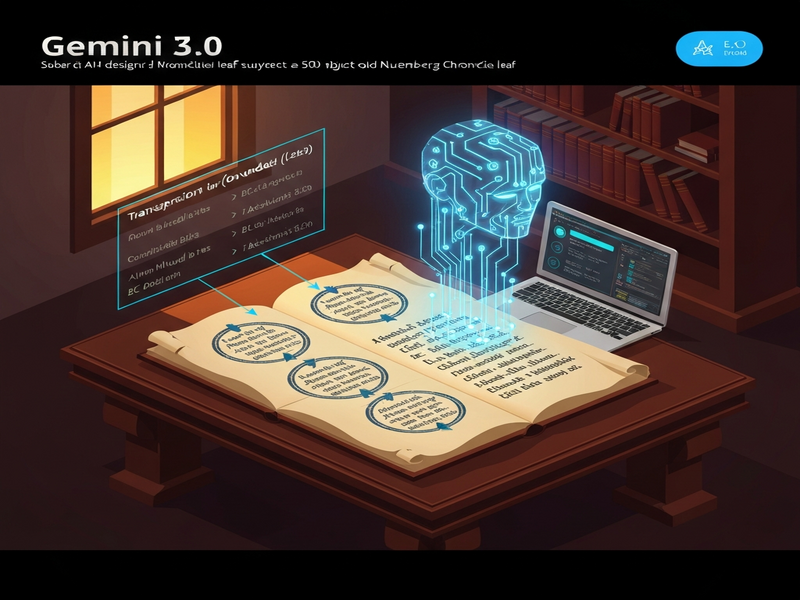
Image: Gemini 3.0’s visual output on the Nuremberg Chronicle leaf (source: UBOS).
Read the Full GDELT Report
For a deeper dive into the methodology, prompt engineering, and cost analysis, visit the original GDELT blog post:
Gemini 3.0 Deciphers 500‑Year‑Old Nuremberg Chronicle Annotations – GDELT Blog
How UBOS Is Empowering AI‑Driven Research
UBOS provides a full‑stack UBOS platform overview that lets developers spin up AI agents, connect them to data sources, and orchestrate complex workflows. Below are a few components that make this possible:
- Web app editor on UBOS – build custom interfaces for scholars to upload manuscript images.
- Workflow automation studio – chain OCR, translation, and reasoning steps without writing code.
- AI marketing agents – while designed for marketing, the same underlying models can be repurposed for academic use.
- UBOS partner program – collaborate with universities to integrate Gemini‑style models into curricula.
- UBOS pricing plans – affordable tiers for research labs and independent scholars.
Whether you are a startup building a digital archive (UBOS for startups) or an SMB looking to automate document processing (UBOS solutions for SMBs), the platform’s modular architecture makes it easy to plug in Gemini‑style vision‑language models.
Explore Related Templates and Tools
UBOS’s UBOS templates for quick start include ready‑made pipelines for:
- AI SEO Analyzer – optimize your research portal for discoverability.
- AI Article Copywriter – generate scholarly summaries from model outputs.
- AI Survey Generator – collect feedback from historians on AI‑generated interpretations.
- AI Video Generator – turn decoded pages into narrated videos for outreach.
These templates accelerate the creation of custom applications that can, for example, ingest a batch of medieval manuscripts, run Gemini‑style analysis, and publish the results directly to a public repository.
The Future Is Already Here
Gemini 3.0’s breakthrough on the Nuremberg Chronicle proves that AI is no longer a speculative tool for the humanities—it is a practical partner that can unlock centuries‑old mysteries in seconds. As more multimodal models become accessible through platforms like Enterprise AI platform by UBOS, we can expect a cascade of discoveries across archives, libraries, and museums worldwide.
Ready to bring AI into your own research workflow? Explore the UBOS AI news hub for the latest case studies, or start a free trial on the UBOS homepage today.