

- Updated: March 16, 2026
- 6 min read
Fact‑Check: Netanyahu Deepfake Claims Debunked – What the Evidence Shows
Answer: The claim that Israeli Prime Minister Benjamin Netanyahu is an AI‑generated deepfake is a viral conspiracy lacking credible evidence; fact‑checkers have debunked the videos, but the episode highlights how AI‑created media can erode public trust and amplify misinformation.
Netanyahu Deepfake Controversy: Why Proof‑of‑Life Videos No Longer Convince
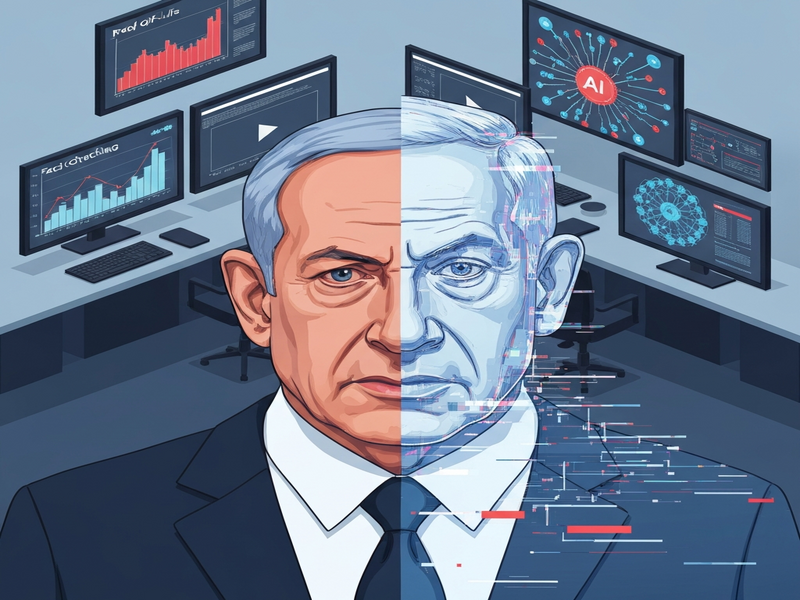
In March 2026, social‑media feeds exploded with a startling allegation: the Israeli Prime Minister Benjamin Netanyahu had been replaced by an AI clone. The rumor hinged on a series of short clips that appeared to show the leader with six fingers on one hand and sipping coffee from a cup that defied gravity. While the videos sparked heated debate, leading fact‑checking organisations quickly labeled them as fabricated or misinterpreted. This article dissects the original original Verge article, examines the proof‑of‑life attempts, and explores the broader implications for AI‑driven misinformation.
What the Verge Report Said
The Verge’s coverage, authored by Jess Weatherbed, outlined three key moments that fueled the deepfake narrative:
- A live‑streamed press conference appeared to show Netanyahu with an extra finger on his right hand.
- A self‑produced “proof‑of‑life” video posted on X (formerly Twitter) featured the prime minister counting his fingers while holding a coffee cup.
- Commentators pointed to visual anomalies—such as a floating coffee surface and a ring that seemed to disappear—suggesting AI manipulation.
Weatherbed highlighted that older generative‑AI models often struggle with realistic hand rendering, which made the “six‑finger” claim plausible to a lay audience. However, she also noted that the video’s 40‑minute length far exceeds the capabilities of current AI video generators, which typically produce clips under a few minutes.
Fact‑Checking the Videos
Major fact‑checking organisations, including Snopes and the Poynter Institute’s PolitiFact, examined the footage and reached a consensus:
- Video quality degradation: The “extra” finger is most likely a compression artifact amplified by low‑light conditions.
- Metadata absence: Neither clip contains C2PA Content Credentials or Google’s SynthID, tools that could verify authenticity.
- Inconsistent background details: The coffee shop’s cash register displayed a date from 2024, suggesting the footage was repurposed from older material.
Despite these findings, the “proof‑of‑life” video posted by Netanyahu himself did not escape scrutiny. Viewers noted that the prime minister raised his left hand to count fingers, yet the cup’s liquid appeared to remain static—a classic sign of frame‑by‑frame editing.
“When a leader’s own video is questioned, the damage to public trust is immediate and hard to reverse.” – About UBOS
Why Proof‑of‑Life Videos No Longer Convince
Historically, a simple video of a public figure speaking directly to the camera was enough to dispel rumors. In the AI era, however, three forces undermine that confidence:
1. Advanced Generative Models
State‑of‑the‑art models like OpenAI ChatGPT integration can synthesize realistic speech, facial expressions, and even hand movements, making it harder for the naked eye to spot inconsistencies.
2. Lack of Trusted Metadata
Without embedded provenance tags, viewers cannot verify whether a clip originated from a verified source. Platforms such as Instagram and YouTube have pledged to label AI‑generated content, yet enforcement remains inconsistent.
3. Social Amplification
Algorithms prioritize sensational content. A claim that a world leader is a deepfake spreads faster than the subsequent debunking, creating a “first‑impression bias” that persists even after correction.
The Bigger Picture: AI Misinformation in Politics
Netanyahu’s case is not isolated. Similar deepfake rumors have targeted figures from the United States, Europe, and Asia. The implications are profound:
- Erosion of democratic discourse: When citizens cannot trust visual evidence, political debate shifts from facts to speculation.
- Operational security risks: Adversaries could weaponize fabricated videos to provoke military responses or diplomatic incidents.
- Economic fallout: Markets react to perceived instability; a false video suggesting a leader’s death could trigger stock volatility.
To combat these threats, several technical and policy solutions are emerging:
| Solution | Key Players |
|---|---|
| Digital provenance standards (C2PA, SynthID) | UBOS platform overview |
| AI‑driven detection tools | AI SEO Analyzer |
| Legislative frameworks | EU Digital Services Act, US Executive Orders |
Expert Perspectives
Dr. Maya Levin, a professor of Computer Science at Tel‑Aviv University, told us:
“Deepfake detection is a cat‑and‑mouse game. As generative models improve, we must embed verification at the point of creation, not rely on post‑hoc analysis.”
Levin also emphasized the role of “AI‑augmented fact‑checking,” where large language models assist human reviewers in spotting subtle anomalies. Platforms like AI marketing agents already use similar pipelines to verify brand‑generated media before publishing.
Practical Steps for Companies and Creators
Organizations that rely on video content can adopt a multi‑layered defense strategy:
- Integrate provenance tools: Use services that embed C2PA metadata automatically. The Chroma DB integration offers a searchable ledger of media assets.
- Leverage AI detection APIs: Services like the AI Video Generator include built‑in authenticity checks.
- Adopt secure distribution channels: Share content through platforms that enforce verification, such as the Telegram integration on UBOS for encrypted delivery.
- Educate audiences: Publish clear “how‑to‑verify” guides alongside releases. The UBOS templates for quick start include pre‑built verification checklists.
Conclusion: Trust Must Be Re‑Engineered
The Netanyahu deepfake saga underscores a stark reality: visual media can no longer be taken at face value. While fact‑checkers can debunk individual claims, the systemic risk of AI‑generated misinformation demands a proactive, technology‑first approach. By embedding provenance, deploying AI‑assisted detection, and fostering media literacy, societies can begin to restore confidence in what they see.
At UBOS homepage, we are building the infrastructure that makes trustworthy AI content possible—from the Workflow automation studio that tags assets at creation, to the Web app editor on UBOS that lets creators embed verification badges with a single click.
Ready to future‑proof your media? Explore our UBOS pricing plans and start building deepfake‑resilient content today.
Stay informed, stay skeptical, and remember: when the line between reality and synthetic blurs, the only reliable compass is provenance.
Andrii Bidochko
CTO UBOS
Andrii Bidochko is an AI entrepreneur and researcher focused on AI agents, reinforcement learning, and autonomous systems. He writes about the technologies shaping the future of machine intelligence, from frontier models and agent architectures to real-world AI applications.