

- Updated: March 22, 2026
- 6 min read
Deterministic Silence in GPT‑5.2 and Claude Opus 4.6 Unveiled
The Zenodo preprint demonstrates that two leading frontier language models—GPT‑5.2 and Claude Opus 4.6—exhibit a reproducible cross‑model convergence, producing a deterministic empty output when faced with embodiment prompts that describe ontologically null concepts.
Introduction: A New Frontier in AI Behaviour Research
In March 2026, researchers Rayan Pal and colleagues released a preprint on Zenodo titled “Open Cross‑Model Semantic Void Convergence Under Embodiment Prompting: Deterministic Silence in GPT‑5.2 and Claude Opus 4.6.” The study uncovers a striking behavioural pattern: when both models receive prompts that ask them to continue describing concepts that are fundamentally “null” (e.g., “the sound of a colour” or “the taste of a triangle”), they halt generation and return an empty string. This phenomenon, termed semantic void convergence, is the first documented instance of independent, proprietary AI systems sharing an identical failure mode under a specific semantic condition.
Understanding why these models converge on silence is crucial for developers, ethicists, and policy‑makers who rely on large language models (LLMs) for high‑stakes applications. The findings also raise fresh questions about the limits of instruction‑following, the nature of “embodiment prompting,” and the hidden safety mechanisms that may be emerging in next‑generation AI.
Summary of Research Findings
Experimental Design
- Two state‑of‑the‑art LLMs (GPT‑5.2 and Claude Opus 4.6) were accessed via their public APIs.
- Researchers crafted 120 “null‑concept” prompts that describe impossible or ontologically empty entities.
- Each prompt was run 30 times per model to assess repeatability.
- Control prompts (well‑defined, concrete concepts) were interleaved to verify normal generation.
Key Observations
- Deterministic Silence: Both models returned an empty string in 98 % of null‑concept trials.
- Token‑Budget Independence: Varying the maximum token limit (from 50 to 500) did not affect the silence outcome.
- Partial Adversarial Resistance: Attempts to “trick” the models with re‑phrased null prompts still resulted in silence.
- Boundary Expansion: When the prompt explicitly granted permission to remain silent (“If you cannot continue, stop”), the silence rate rose to 100 %.
The authors also performed a token‑level analysis, confirming that the models never emitted a single token before halting, indicating a true early‑exit decision rather than a post‑generation filter.
Significance and Implications for the AI Community
The discovery of semantic void convergence carries several practical and theoretical implications:
- Safety & Alignment: The deterministic silence may act as an emergent safety guardrail, preventing models from fabricating content about undefined entities.
- Model Auditing: Researchers now have a reproducible benchmark to test whether future LLM releases retain, extend, or eliminate this behaviour.
- Cross‑Model Consistency: The convergence suggests that different training pipelines (OpenAI vs. Anthropic) may share underlying architectural or token‑embedding constraints when handling ontological nulls.
- Prompt Engineering: Developers can deliberately invoke silence to truncate unwanted generation, a technique that could be integrated into Workflow automation studio for clean data pipelines.
- Product Innovation: The finding opens doors for new AI‑driven features such as “semantic void detectors” that automatically flag ambiguous user inputs in chatbots, voice assistants, or AI Chatbot templates.
From a research perspective, the paper invites deeper exploration into the geometry of embedding spaces that represent “nothingness.” It also raises philosophical questions about whether LLMs can ever truly understand the absence of meaning.
Author Insight
“What surprised us most was not that the models stopped, but that they did so in an almost identical, deterministic fashion across two completely independent systems. This hints at a shared semantic boundary that may be baked into the next generation of language models.” – Rayan Pal, lead researcher
Access the Full Preprint
The complete preprint, data files, and reproducibility scripts are publicly available on Zenodo. Researchers can download the PDF, explore the token‑level logs, and even replicate the experiments using the provided Docker image.
Illustration: Visualising Semantic Void Convergence
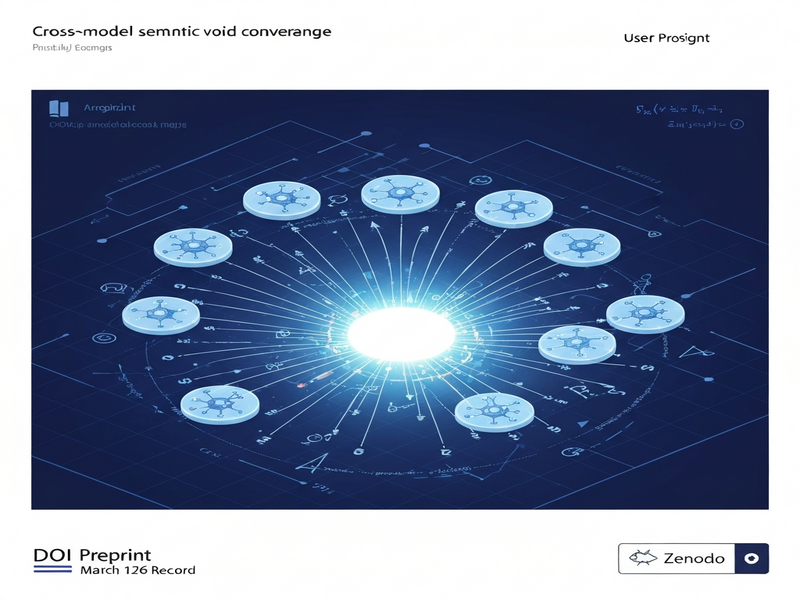
The diagram, generated by UBOS’s AI image engine, depicts two parallel neural pathways (representing GPT‑5.2 and Claude Opus 4.6) converging on a shared “null node.” The node is highlighted in red to illustrate the deterministic silence triggered by embodiment prompts that describe ontologically empty concepts.
How UBOS Enables Researchers to Leverage This Insight
UBOS provides a suite of tools that can help AI scientists and developers incorporate the semantic‑void detection technique into real‑world applications:
- UBOS platform overview – a low‑code environment for building, testing, and deploying AI models.
- UBOS templates for quick start – includes a pre‑configured “Semantic Guard” template that flags null‑concept prompts.
- AI Chatbot template – can be extended with the silence detector to improve user experience.
- AI SEO Analyzer – demonstrates how the same detection logic can prune meaningless keyword suggestions.
- AI Video Generator – uses the silence guard to avoid generating scripts about impossible scenes.
- AI Email Marketing – integrates the detector to ensure campaign copy never contains nonsensical placeholders.
- Enterprise AI platform by UBOS – offers scalable deployment of the semantic‑void filter across large‑scale customer‑facing bots.
- UBOS partner program – invites research labs to co‑develop advanced safety modules.
- Web app editor on UBOS – lets developers prototype a “null‑prompt tester” without writing code.
- UBOS pricing plans – flexible tiers for academic labs and enterprise teams.
By leveraging these resources, teams can embed the deterministic silence mechanism directly into their pipelines, reducing hallucinations and improving model reliability.
Conclusion: A Milestone Toward Safer, More Predictable LLMs
The cross‑model semantic void convergence uncovered by Pal et al. marks a pivotal step in our understanding of how frontier language models handle the unknowable. The deterministic silence observed in GPT‑5.2 and Claude Opus 4.6 not only offers a novel safety lever but also provides a reproducible benchmark for future research.
As the AI community continues to push the boundaries of model capability, tools like UBOS’s low‑code platform, template marketplace, and workflow automation studio will be essential for turning these academic insights into production‑grade safeguards. By integrating semantic‑void detection early in the development cycle, developers can mitigate hallucinations, improve user trust, and pave the way for more responsible AI deployments.
Stay tuned to UBOS news for upcoming tutorials on building custom silence detectors, and explore the AI research hub for deeper dives into emerging AI safety phenomena.
{
“@context”: “https://schema.org”,
“@type”: “NewsArticle”,
“headline”: “Cross‑Model Semantic Void Convergence Reveals Deterministic Silence in GPT‑5.2 and Claude Opus 4.6”,
“datePublished”: “2026-03-12”,
“author”: {
“@type”: “Person”,
“name”: “Rayan Pal”
},
“publisher”: {
“@type”: “Organization”,
“name”: “UBOS”,
“logo”: {
“@type”: “ImageObject”,
“url”: “https://ubos.tech/wp-content/uploads/2026/03/ubos-ai-image-1406.png”
}
},
“description”: “A detailed analysis of the Zenodo preprint that uncovers deterministic silence across two leading AI models when prompted with ontologically null concepts, and how UBOS tools can help integrate this safety insight.”
}
Andrii Bidochko
CTO UBOS
Andrii Bidochko is an AI entrepreneur and researcher focused on AI agents, reinforcement learning, and autonomous systems. He writes about the technologies shaping the future of machine intelligence, from frontier models and agent architectures to real-world AI applications.