

- Updated: January 18, 2026
- 6 min read
DeepSeek AI Unveils Engram: A Conditional Memory Axis Boosting Sparse LLM Performance
DeepSeek AI’s Engram: A Conditional Memory Axis That Supercharges Sparse LLMs
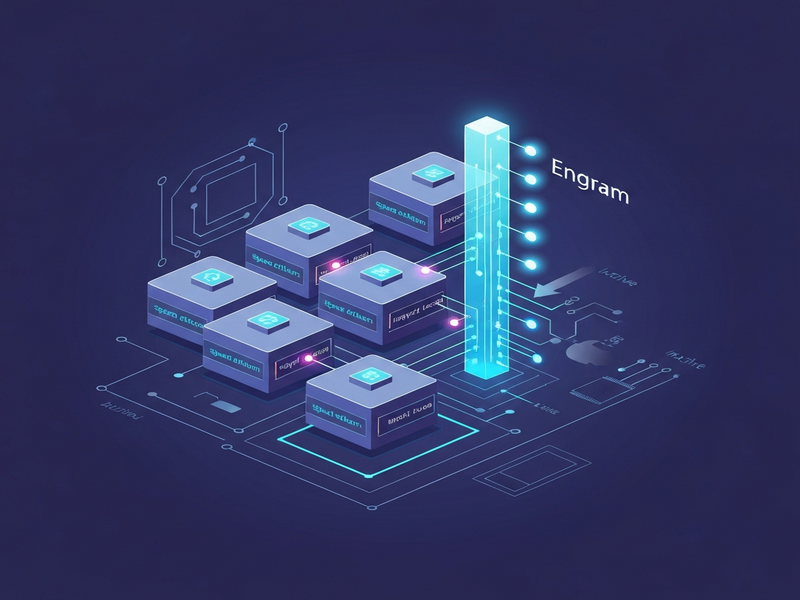
Engram is a conditional memory axis that plugs into sparse large language models (LLMs) to provide O(1) hashed‑lookup memory for frequent n‑gram patterns, allowing the transformer backbone and Mixture‑of‑Experts (MoE) modules to focus on complex reasoning and long‑range dependencies.
In a MarkTechPost article published on January 17 2026, DeepSeek AI detailed how the Engram module reshapes the architecture of sparse LLMs, delivering measurable improvements on language modeling, knowledge, and reasoning benchmarks while keeping the total parameter count constant. This breakthrough is already sparking interest among AI researchers, machine‑learning engineers, and developers looking to push the limits of long‑context models.
1. The Conditional Memory Axis Explained
Traditional transformers rely on dense feed‑forward layers or MoE experts to capture patterns. However, they repeatedly recompute common n‑gram sequences, wasting compute cycles. Engram introduces a conditional memory axis that stores static patterns—such as frequent phrases, named entities, and syntactic templates—in a separate, sparsely‑activated embedding table.
- O(1) Lookup: Hashed n‑gram tables enable constant‑time retrieval, eliminating redundant calculations.
- Context‑Aware Gating: A scalar gate (0‑1) decides how much of the retrieved embedding influences each transformer layer.
- Layer‑Specific Insertion: Engram is injected at early and mid‑depth layers (e.g., layers 2 and 15 in the 30‑layer backbone) where static knowledge is most beneficial.
By offloading these “low‑entropy” patterns to memory, the model’s active parameters can concentrate on high‑entropy reasoning, effectively deepening the network without adding FLOPs.
2. Training Methodology and Dataset Details
DeepSeek trained Engram‑augmented models on the same 262 B token corpus used for their baseline MoE‑27B and MoE‑40B systems. The tokenizer is the DeepSeek V3 variant with a 128 k vocabulary, ensuring fine‑grained tokenization for long‑context tasks.
Key training hyper‑parameters:
| Component | Configuration |
|---|---|
| Backbone | 30‑layer Transformer, hidden size 2560 |
| MoE Experts | 72 routed + 2 shared (for 27 B model) |
| Engram Memory | 5.7 B parameters (27 B model) – 18.5 B (40 B model) |
| N‑gram Order | {2, 3} |
| Optimizer | Muon optimizer |
The Engram module uses multi‑head hashing into prime‑sized buckets, followed by a lightweight depthwise convolution that captures local context before the gating mechanism decides the contribution to each transformer branch.
3. Benchmark Results and Performance Gains
Across a suite of standard and knowledge‑heavy benchmarks, Engram consistently outperformed the pure MoE baseline while keeping the same activated‑parameter budget (≈3.8 B). Highlights include:
- The Pile (LM loss): 1.960 for Engram‑27 B vs. 2.091 for MoE‑27 B.
- MMLU: 60.4 vs. 57.4 (↑ 5.2%).
- CMMLU: 61.9 vs. 57.9 (↑ 6.9%).
- C‑Eval: 62.7 vs. 58.0 (↑ 8.1%).
- ARC‑Challenge: 73.8 vs. 70.1.
- HumanEval (code): 40.8 vs. 37.8.
- GSM8K (math): 60.6 vs. 58.4.
Validation loss on an internal hold‑out set dropped from 1.768 (MoE‑27 B) to 1.634 (Engram‑27 B), confirming that the conditional memory axis reduces over‑fitting while improving generalization.
4. Long‑Context Behavior and Ablation Insights
After the initial 262 B token pre‑training, DeepSeek extended the context window to 32 k tokens using the YaRN scaling technique. Engram‑27 B was evaluated on LongPPL and RULER suites:
- At 32 k tokens, Engram matched or surpassed MoE on perplexity while delivering a 20 % boost on RULER’s Multi‑Query‑Needle task (99.6 % vs. 73.0 %).
- Ablation of the gating scalar reduced long‑context performance by up to 12 %, confirming its critical role.
- Layer‑wise KL‑divergence analysis showed that Engram layers become “prediction‑ready” earlier, effectively deepening the model without extra compute.
These findings suggest that Engram not only improves static knowledge recall but also accelerates the emergence of high‑level representations, a key factor for handling very long sequences.
5. Potential Applications and Industry Impact
The conditional memory axis opens new avenues for AI products that demand both massive context and low latency. Some promising use‑cases include:
- Enterprise Document Search: Instant retrieval of frequently referenced clauses or legal terminology without re‑computing transformer layers.
- AI‑Powered Customer Support: Embedding common FAQ patterns in Engram enables faster, more accurate responses while the backbone handles nuanced queries.
- Content Generation at Scale: Marketing platforms can store brand‑specific phrasing in memory, allowing the model to stay on‑brand with minimal prompt engineering.
- Long‑Form Code Assistance: Reusing common code snippets from a memory bank reduces token consumption for IDE assistants.
- Multimodal Agents: When paired with voice or image modules (e.g., ElevenLabs AI voice integration), Engram can quickly recall standard utterances, improving latency for conversational agents.
Companies that already leverage UBOS’s Enterprise AI platform can integrate Engram‑enhanced models via the Workflow automation studio, accelerating time‑to‑value for these scenarios.
6. DeepSeek AI Team’s Perspective
“Engram gives us a new degree of freedom in allocating sparsity. By shifting roughly 20‑25 % of the sparse budget from MoE experts to conditional memory, we achieve lower validation loss without sacrificing compute efficiency. This demonstrates that memory and computation are complementary, not competing, resources in next‑generation LLMs.” – DeepSeek AI Research Lead
7. Accelerate Your Projects with UBOS
UBOS provides a seamless environment to experiment with Engram‑augmented models:
- UBOS platform overview offers pre‑configured containers for Engram‑enabled transformers.
- Use the Web app editor on UBOS to prototype long‑context chatbots that instantly benefit from conditional memory.
- Explore ready‑made templates such as the AI Chatbot template or the AI SEO Analyzer to see Engram in action.
- For startups, the UBOS for startups program provides credits and expert guidance to integrate cutting‑edge LLMs quickly.
- SMBs can adopt the technology through UBOS solutions for SMBs, which include cost‑effective pricing plans (UBOS pricing plans).
8. Future Directions and Research Outlook
The Engram paper hints at several avenues for further exploration:
- Scaling Memory Size: Experiments with up to 10 M slots showed a near‑linear reduction in validation loss, suggesting that even larger conditional memories could be viable.
- Hybrid Retrieval: Combining Engram with external vector stores (e.g., Chroma DB integration) may enable both static and dynamic knowledge retrieval.
- Cross‑Modal Memory: Extending the axis to store image embeddings or audio tokens could unify multimodal reasoning under a single memory framework.
As the AI community adopts these ideas, we expect a new class of “memory‑augmented sparse models” that deliver both efficiency and depth, reshaping how enterprises build intelligent systems.
9. Conclusion & Call to Action
DeepSeek’s Engram demonstrates that a well‑designed conditional memory axis can dramatically improve sparse LLMs without inflating compute budgets. For AI researchers and developers, the takeaway is clear: allocate part of your sparsity budget to memory, not just experts, and you’ll see gains across language, reasoning, and long‑context tasks.
Ready to experiment with Engram‑enhanced models? Visit the UBOS homepage to spin up a sandbox, explore the UBOS templates for quick start, and join the UBOS partner program for early‑access resources and dedicated support.