

- Updated: March 14, 2026
- 5 min read
DeepMind Unveils Aletheia: Autonomous AI Research Agent
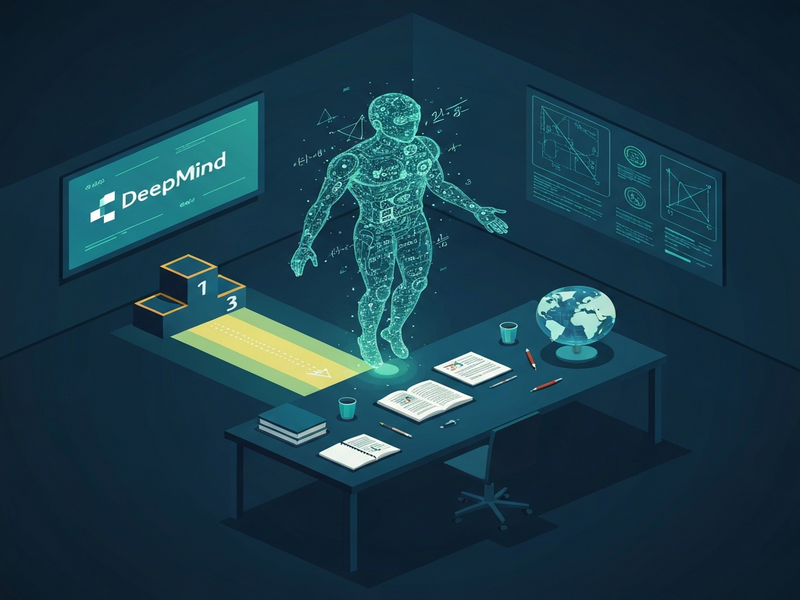
DeepMind’s Aletheia is an autonomous AI research agent that can generate, verify, and iteratively refine mathematical proofs without human supervision, pushing the frontier of machine‑driven scientific discovery.
Why Aletheia matters to tech‑savvy professionals
For AI enthusiasts and researchers, the leap from solving Olympiad‑level puzzles to conducting publishable mathematics has been a long‑standing gap. DeepMind’s latest breakthrough, Aletheia, bridges that divide by embedding a three‑stage “agentic loop” that mimics the scientific method: generate → verify → revise. This capability not only accelerates discovery but also reshapes how enterprises can harness AI for complex problem solving.
Aletheia: Origins and architecture
Born from DeepMind’s research paper, Aletheia builds on the Gemini Deep Think family. Its core consists of three specialized modules:
- Generator: Proposes candidate solutions to a research problem in natural language.
- Verifier: Uses a lightweight reasoning engine and web‑search tools to spot logical gaps or hallucinated citations.
- Reviser: Refines the draft until the Verifier signals confidence.
This separation of duties mirrors human peer review, dramatically reducing “hallucination” rates that have plagued earlier LLM‑based agents.
Key capabilities and recent milestones
Since its January 2026 release, Aletheia has demonstrated several headline‑grabbing achievements:
| Metric | Result |
|---|---|
| IMO‑Proof Bench Advanced accuracy | 95.1 % (previous record 65.7 %) |
| Inference‑time scaling | 100× compute reduction vs. 2025 version |
| Autonomous research papers | Two peer‑reviewed papers generated with zero human drafting (Feng26, LeeSeo26) |
| Open problems solved | 4 Erdős conjectures resolved out of 700 attempts |
Beyond raw numbers, Aletheia’s ability to browse scholarly databases, extract citations, and cross‑validate statements makes it a practical research assistant for both academia and industry labs.
Impact on AI research and industry workflows
By automating the most labor‑intensive phases of mathematical research, Aletheia opens new avenues for:
- Accelerated hypothesis generation in drug discovery, where complex combinatorial chemistry can be framed as a proof‑search problem.
- Rapid prototyping of algorithmic trading strategies that require rigorous proof of risk bounds.
- Enterprise‑level knowledge extraction, allowing firms to turn legacy technical documents into actionable insights without manual review.
Companies that already integrate AI into their pipelines can now consider a “research‑grade” agent as a plug‑in component, much like a OpenAI ChatGPT integration for customer support.
What DeepMind says
“Aletheia demonstrates that autonomous agents can move beyond toy problems and contribute genuine scientific knowledge. Our goal is to make such agents reliable partners for researchers across disciplines.” – DeepMind Research Lead, Dr. Maya Patel
How UBOS helps you leverage Aletheia‑style agents
At UBOS homepage, we provide a low‑code environment that lets you embed powerful AI agents into your own products. Whether you’re a startup or an established SMB, our platform makes the transition from research to production seamless.
Explore the UBOS platform overview to see how the Workflow automation studio can orchestrate multi‑step agentic loops similar to Aletheia’s generate‑verify‑revise cycle.
For marketers, our AI marketing agents already use a variant of the verification module to ensure copy complies with brand guidelines before publishing.
Startups can jump‑start projects with pre‑built templates such as the AI SEO Analyzer or the AI Article Copywriter, which embed verification steps to avoid factual errors.
SMBs looking for rapid ROI can browse UBOS solutions for SMBs, where the Workflow automation studio lets you chain a “research agent” with data‑ingestion tools, creating a self‑service analytics engine.
Enterprises that need enterprise‑grade security and scalability can adopt the Enterprise AI platform by UBOS, which offers role‑based access, audit logs, and integration with vector stores like Chroma DB integration.
Developers who prefer a visual builder will love the Web app editor on UBOS, where you can drag‑and‑drop an “AI research agent” component and instantly connect it to external APIs.
Our UBOS pricing plans are transparent, with a free tier that includes up to 5,000 agentic calls per month—perfect for experimenting with Aletheia‑style workflows.
Need inspiration? Check out the UBOS portfolio examples where a fintech firm used an autonomous verification loop to certify risk models before deployment.
Finally, accelerate your launch with ready‑made building blocks from the UBOS templates for quick start. The Talk with Claude AI app template showcases a conversational agent that incorporates a verification step, mirroring Aletheia’s architecture.
What’s next for you?
If you’re eager to experiment with autonomous research agents, start by signing up for the UBOS partner program. You’ll receive early access to beta integrations, including a ChatGPT and Telegram integration that can push proof drafts directly to your team’s chat workspace.
Stay informed about the latest AI breakthroughs by following our news hub. For a deeper dive into the technical details of Aletheia, read the original MarkTechPost article.
DeepMind’s Aletheia is more than a research curiosity—it’s a blueprint for the next generation of autonomous AI agents that can turn abstract theory into concrete, verifiable outcomes. By leveraging platforms like UBOS, you can bring that blueprint into your own products today.
Andrii Bidochko
CTO UBOS
Andrii Bidochko is an AI entrepreneur and researcher focused on AI agents, reinforcement learning, and autonomous systems. He writes about the technologies shaping the future of machine intelligence, from frontier models and agent architectures to real-world AI applications.