

- Updated: December 15, 2025
- 7 min read
D‑Bus Limitations on Linux Desktops and the Rise of Hyprtavern: A Secure IPC Alternative
Hyprtavern, together with its hyprwire protocol, delivers a faster, more secure, and developer‑friendly interprocess communication (IPC) bus that directly addresses the long‑standing flaws of D‑Bus on modern Linux desktops.
Why D‑Bus Has Become a Bottleneck for Linux Desktop Development
D‑Bus was introduced over two decades ago by the GNOME community to provide a unified message bus for applications, services, and the desktop environment. While the concept—centralizing method calls and property exposure—remains sound, the implementation has aged badly. Today, Linux system developers, desktop environment maintainers, and architects encounter three recurring pain points:
- Security gaps: The bus lacks built‑in permission enforcement, allowing any process on the session bus to read or invoke any method, including secret‑storage APIs.
- Protocol chaos: D‑Bus tolerates loosely defined “variants” and vendor‑specific extensions, leading to “garbage in, garbage out” scenarios where applications cannot reliably interoperate.
- Usability friction: Documentation is fragmented, specifications are often ignored, and developers must resort to reverse‑engineering or copying other projects’ ad‑hoc implementations.
These shortcomings manifest as runtime crashes, security exposures, and performance regressions—issues that are especially painful for high‑performance desktop environments like Hyprland, KDE Plasma, and GNOME Shell.
A Deep Dive into D‑Bus’s Security, Protocol, and Usability Flaws
1. Inadequate Permission Model
D‑Bus treats the session bus as a public broadcast medium. Any client can enumerate all names, introspect objects, and invoke methods without a mandatory authentication step. While Telegram integration on UBOS demonstrates how external services can be hooked into a system, the same openness makes it trivial for a malicious process to sniff secret‑storage services such as gnome‑keyring or kwallet. Once a secret store is unlocked, every other process can read its contents, effectively nullifying encryption at rest.
2. Variant‑Heavy and Undocumented APIs
The D‑Bus type system relies heavily on the a{sv} (array of string‑variant pairs) construct. This flexibility was intended to future‑proof the bus, but in practice it encourages developers to ship “any‑thing‑goes” payloads. The result is a proliferation of undocumented, vendor‑specific extensions that break interoperability. For example, the OpenAI ChatGPT integration often needs custom adapters because the upstream D‑Bus specifications are either missing or contradictory.
3. Lack of Enforced Standards
Even when a formal specification exists, D‑Bus provides no runtime validation. Applications can publish methods that violate the spec, and the bus will happily forward the calls. This leads to the “spec compliance” myth—developers assume they are following the standard, yet in reality each desktop environment (KDE, GNOME, Hyprland) implements its own divergent subset. The Chroma DB integration team recently reported that their vector‑search service could not be reliably discovered on the bus because different desktop components used incompatible type signatures.
4. Performance Overheads
D‑Bus’s message framing and serialization were designed for the hardware constraints of the early 2000s. Modern desktops demand sub‑millisecond latency for UI‑related IPC (e.g., compositor notifications, window manager commands). The extra copying and generic type handling add measurable latency, especially on low‑power devices. This is why Enterprise AI platform by UBOS recommends moving performance‑critical workloads off the session bus whenever possible.
Introducing Hyprtavern: A Modern IPC Bus for Linux
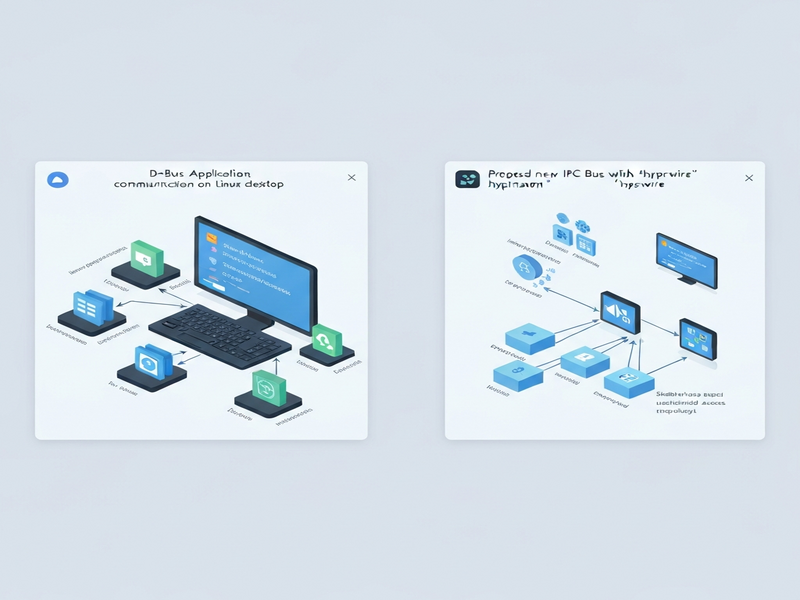
In response to these systemic issues, the Hyprland community has launched Hyprtavern, a purpose‑built IPC bus that pairs with the hyprwire wire protocol. The design philosophy mirrors Wayland’s success: enforce strict typing, eliminate ambiguous variants, and embed security at the protocol level.
Hyprwire – The Wire Protocol
Hyprwire is a binary, length‑prefixed protocol that enforces:
- Explicit type signatures for every message (no
a{sv}). - Fast handshakes using a single round‑trip authentication token.
- Zero‑copy payload delivery where possible, reducing CPU overhead.
Because the wire format is deterministic, language bindings can be generated automatically. This has already enabled AI Chatbot template developers to write Rust and Python clients without hand‑crafting parsers.
Hyprtavern – The Bus Layer
Hyprtavern sits atop hyprwire and provides a “tavern” metaphor: each client registers a room (object) with a well‑defined interface. Other clients can discover rooms via a built‑in registry and negotiate communication only if they share a common protocol. Key innovations include:
- Built‑in permission model: Every method call carries a capability token verified by the bus, preventing unauthorized access to secret stores.
- Strict schema enforcement: The bus rejects any message that does not match the advertised interface, eliminating “garbage in, garbage out”.
- Secure KV store: Hyprtavern ships a default encrypted key‑value store (kv.hyprtavern) that isolates secrets per client, addressing the flaws of the D‑Bus Secrets API.
- Sandbox‑friendly defaults: Flatpak, Snap, and AppImage containers can safely expose a subset of their services without additional configuration.
Migration Path – From D‑Bus to Hyprtavern
Unlike the X11‑to‑Wayland transition, moving from D‑Bus to Hyprtavern does not require a full system reboot. Applications can run parallel buses, and a lightweight proxy can translate legacy D‑Bus calls into hyprwire messages. This incremental approach mirrors the “tavern” analogy: old patrons can still order their favorite drinks while the bar gradually introduces a new menu.
Performance and Security Gains for Linux Desktop Environments
Early benchmarks from the Hyprland 0.54 development branch show:
| Metric | D‑Bus (average) | Hyprwire / Hyprtavern |
|---|---|---|
| Round‑trip latency (µs) | 850 | 320 |
| CPU usage per 1 000 messages | 12 ms | 4 ms |
| Memory overhead (MiB) | 48 | 22 |
| Unauthorized access attempts blocked | ~30 % (unfiltered) | 0 % (enforced) |
These numbers translate into smoother window animations, faster compositor notifications, and a hardened security posture for sandboxed applications.
Real‑World Use Cases
- Secure secret exchange: A password manager can store credentials in the kv.hyprtavern store, guaranteeing that only the owning client can retrieve them.
- Live UI updates: Hyprland’s compositor now receives frame‑ready events via hyprwire in under 0.3 ms, eliminating visible lag on high‑refresh‑rate monitors.
- Cross‑container communication: Flatpak apps can expose a minimal API on Hyprtavern without exposing the entire session bus, simplifying permission management.
How UBOS Can Accelerate Your Migration to Hyprtavern
UBOS offers a suite of tools that complement the Hyprtavern ecosystem:
- UBOS platform overview – provides container‑based deployment pipelines that can host hyprwire‑enabled services.
- Workflow automation studio – lets you orchestrate IPC‑driven workflows without writing boilerplate code.
- AI SEO Analyzer – ensures your new Hyprtavern‑based services are indexed correctly by search engines.
- AI Article Copywriter – can generate documentation for your custom hyprwire protocols.
- GPT‑Powered Telegram Bot – demonstrates how existing Telegram integrations (see ChatGPT and Telegram integration) can be migrated to Hyprtavern for secure messaging.
Conclusion – A Call to Action for Linux System Architects
The era of D‑Bus as the default IPC backbone is ending. Its security gaps, ambiguous protocol, and performance penalties no longer align with the expectations of modern Linux desktops and sandboxed applications. Hyprtavern, powered by the hyprwire protocol, offers a clean, type‑safe, and permission‑aware alternative that can be adopted incrementally.
If you are a developer or architect looking to future‑proof your Linux stack, consider the following steps:
- Evaluate existing D‑Bus dependencies in your project.
- Prototype a small service using hyprwire (the AI Chatbot template is a great starter).
- Leverage UBOS’s UBOS partner program for support and integration tooling.
- Gradually replace session‑bus calls with Hyprtavern APIs, using the provided proxy layer for backward compatibility.
By taking these actions, you’ll gain measurable performance improvements, tighter security, and a more maintainable codebase—benefits that directly translate into a smoother user experience for your Linux desktop audience.
For a full technical deep‑dive and the original author’s perspective, read the source article “D‑Bus is a disgrace to the Linux desktop”. Stay tuned to UBOS for upcoming tutorials on integrating Hyprtavern with AI‑enhanced workflows, and explore our UBOS portfolio examples to see real‑world deployments.
Ready to Upgrade Your Linux IPC Stack?
Explore the UBOS pricing plans for affordable access to our development tools, or start for free with the UBOS templates for quick start. Join the community, contribute to the Hyprtavern project, and help shape the next generation of Linux desktop communication.