

- Updated: December 29, 2025
- 6 min read
Contract‑First Agentic Decision Systems with PydanticAI: A Comprehensive Overview
Contract‑first agentic decision systems built with PydanticAI let enterprises enforce risk‑aware, policy‑compliant AI outputs through strict schema contracts, turning LLMs into reliable decision‑making components.
Why Contract‑First AI Is the Next Frontier for Enterprise Decision‑Making
Enterprises are increasingly adopting large language models (LLMs) for critical decisions—credit approvals, compliance checks, and automated policy enforcement. Yet, the free‑form nature of LLM output creates a hidden risk: the model can generate plausible‑looking text that violates internal regulations or industry standards. The original MarkTechPost tutorial demonstrates a solution—using PydanticAI to bind AI responses to immutable, contract‑level schemas.
By treating a schema as a non‑negotiable contract rather than a mere data format, developers can embed risk‑aware policies directly into the model’s output validation layer. This approach aligns perfectly with the growing demand for AI governance solutions that guarantee compliance without sacrificing the agility of generative AI.
What Is a Contract‑First Agentic Decision System?
A contract‑first system is built around three core pillars:
- Contract Definition: A
Pydanticmodel that codifies every required field, data type, and business rule. - Agent Execution: An LLM (e.g., OpenAI’s GPT‑5) wrapped by
PydanticAIto generate outputs that must satisfy the contract. - Governance Loop: Post‑generation validators that enforce risk thresholds, compliance checks, and self‑correction via retries.
This architecture transforms an LLM from a “creative text generator” into a decision engine that can be audited, logged, and trusted by downstream systems.
How PydanticAI Enables Risk‑Aware, Policy‑Compliant AI
PydanticAI extends the popular Pydantic validation library with two powerful capabilities:
- Schema‑Driven Generation: The agent receives the contract as a
BaseModeland must output a JSON that validates against it. - Automatic Retry & Self‑Correction: If validation fails, the framework re‑prompts the model with error details, forcing a corrected response.
In practice, developers embed risk‑aware policies directly into the schema. For example, a confidence field can be limited when high‑severity risks are present, and a compliance_passed flag can automatically trigger a reject decision if policy violations are detected.
Example snippet (simplified):
class DecisionOutput(BaseModel):
    decision: Literal["approve", "reject", "approve_with_conditions"]
    confidence: float = Field(..., ge=0.0, le=1.0)
    identified_risks: List[RiskItem] = Field(..., min_items=2)

    @field_validator("confidence")
    def confidence_vs_risk(cls, v, info):
        risks = info.data.get("identified_risks", [])
        if any(r.severity == "high" for r in risks) and v > 0.7:
            raise ValueError("Confidence too high for high‑severity risks")
        return v
This pattern guarantees that the model cannot claim high confidence while ignoring critical risks—a common compliance pitfall in unconstrained LLM deployments.
Step‑by‑Step Guide to Building a Contract‑First Decision Agent
Below is a MECE‑structured roadmap that mirrors the MarkTechPost tutorial while adding practical tips for low‑code AI teams.
1️⃣ Set Up the Development Environment
Install the required packages and configure async execution (useful for cloud notebooks or CI pipelines):
pip install -U pydantic-ai pydantic openai nest_asyncio
Load your OPENAI_API_KEY securely—environment variables, secret managers, or getpass for local testing.
2️⃣ Define the Contract Models
Model the decision output, risk items, and any auxiliary data. Use field_validator to embed business logic.
- Enforce a minimum of two identified risks.
- Require concrete security controls (encryption, audit logging) when
compliance_passedis true. - Disallow conditions on a plain
approvedecision.
3️⃣ Create the Agent with Contextual Dependencies
Wrap the LLM in a Agent and inject enterprise‑specific context (e.g., company policy strings, risk thresholds) via a dataclass.
@dataclass
class DecisionContext:
    company_policy: str
    risk_threshold: float = 0.6
    model = OpenAIChatModel("gpt-5", provider=OpenAIProvider(api_key=OPENAI_API_KEY))

agent = Agent(
    model=DecisionContext.model,
    deps_type=DecisionContext,
    output_type=DecisionOutput,
    system_prompt="You are a corporate decision analysis agent..."
)
4️⃣ Add Post‑Generation Validators
These validators act as a second line of defense, checking for missing controls or insufficient risk granularity. If they raise an exception, the agent automatically retries.
@agent.output_validator
def enforce_policy_controls(result: DecisionOutput) -> DecisionOutput:
    policy = CURRENT_DEPS.company_policy.lower()
    text = (result.rationale + " ".join(result.next_steps)).lower()
    if result.compliance_passed and not any(k in text for k in ["encryption", "audit", "logging"]):
        raise ValueError("Missing required security controls")
    return result
5️⃣ Execute the Decision Request
Provide a realistic scenario—such as deploying a customer‑analytics dashboard—to the agent. The async call returns a validated DecisionOutput object ready for downstream consumption.
async def run_decision():
    global CURRENT_DEPS
    CURRENT_DEPS = DecisionContext(
        company_policy="All personal data must be encrypted and logged."
    )
    prompt = """Decision request: Deploy an AI‑powered analytics dashboard..."""
    result = await agent.run(prompt, deps=CURRENT_DEPS)
    return result.output

decision = asyncio.run(run_decision())
print(decision.model_dump())
6️⃣ Integrate with UBOS Low‑Code Platform
UBOS’s Web app editor lets you embed the Python code as a micro‑service, expose it via a REST endpoint, and connect it to the Workflow automation studio. This turns the contract‑first agent into a reusable component across multiple business processes.
Enterprise Benefits of Contract‑First Agentic AI
Adopting this pattern yields tangible ROI and risk mitigation:
- Regulatory Compliance: Every output is auditable against a pre‑approved schema, simplifying GDPR, CCPA, and industry‑specific audits.
- Risk Reduction: Built‑in confidence‑vs‑risk checks prevent over‑optimistic decisions that could expose the organization.
- Operational Efficiency: Automated retries eliminate manual re‑prompting, cutting down on engineering overhead.
- Scalable Governance: Centralized contracts can be versioned and reused across teams, ensuring consistent policy enforcement.
- Low‑Code Integration: UBOS’s drag‑and‑drop environment accelerates deployment, letting non‑engineers configure agents via UI.
For CIOs and AI architects, this translates into faster time‑to‑value for AI initiatives while maintaining a strong compliance posture—exactly the promise of an Enterprise AI platform by UBOS.
Visual Overview
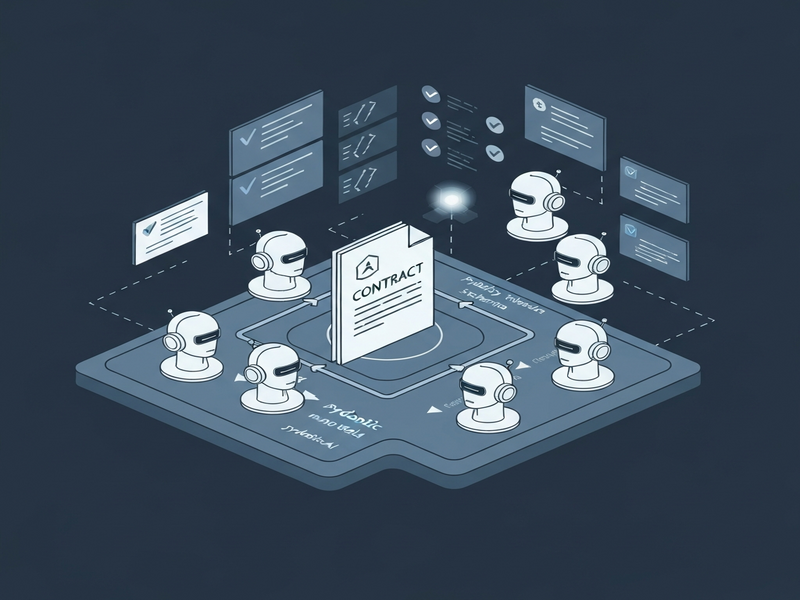
The diagram above illustrates the flow from contract definition → LLM generation → validation & retry → trusted decision output. Each arrow represents a deterministic checkpoint that enforces policy compliance.
Explore Related UBOS Resources
To deepen your understanding of AI governance and low‑code deployment, check out these curated pages:
- About UBOS – Learn how the company’s mission aligns with responsible AI.
- UBOS partner program – Opportunities for technology partners to co‑create AI solutions.
- UBOS pricing plans – Flexible pricing for startups, SMBs, and enterprises.
- UBOS templates for quick start – Jump‑start your contract‑first agents with pre‑built templates.
- AI marketing agents – See how contract‑first principles can power compliant marketing automation.
- UBOS portfolio examples – Real‑world case studies of AI governance in action.
Take the Next Step
If you’re ready to embed risk‑aware, policy‑compliant AI into your organization, start with UBOS’s UBOS for startups or explore the UBOS solutions for SMBs. Our PydanticAI tutorial walks you through the exact code used in this article, and our UBOS news hub keeps you updated on the latest governance features.
Leverage the power of contract‑first AI today—turn uncertainty into auditable decisions and accelerate your AI roadmap with confidence.
© 2025 UBOS Technologies. All rights reserved.
Andrii Bidochko
CTO UBOS
Andrii Bidochko is an AI entrepreneur and researcher focused on AI agents, reinforcement learning, and autonomous systems. He writes about the technologies shaping the future of machine intelligence, from frontier models and agent architectures to real-world AI applications.