

- Updated: February 5, 2026
- 6 min read
Conduent Data Breach: Massive Ransomware Attack Exposes Millions of Americans’ Personal Information

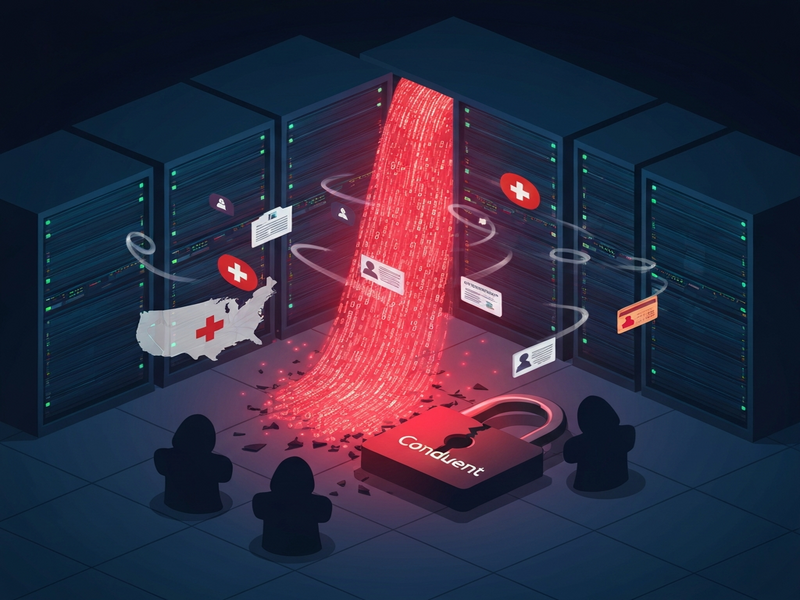
The Conduent data breach, caused by a ransomware attack in January 2025, exposed personal data of millions of Americans across multiple states, including names, Social Security numbers, medical records, and health‑insurance information.
Conduent Data Breach: What Happened, Who Was Affected, and How to Protect Your Organization
In early 2025, the government‑technology giant Conduent suffered a massive ransomware intrusion that crippled its operations for several days and later revealed a data leak affecting at least 15.4 million residents of Texas alone. Subsequent investigations show that the breach spans dozens of millions of individuals across Texas, Oregon, Delaware, Massachusetts, New Hampshire, and several other states. This article breaks down the attack, its fallout, and actionable steps for IT security professionals, compliance officers, and privacy‑concerned consumers.
1. Overview of the Ransomware Attack and Breach Scope
The intrusion was claimed by the notorious Safeway ransomware gang, which announced it had exfiltrated over 8 terabytes of data. Conduent first disclosed the incident in April 2025, months after the initial system outage. Key points:
- Attack vector: Phishing‑laden email attachment that delivered a malicious payload to Conduent’s internal network.
- Encryption: Ransomware encrypted critical databases, forcing a temporary shutdown of many state‑run services.
- Data exfiltration: Attackers stole raw files before encryption, including personally identifiable information (PII) and protected health information (PHI).
Initial public statements estimated 4 million Texans were impacted, but later state‑attorney‑general notices raised that figure to 15.4 million, roughly half the state’s population. Oregon reported 10.5 million affected residents, while smaller notifications covered hundreds of thousands in Delaware, Massachusetts, New Hampshire, and other jurisdictions.
2. Impact on Affected Individuals and States
The compromised data set includes:
| Data Type | Potential Risks |
|---|---|
| Full name & address | Identity theft, phishing scams |
| Social Security Number (SSN) | Credit fraud, government benefit fraud |
| Medical records & health‑insurance IDs | Medical identity theft, insurance fraud |
| Employment & income data | Tax‑return fraud, wage theft |
Beyond personal inconvenience, the breach threatens public‑sector trust. State agencies that rely on Conduent for Medicaid, unemployment benefits, and licensing now face heightened scrutiny and potential legal exposure.
3. Conduent’s Response and Notification Strategy
Conduent’s public communications have been criticized for being vague. The company’s spokesperson, Sean Collins, issued a boilerplate statement emphasizing ongoing investigations but avoided concrete numbers. Key actions taken by Conduent include:
- Engaging third‑party forensic experts to map the breach timeline.
- Launching a cybersecurity best‑practice review across all client environments.
- Notifying affected individuals via mail and email, with a target completion date of early 2026.
- Offering free credit‑monitoring services for a limited period.
Despite these steps, Conduent has not disclosed the total number of breach notifications sent, nor confirmed whether the breach could affect its broader client base of over 100 million U.S. residents.
4. Expert Analysis and Best‑Practice Recommendations
Security analysts agree that the Conduent incident underscores three persistent weaknesses in large‑scale SaaS and government‑contract environments:
- Supply‑chain exposure: Third‑party vendors often inherit the same security posture as their clients.
- Insufficient segmentation: Lateral movement across networks allowed attackers to reach sensitive databases.
- Delayed disclosure: Late public notification hampers victim remediation.
To mitigate similar risks, we recommend the following actionable steps, each aligned with the guidance in our data‑privacy regulations overview:
Immediate Action Checklist for IT Security Teams
- Conduct a rapid asset inventory: Identify all data stores, especially those holding PII/PHI.
- Implement zero‑trust network access (ZTNA): Enforce strict identity verification for every request.
- Deploy endpoint detection and response (EDR): Ensure real‑time monitoring for anomalous activity.
- Encrypt data at rest and in transit: Use industry‑standard AES‑256 encryption.
- Run regular phishing simulations: Train employees to recognize malicious attachments.
- Establish a breach‑notification playbook: Align with state and federal timelines.
Organizations looking to accelerate these initiatives can leverage platforms like the UBOS platform overview, which offers built‑in security controls, automated compliance checks, and a Workflow automation studio to streamline incident‑response workflows.
5. Legal and Regulatory Implications
Given the scale of the Conduent breach, multiple regulatory bodies are likely to investigate:
- HIPAA (Health Insurance Portability and Accountability Act): Exposure of PHI could trigger civil penalties up to $1.5 million per violation.
- GLBA (Gramm‑Leach‑Bliley Act): Financial‑institution data breaches may result in fines and mandatory remediation.
- State data‑breach notification laws: Each affected state has its own timeline and content requirements for notifying residents.
- Potential class‑action lawsuits: Consumers may band together to seek damages for identity‑theft exposure.
Compliance officers should review the latest guidance from the About UBOS resource center, which includes templates for breach‑notification letters and risk‑assessment frameworks.
6. Leveraging AI‑Driven Security to Reduce Future Risks
Artificial intelligence is rapidly becoming a cornerstone of modern cyber‑defense. UBOS’s suite of AI tools—such as AI marketing agents and the AI Video Generator—demonstrate how generative models can automate threat‑intelligence gathering, anomaly detection, and user‑behavior analytics.
Key AI‑enabled capabilities relevant to breach prevention:
- Predictive threat modeling: Machine‑learning models forecast attack vectors based on historical data.
- Automated log analysis: Natural‑language processing (NLP) parses terabytes of logs to surface hidden indicators of compromise.
- Intelligent phishing detection: AI classifiers evaluate email content in real time, reducing successful phishing rates.
Enterprises can prototype these solutions quickly using the Web app editor on UBOS and the extensive UBOS templates for quick start, which include pre‑built security dashboards and compliance checklists.
7. Conclusion & Call‑to‑Action
The Conduent data breach serves as a stark reminder that even the most established government‑technology providers are vulnerable to sophisticated ransomware campaigns. By adopting a zero‑trust mindset, leveraging AI‑driven security automation, and adhering to rigorous data‑privacy regulations, organizations can dramatically lower their exposure.
If you’re an IT security professional or compliance officer, start today by reviewing your asset inventory, implementing the checklist above, and exploring the UBOS homepage for a unified security platform that scales with your needs.
Stay informed, stay prepared, and protect the data that powers our digital society.
For the original reporting, see the TechCrunch article.