

- Updated: February 23, 2026
- 5 min read
Code is Cheap: AI‑Driven Development Revolution
Agentic Engineering Makes Code Cheap—But Good Code Still Costs Real Effort
Answer: With AI‑driven coding agents, writing syntactically correct code has become almost free, yet delivering good code—tested, maintainable, and aligned with business value—remains a costly, human‑centric activity that requires new habits, governance, and strategic thinking.
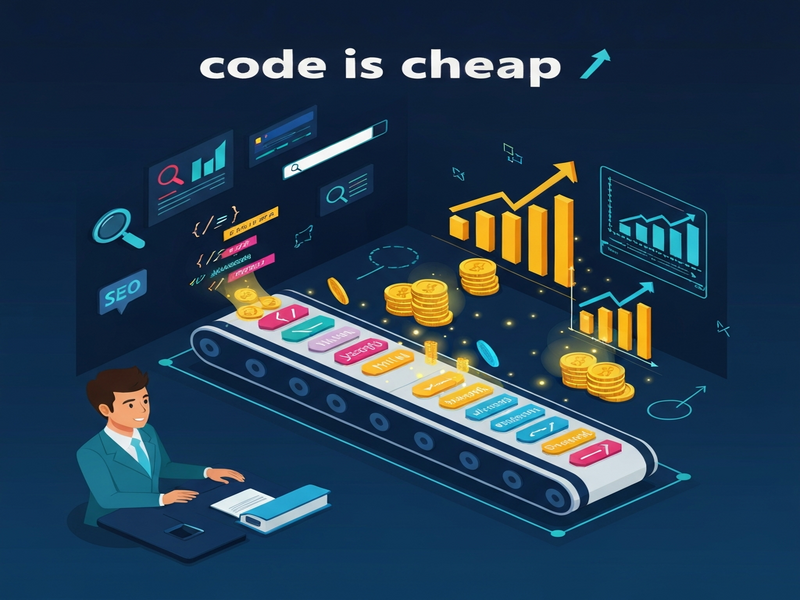
What Simon Willison Calls “Code Is Cheap”
In his seminal post “Code is Cheap”, Simon Willison argues that the era of manual, line‑by‑line coding is ending. AI agents—powered by large language models—can generate, refactor, test, and document code at a fraction of the time a human developer spends. This shift collapses the traditional cost model where a single developer might spend a full day producing a few hundred lines of clean, tested code.
The Core Premise: Code Production Is Near‑Free
- AI agents can produce boilerplate and even complex logic in seconds.
- Parallel agents enable a single engineer to orchestrate multiple code streams simultaneously.
- Token‑based pricing of LLM APIs makes the marginal cost of each generated line negligible.
Agentic Engineering – A New Development Paradigm
Agentic engineering treats AI assistants as autonomous collaborators. Instead of prompting a model once and manually polishing the output, developers launch asynchronous sessions where agents iterate, test, and self‑document. The result is a rapid “draft‑first” workflow that forces teams to rethink estimation, planning, and quality assurance.
New Habits Required
Willison warns that the biggest obstacle is cultural: teams must abandon the old intuition that “coding time = cost.” He suggests a habit of “fire‑and‑forget” prompts—letting agents generate code even for low‑value ideas, then reviewing the output later. This approach surfaces hidden opportunities and forces a shift from “don’t build it” to “let the AI try, then decide.”
Why the Shift Matters for Developers, CTOs, and Engineering Leaders
Cost Structure Re‑Engineering
When the marginal cost of code drops to near zero, the dominant expense becomes quality assurance. Testing frameworks, observability, and documentation now dominate budgets. Organizations that continue to allocate large portions of their sprint capacity to raw coding will see diminishing returns.
Quality Becomes the Competitive Moat
Good code—defined by reliability, security, maintainability, and clear documentation—remains expensive. As AI agents can churn out drafts, the differentiator is how rigorously teams validate those drafts. This aligns perfectly with UBOS’s Enterprise AI platform by UBOS, which embeds automated testing, version control, and compliance checks directly into the agentic workflow.
Team Dynamics and Skill Sets
The role of a software engineer evolves from “code writer” to “AI orchestrator.” Skills in prompt engineering, model evaluation, and data‑centric debugging become essential. Teams that invest in Workflow automation studio can build reusable agent pipelines, reducing the cognitive load on individual developers.
Strategic Planning and Product Roadmaps
Traditional roadmaps, built around effort‑based estimates, must be replaced with value‑first frameworks. Since code can be generated on demand, product managers should prioritize features based on impact per token rather than person‑hours. UBOS’s AI marketing agents illustrate how rapid prototyping can be turned into measurable ROI within days.
Actionable Takeaways for Your Organization
Adopt these six practices to harness cheap code while safeguarding quality:
- Implement a “Prompt‑First” Policy. Require every new feature idea to be expressed as a prompt to an AI agent before any human effort is logged. Use UBOS’s UBOS templates for quick start to standardize prompt formats.
- Automate Validation. Couple generated code with auto‑generated unit tests using the OpenAI ChatGPT integration. Treat test pass rates as the primary “cost” metric.
- Version‑Control Agent Outputs. Store every AI‑generated snippet in a Git repository. UBOS’s Web app editor on UBOS can auto‑commit agent drafts, preserving audit trails.
- Introduce “AI‑Code Review” Gates. Before merging, run a secondary LLM that critiques readability, security, and adherence to coding standards. The Chroma DB integration can store embeddings of approved code for future similarity checks.
- Measure Value in Tokens, Not Hours. Track the number of API tokens spent per feature and compare against business outcomes (e.g., conversion lift, churn reduction). The UBOS partner program offers analytics dashboards for token‑level accounting.
- Invest in Upskilling. Provide workshops on prompt engineering, LLM bias mitigation, and AI‑augmented debugging. Leverage the About UBOS learning hub for curated courses.
Template Marketplace Picks for Immediate Wins
UBOS’s marketplace already hosts ready‑made agentic solutions that embody the principles above:
- AI Article Copywriter – generates SEO‑optimized copy and auto‑adds meta tags.
- AI SEO Analyzer – evaluates generated content against ranking factors.
- GPT‑Powered Telegram Bot – showcases the Telegram integration on UBOS for real‑time code review alerts.
- AI Chatbot template – can be repurposed as an internal “coding assistant” for developers.
- AI Image Generator – creates visual assets for documentation automatically.
Conclusion: Embrace the Cheap‑Code Era, Guard the Good‑Code Frontier
The reality is clear: code is cheap, but good code still costs. Organizations that treat AI agents as mere speed‑boosters will soon drown in technical debt. Those that embed rigorous validation, token‑based economics, and a culture of “prompt‑first” experimentation will turn cheap code into a strategic advantage.
Ready to future‑proof your development pipeline? Explore the UBOS homepage for a unified platform that blends agentic engineering with enterprise‑grade governance, or dive straight into the UBOS pricing plans to start a free trial today.
“The moment you stop treating code as a scarce resource and start treating quality as the scarce resource, you unlock the true power of AI‑augmented development.” – Adapted from Simon Willison
For a deeper dive into how AI agents are reshaping software engineering, read our software development resources and the latest insights on AI code generation.
This article is based on the concepts presented in Simon Willison’s original article. All internal references point to UBOS resources for further exploration.
Andrii Bidochko
CTO UBOS
Andrii Bidochko is an AI entrepreneur and researcher focused on AI agents, reinforcement learning, and autonomous systems. He writes about the technologies shaping the future of machine intelligence, from frontier models and agent architectures to real-world AI applications.