

- Updated: November 27, 2025
- 7 min read
China Advances with Three Partially Reusable Rockets – New Launch Plans
China is set to launch three partially reusable rockets—Long March 12A, Zhuque‑3, and Tianlong‑3—by the end of 2025, a milestone that will reshape the global launch market and accelerate the commercialization of space.
China’s Reusable Rocket Surge: A Quick Overview
In the past twelve months, three Chinese launch providers have moved their reusable launch vehicles from the drawing board to the launch pad at the Jiuquan Satellite Launch Center. The Long March 12A (Shanghai Academy of Spaceflight Technology), Zhuque‑3 (LandSpace), and Tianlong‑3 (Space Pioneer) each employ a first‑stage booster that can return to Earth and land vertically, mirroring the approach pioneered by SpaceX.
These rockets are designed to carry payloads ranging from 11 tonnes to 17 tonnes to low‑Earth orbit (LEO), using a mix of liquid methane/LOX and kerosene/LOX propulsion. Their debut flights are slated for the final quarter of 2025, positioning China as the third nation to field operational reusable launch vehicles.
For a deeper dive into the technical specifications, see the UBOS platform overview, which illustrates how modular architectures accelerate complex engineering projects.
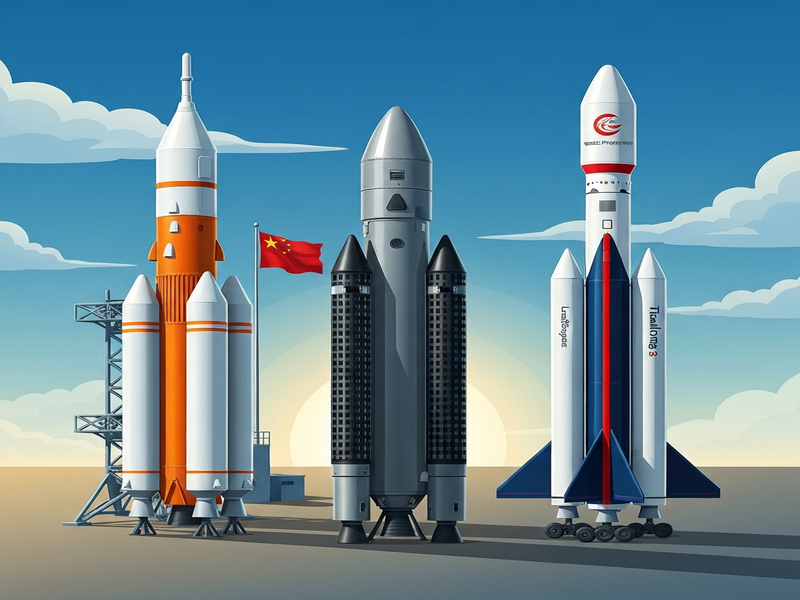
Detailed Look at Each Reusable Rocket
Long March 12A – Shanghai Academy of Spaceflight Technology
The Long March 12A is a two‑stage, methane‑fuelled launch vehicle standing 63 meters tall with a 3.8 m diameter. Its first stage is powered by seven Longyun engines, each capable of throttling for a controlled landing burn. The booster lands on four deployable legs, guided by grid fins that provide aerodynamic stability during descent.
Key performance figures:
- Payload to LEO: up to 12 000 kg
- First‑stage reuse: vertical landing with leg‑based touchdown
- Propellant: liquid methane (CH₄) / liquid oxygen (LOX)
Development milestones include a high‑altitude hop test in January 2025, a static‑fire of the second stage in August, and the delivery of the transporter‑erector in November. The next step is a full‑vehicle static fire at Jiuquan, expected before the inaugural flight.
Learn how Telegram integration on UBOS can streamline real‑time telemetry monitoring for launch teams.
Zhuque‑3 – LandSpace
LandSpace’s Zhuque‑3 is a 66‑meter tall, methane‑fuelled vehicle that pushes the envelope with eight first‑stage engines (six TQ‑12A plus two reserves) and a vacuum‑optimized TQ‑15A on the second stage. Like the Long March 12A, its booster lands on four legs after a controlled burn, using four grid fins for precision.
Performance highlights:
- Payload to LEO: up to 11 800 kg (Block 1 configuration)
- First‑stage reuse: vertical landing with autonomous guidance
- Propellant: liquid methane / LOX
The Zhuque‑3 program has already completed a 10‑km hop test (September 2024) and a 45‑second static fire (June 2025). Its hardware has also flown on the earlier Zhuque‑2 family, providing valuable flight heritage.
Start‑up innovators can explore the UBOS for startups toolkit to accelerate their own satellite‑constellation services using reusable launch options.
Tianlong‑3 – Space Pioneer
Space Pioneer’s Tianlong‑3 takes a different propellant route, using kerosene (RP‑1) and LOX. At 72 meters tall, it is the largest of the three and can lift up to 17 000 kg to LEO. The first stage is powered by nine TH‑12 engines, and the second stage uses a single vacuum‑optimized engine.
Key specs:
- Payload to LEO: up to 17 000 kg
- First‑stage reuse: vertical landing with four legs and grid‑fin steering
- Propellant: kerosene (RP‑1) / LOX
A successful static fire in September 2025 demonstrated the engine’s reliability. The vehicle is currently on its dedicated pad, undergoing integration tests with ground support equipment. Notably, the reusable hardware (landing legs and grid fins) is still being installed, indicating a rapid development cadence.
Enterprises looking for an Enterprise AI platform by UBOS can leverage Tianlong‑3’s data streams for predictive maintenance and launch‑window optimization.
Development Milestones and Test Results
All three rockets share a common development philosophy: incremental testing, rapid iteration, and reuse‑focused design. Below is a concise timeline that captures the most critical milestones across the programs.
| Program | Milestone | Date | Outcome |
|---|---|---|---|
| Long March 12A | High‑altitude hop test (first‑stage) | Jan 2025 | Successful ascent to 10 km; soft‑landing burn executed, minor software glitch on splashdown. |
| Zhuque‑3 | In‑atmosphere hop (10 km) | Sep 2024 | Engine relight and controlled descent achieved. |
| Tianlong‑3 | Full static fire (first‑stage) | Sep 2025 | All nine TH‑12 engines ignited for 30 seconds; performance within design envelope. |
These results demonstrate that each provider has validated the core propulsion and landing‑burn sequences required for booster recovery. The next logical step is an integrated static fire that includes both stages, followed by a full launch‑and‑land demonstration.
Automation plays a pivotal role in these campaigns. The Workflow automation studio enables engineers to orchestrate test‑sequence triggers, data capture, and post‑flight analysis with minimal manual intervention.
Launch Site Preparations and Expected Timeline
All three vehicles are stationed at the historic Jiuquan Satellite Launch Center (JSLC), which has been upgraded with dedicated landing zones, fire‑suppression systems, and autonomous recovery infrastructure.
- Landing pads: Completed for Long March 12A and Zhuque‑3; Tianlong‑3’s pad is under final certification.
- Ground support equipment (GSE): New mobile gantries and propellant loading systems installed to accommodate methane and kerosene operations.
- Integration timeline: Full vehicle integration expected by early November 2025, followed by a combined static fire in mid‑November.
Industry insiders anticipate the first flight to occur between 25 November and 5 December 2025, with each provider targeting a separate window to maximize range‑availability and safety checks.
For teams that need to coordinate multi‑agency communications, the AI marketing agents can be repurposed to handle stakeholder updates, media releases, and real‑time launch‑status dashboards.
Implications for the Global Launch Market
The entry of three Chinese reusable launch vehicles will dramatically increase global launch capacity and drive down costs. Analysts project a 15‑20 % reduction in average LEO launch price once booster recovery rates reach 70 %.
Key strategic impacts:
- Competitive pressure on incumbents: SpaceX’s Falcon 9 will face direct competition not only from Blue Origin’s New Glenn but also from three independent Chinese providers.
- Satellite‑constellation economics: Lower launch costs enable larger constellations (e.g., Qianfan, Starlink‑competitors) to achieve faster deployment cycles.
- Supply‑chain diversification: Customers can choose between methane‑based and kerosene‑based reusable rockets, matching payload requirements and cost structures.
Investors are already reallocating capital toward Chinese launch startups. The UBOS partner program offers co‑development opportunities for aerospace firms seeking AI‑driven analytics and predictive maintenance tools.
From a technology‑stack perspective, the OpenAI ChatGPT integration can provide natural‑language query interfaces for mission planners, turning complex telemetry into actionable insights.
Conclusion: A New Era for Reusability
China’s trio of reusable rockets is poised to become the world’s third operational reusable launch system, challenging the long‑standing dominance of U.S. providers. Their successful debut will not only validate China’s engineering capabilities but also catalyze a more competitive, affordable, and frequent launch ecosystem.
Stay ahead of the curve by exploring how AI can amplify your space‑related projects. Check out the UBOS templates for quick start to prototype mission‑control dashboards, or dive into the UBOS pricing plans to find a cost‑effective solution for your next launch‑data analytics initiative.
For a full technical deep‑dive, read the original report that first disclosed these upcoming flights.
ChatGPT and Telegram integration
Leverage real‑time chatbots for launch‑status alerts and crew communications.
Chroma DB integration
Store and query high‑dimensional telemetry data with vector search.
ElevenLabs AI voice integration
Convert mission updates into natural‑sounding voice briefings.
About UBOS
Discover the team behind the AI platform powering next‑gen aerospace analytics.
UBOS portfolio examples
See case studies of AI‑enhanced launch operations across the industry.
AI SEO Analyzer
Optimize your aerospace content for search and AI discovery.