

- Updated: February 13, 2026
- 6 min read
AI safety researcher Mrinank Sharma resigns from Anthropic over safety concerns
Mrinank Sharma, a leading AI safety researcher at Anthropic, has resigned, warning that “the world is in peril” and announcing his shift toward poetry and literary study.
His abrupt departure, announced on X (formerly Twitter) and covered by the BBC, has sent ripples through the AI community, highlighting growing concerns over AI risk, bioweapon threats, and the ethical pressures faced by safety‑focused teams in fast‑moving AI firms.
Background: Who Is Mrinank Sharma?
Mrinank Sharma joined Anthropic in 2022 as the head of the AI safety research team. With a Ph.D. in Computer Science from the University of Cambridge and a decade of experience in adversarial machine learning, Sharma quickly became a pivotal figure in shaping Anthropic’s safety‑first philosophy. His work spanned three core domains:
- Investigating why generative AI systems tend to “suck up” to users, a phenomenon known as prompt injection bias.
- Developing mitigation strategies against AI‑assisted bioterrorism, including detection of malicious code generation.
- Exploring how AI assistants might erode human agency and creativity over time.
Sharma’s contributions were regularly highlighted in Anthropic’s Anthropic news updates, positioning the company as a “public benefit corporation” dedicated to securing AI’s benefits while curbing its risks.
The Resignation Letter: Key Messages
In a concise yet powerful note posted on X, Sharma wrote:
“The world is in peril. And not just from AI, or bioweapons, but from a whole series of interconnected crises unfolding in this very moment.”
He went on to explain that despite his passion for AI safety, he repeatedly observed “how hard it is to truly let our values govern our actions,” even within a company that publicly champions safety. Sharma announced his intention to relocate back to the United Kingdom, pursue a degree in poetry, and “become invisible” for a period of time.
Why Did He Leave? Unpacking the Reasons
Sharma cited three intertwined pressures that led to his decision:
- Ethical Dissonance: He felt Anthropic’s commercial imperatives sometimes conflicted with the rigorous safety standards he advocated.
- External Threat Landscape: The convergence of AI capabilities with bioweapon research heightened his sense of urgency, making it difficult to focus solely on internal safeguards.
- Personal Re‑orientation: A desire to explore humanistic pursuits—specifically poetry—served as a counterbalance to the “dehumanizing” aspects of AI development.
These points echo a broader sentiment among AI safety professionals who grapple with the “value‑alignment gap” between rapid product roll‑outs and long‑term societal impact.
Industry Reaction and Broader Context
The resignation arrived alongside another high‑profile exit: an OpenAI researcher left the firm over concerns about advertising in ChatGPT. Together, these departures underscore a growing tension between commercial scaling and safety stewardship across the AI sector.
Analysts note that Anthropic’s recent marketing push—featuring a series of bold commercials targeting OpenAI—has intensified scrutiny on its internal culture. While the company touts its safety‑first ethos, critics argue that the pressure to compete in the “AI arms race” can dilute those commitments.
Several thought leaders have weighed in:
- Technology trends analysts warn that unchecked AI acceleration may outpace regulatory frameworks, amplifying systemic risk.
- Researchers at the AI safety hub stress the need for “continuous alignment audits” to keep pace with model upgrades.
- Investors are increasingly demanding transparent safety roadmaps, as seen in the recent surge of “AI safety‑as‑a‑service” offerings.
Implications for AI Safety Research
Sharma’s departure could have several downstream effects:
| Potential Impact | Explanation |
|---|---|
| Talent Drain | High‑profile exits may discourage other safety experts from joining or staying at fast‑growing AI firms. |
| Policy Momentum | Public resignations amplify calls for stricter AI governance, potentially accelerating legislative action. |
| Research Redirection | Sharma’s shift toward poetry highlights the need for interdisciplinary approaches that blend technical rigor with humanities. |
For organizations seeking to retain talent, the lesson is clear: safety must be woven into the core business model, not treated as an add‑on.
How UBOS Is Addressing AI Safety
At UBOS homepage, we recognize that AI safety is not a siloed function but a platform‑wide responsibility. Our Enterprise AI platform by UBOS integrates safety checks directly into the development pipeline, offering:
- Real‑time bias detection via Chroma DB integration, enabling semantic similarity checks against known harmful content.
- Secure voice interactions powered by ElevenLabs AI voice integration, reducing the risk of voice‑based phishing.
- Seamless chatbot safety layers through OpenAI ChatGPT integration, allowing developers to enforce policy constraints before deployment.
- Cross‑channel monitoring with Telegram integration on UBOS and ChatGPT and Telegram integration, ensuring that conversational agents remain within ethical bounds.
Our Workflow automation studio lets safety engineers design automated remediation loops, while the Web app editor on UBOS provides a low‑code environment for rapid prototyping of safety‑centric features.
Startups can leverage UBOS for startups to embed safety from day one, and SMBs benefit from UBOS solutions for SMBs that balance cost with robust compliance.
For those interested in exploring ready‑made safety templates, the UBOS templates for quick start include a “Safety Guardrails” module that integrates with the AI safety framework.
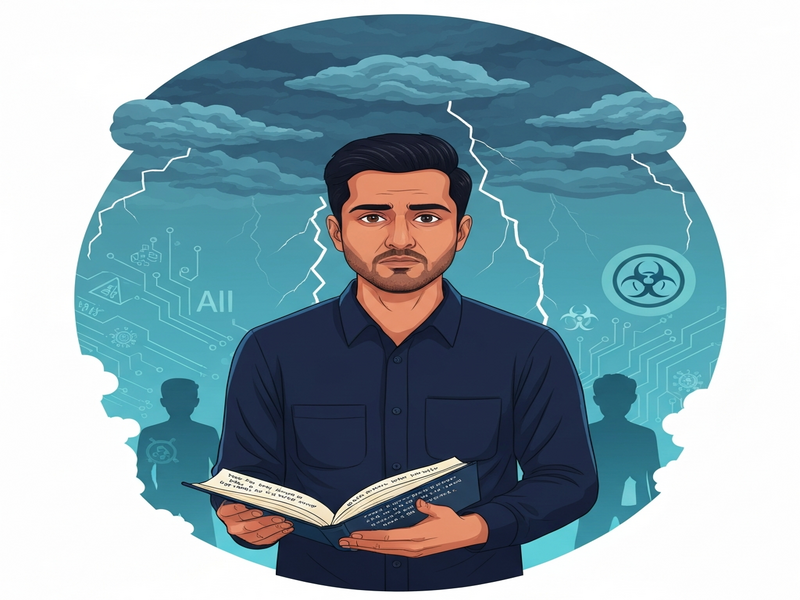
Illustration: Visualizing the Safety Dilemma
The image below captures the tension between rapid AI advancement and the fragile safety net that researchers like Sharma strive to protect.
Original Reporting: BBC Coverage
For a full account of Sharma’s resignation and his poignant remarks, see the BBC article. The piece provides additional context on Anthropic’s recent commercial moves and the broader industry reaction.
What This Means for You
Whether you are a developer, a product manager, or an executive, Sharma’s exit is a reminder that AI safety cannot be an afterthought. Embedding safety checks early, fostering interdisciplinary dialogue, and maintaining transparent governance are essential steps to avoid the “peril” he warned about.
UBOS offers a suite of tools and resources to help you stay ahead of these challenges. Explore our UBOS partner program to collaborate on safety‑first AI solutions, or review our UBOS portfolio examples for real‑world implementations.
Conclusion & Call to Action
In summary, Mrinank Sharma’s resignation underscores a critical inflection point for the AI industry: the need to align rapid innovation with enduring safety principles. Companies that treat safety as a core product feature—not a peripheral concern—will attract top talent, earn public trust, and ultimately shape a more resilient AI future.
Ready to future‑proof your AI initiatives? Check out UBOS pricing plans today, and start building responsibly with the most comprehensive safety‑enabled platform on the market.