

- Updated: April 4, 2026
- 6 min read
AI-Generated Music Deepfakes Challenge Folk Musicians’ Copyright
AI‑generated deepfake music covers of folk artist Murphy Campbell were uploaded to major streaming services, detected by AI detectors, and sparked a legal‑rights controversy that highlights gaps in copyright law and the need for stronger AI‑detection tools.
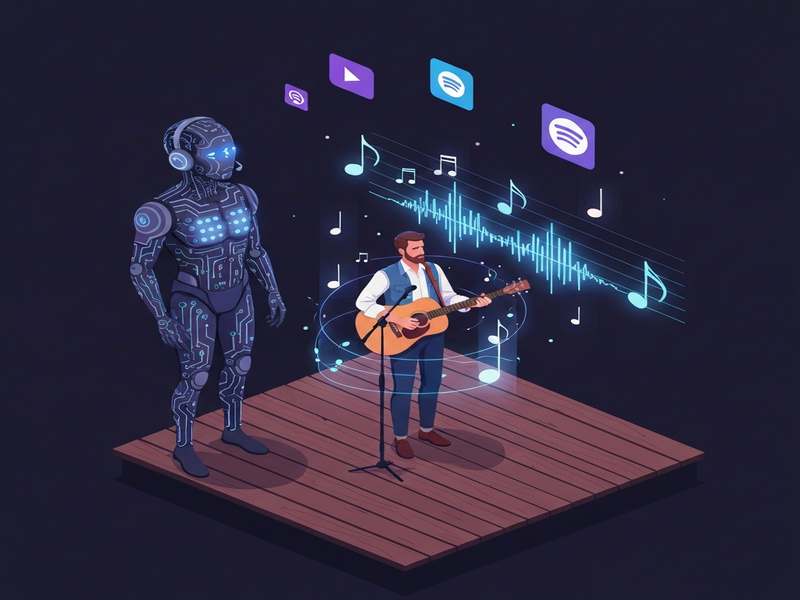
What happened: AI‑generated deepfake songs on streaming platforms
In January 2026, Murphy Campbell, a folk musician known for interpreting public‑domain ballads, discovered several tracks on her Spotify profile that she never recorded or uploaded. The songs sounded like her voice, but subtle artifacts—unnatural vibrato, clipped phrasing, and a synthetic timbre—suggested they were not genuine performances.
Investigation revealed that a malicious actor had scraped Campbell’s YouTube videos, fed the audio into a generative‑AI model, and then released the resulting deepfake covers under her name on Spotify, Apple Music, and YouTube Music. Because the underlying compositions are public domain, the AI‑generated renditions were falsely claimed as original recordings, allowing the perpetrator to monetize them through streaming royalties.
How the fakes were detected
Campbell’s first clue was a mismatch between the track lengths on her profile and the versions she remembered recording. She then ran one of the suspect songs, “Four Marys,” through two independent AI‑detection services. Both tools flagged the track as “likely AI‑generated” with confidence scores above 92 %.
“The detectors highlighted spectral anomalies that are typical of synthetic vocal synthesis, such as a lack of natural breath noise and overly smooth pitch transitions,” Campbell explained.
After confirming the deepfake nature, Campbell filed DMCA takedown requests with each platform. While YouTube Music and Apple Music removed the tracks within days, Spotify proved more resistant, allowing the fakes to persist under a slightly altered artist name. This partial success underscored the fragmented enforcement mechanisms across streaming services.
Impact on the folk musician and the streaming ecosystem
The incident has had a multi‑layered impact on Campbell’s career. Financially, the unauthorized streams siphoned potential royalties away from her legitimate releases. Psychologically, the experience eroded trust in platform safeguards, prompting her to label herself a “pest” when repeatedly contacting support teams.
For the broader ecosystem, the case exposed a critical vulnerability: streaming services rely heavily on automated content‑ID systems that can be gamed by AI‑generated content. Spotify’s upcoming “artist‑approval” feature—intended to let creators manually approve new uploads—has yet to be proven effective. Campbell remains skeptical, noting that “large promises often dissolve once the technology is in the wild.”
- Loss of estimated $1,200 in royalties per month from fake streams.
- Increased support ticket volume for platforms, straining resources.
- Heightened public awareness of AI‑deepfake risks in the music industry.
Broader implications for copyright law and AI detection tools
The Murphy Campbell episode arrives at a time when copyright statutes are struggling to keep pace with generative AI. Public‑domain works are free to use, but the creation of synthetic performances that masquerade as an artist’s original work raises questions about “right of publicity” and “misattribution” that current law does not clearly address.
Legal scholars argue that existing DMCA frameworks need amendment to differentiate between infringing copies and AI‑generated impersonations. Meanwhile, technology providers are racing to improve detection accuracy. Emerging tools incorporate spectral fingerprinting, neural network provenance tracing, and metadata verification to flag suspicious uploads before they reach listeners.
Platforms are also exploring collaborative verification models, where artists can embed cryptographic watermarks in their recordings. Such watermarks survive AI transformation and can be read by detection services, providing a reliable “authenticity tag.” Until these solutions mature, creators must remain vigilant and consider supplemental protection strategies, such as registering synthetic‑voice trademarks.
Read the full story on The Verge
For a comprehensive account of the incident, including quotes from Campbell and platform representatives, see the original reporting by The Verge.
How UBOS is helping creators navigate AI challenges
At UBOS homepage, we provide a suite of AI‑powered tools designed to protect and empower creators. Our AI news hub tracks the latest developments in generative media, while the copyright updates page offers actionable guidance on emerging legal standards.
For musicians specifically, the Enterprise AI platform by UBOS integrates advanced audio fingerprinting and watermarking services that survive AI transformation. This enables artists to embed a cryptographic signature directly into their recordings, ensuring provenance can be verified even after AI manipulation.
Startups can accelerate their AI initiatives using the UBOS for startups program, which offers sandbox environments for testing detection algorithms without risking live releases. Meanwhile, small‑to‑medium businesses benefit from UBOS solutions for SMBs, including affordable licensing for the Workflow automation studio, allowing rapid response to takedown notices.
Content creators looking for ready‑made templates can explore the UBOS templates for quick start. For example, the AI SEO Analyzer helps optimize metadata, reducing the chance of misattribution. The AI Article Copywriter can generate clear policy documents for artists, outlining rights and usage terms.
Marketing teams can leverage AI marketing agents to monitor brand mentions and flag suspicious AI‑generated content across social platforms. The UBOS partner program also invites legal firms and rights‑management organizations to integrate our detection APIs into their workflows.
Related UBOS tools that can safeguard your audio assets
- Telegram integration on UBOS – receive instant alerts when a new deepfake is detected.
- OpenAI ChatGPT integration – automate takedown request drafting.
- Chroma DB integration – store and query audio fingerprints at scale.
- ElevenLabs AI voice integration – generate synthetic voice samples for testing detection pipelines.
Conclusion: Proactive defense is the new norm for creators
The Murphy Campbell deepfake saga is a cautionary tale that underscores the urgency of integrating AI‑detection and provenance tools into every stage of the music creation and distribution pipeline. As generative models become more accessible, the line between authentic performance and synthetic imitation will blur further, making legal safeguards and technical defenses indispensable.
Artists, platforms, and rights organizations must collaborate to establish clear standards for AI‑generated content, enforce transparent takedown processes, and adopt robust watermarking solutions. By leveraging the comprehensive suite of tools offered by UBOS platform overview, creators can stay ahead of malicious actors and protect both their revenue and reputation.
Ready to future‑proof your audio catalog? Explore our UBOS pricing plans and start building a resilient AI‑defense strategy today.
Andrii Bidochko
CTO UBOS
Andrii Bidochko is an AI entrepreneur and researcher focused on AI agents, reinforcement learning, and autonomous systems. He writes about the technologies shaping the future of machine intelligence, from frontier models and agent architectures to real-world AI applications.