

- Updated: February 17, 2026
- 8 min read
AI Data Centre Controversy in Potters Bar Highlights Global AI Race
The AI data centre dispute in Potters Bar revolves around a planning conflict in which a large‑scale AI data centre is slated to replace green‑belt farmland, sparking protests, environmental concerns, and a national debate about the UK’s AI infrastructure strategy.
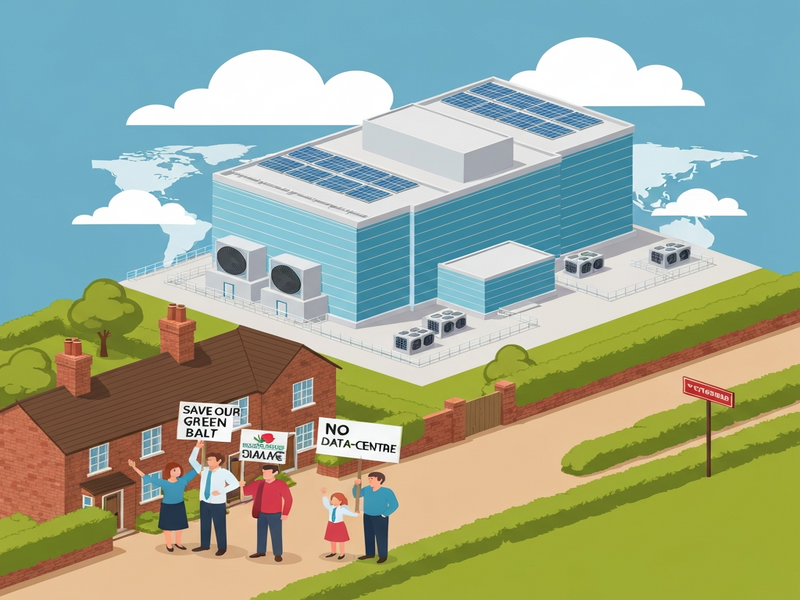
Potters Bar AI Data Centre Controversy: Green Belt vs. Global AI Arms Race
In the quiet outskirts of London, the small town of Potters Bar has become an unlikely flashpoint in the worldwide scramble for artificial‑intelligence power. A developer’s request to build one of Europe’s biggest AI data centres on 85 acres of traditionally protected green belt land has ignited a fierce local backlash, while the UK government touts the project as a cornerstone of its national AI strategy.
For technology enthusiasts, AI professionals, and community stakeholders, the dispute offers a vivid case study of how rapid AI expansion collides with environmental stewardship and local identity.
Why the UK Is Racing to Build AI Data Centres
The British government’s AI roadmap released in 2023 set an ambitious target: double the nation’s AI‑ready compute capacity by 2027. This goal is driven by three intertwined forces:
- Data‑intensive models: Modern large language models (LLMs) such as GPT‑4 and Claude require petabytes of storage and massive GPU farms.
- Economic competitiveness: Nations that host AI infrastructure attract high‑value tech firms, research talent, and venture capital.
- National security: AI is increasingly viewed as critical national infrastructure, essential for defense, healthcare, and public services.
To meet this demand, the UK introduced a new “grey belt” classification that relaxes planning rules on under‑performing green‑belt parcels, effectively opening the door for data‑centre construction on land previously off‑limits.
The Planning Dispute: Green Belt vs. Grey Belt Reclassification
In September 2024, a property developer submitted a planning application to erect a 150‑megawatt AI data centre on farmland that sits between Potters Bar and the village of South Mimms. The site, once part of the protected green belt, was re‑designated by Hertsmere Borough Council as “grey belt,” a move the council justified by the land’s low agricultural productivity.
Local residents quickly organized a Facebook group that amassed over 1,000 members. Their objections centred on three core issues:
- Loss of green space: The oak‑lined footpath and surrounding hedgerows provide a mental‑health sanctuary for walkers and cyclists.
- Environmental impact: Data centres consume vast amounts of electricity and water, raising concerns about carbon emissions and local ecosystems.
- Precedent setting: Neighbours fear that reclassifying one field will make it easier to reclassify others, eroding the green‑belt buffer around London.
The council’s planning officers concluded that the site met the definition of grey belt and that the project aligned with the national AI agenda. Their decision, announced in January 2025, granted permission despite a public consultation in which objections outnumbered support by roughly two‑to‑one.
Government’s Green Light: Economic and Strategic Rationale
When asked to justify the approval, council leader Jeremy Newmark cited the “critical national infrastructure” status granted to data centres by the Department for Business, Energy & Industrial Strategy. He argued that the economic upside—estimated at over £5 billion in investment and the creation of 2,500 construction jobs plus 200 permanent roles—outweighed the perceived loss of green space.
Equinix, the multinational operator that later acquired the land, promised to retain half of the site as “biodiversity zones” featuring ponds, wetlands, and new tree plantings. While critics remain skeptical, the company’s sustainability pledge aligns with the UK’s net‑zero targets.
From a policy perspective, the decision reflects a broader shift: the UK is positioning itself as a hub for AI research and deployment, hoping to capture a share of the global AI arms race that sees billions poured into compute infrastructure worldwide.
Grassroots Resistance: Protests, Petitions, and Legal Challenges
Local opposition has taken many forms:
- Physical protests at the oak tree, where signs reading “NO TO DATA CENTRE” have become a familiar sight.
- Petitions on Change.org that have gathered thousands of signatures from residents and environmental groups.
- Formal appeals to the UK’s Office of Environmental Protection and a complaint lodged against council leader Newmark for alleged conflict of interest.
Despite these efforts, the council’s internal review found no procedural irregularities, and the planning permission remains in force. The protestors have now turned to a “filibuster” strategy, filing objections at every subsequent planning stage to delay construction.
Economic Stakes: Jobs, Tax Revenue, and the AI Competitive Edge
Proponents of the Potters Bar data centre highlight several tangible benefits:
- Job Creation
- 2,500 construction jobs over the build phase and 200 permanent technical positions once operational.
- Tax Revenue
- Projected £27 million in annual property tax, with half earmarked for local services.
- Tech Cluster Effect
- Data centres often attract ancillary AI startups, creating a virtuous cycle of innovation.
- National AI Strategy Alignment
- Supports the UK’s goal to become a leading AI hub, ensuring data sovereignty and reduced latency for domestic AI workloads.
For businesses looking to leverage AI, the presence of a high‑capacity data centre nearby can dramatically reduce latency and operational costs. Companies can spin up GPU‑intensive workloads for training large models without relying on overseas cloud providers.
The Global AI Arms Race: Why Potters Bar Matters
The Potters Bar saga is a microcosm of a worldwide phenomenon. Nations from the United States to China are racing to secure compute capacity, recognizing that AI will shape the next decade of economic growth and security. According to a recent original Wired story, the UK’s “grey belt” policy mirrors similar fast‑track measures in the United States, where federal agencies have designated AI data centres as critical infrastructure.
These policy shifts have a two‑fold effect:
- Accelerated permitting reduces time‑to‑market for AI services.
- Environmental trade‑offs become more visible, prompting public debate about sustainable AI.
In this context, the Potters Bar dispute is not just a local zoning issue; it is a litmus test for how democracies balance innovation with stewardship.
UBOS Solutions: Building AI Infrastructure with Responsibility
While the Potters Bar case highlights the challenges of large‑scale data‑centre development, smaller‑scale, modular AI infrastructure can deliver comparable compute power with a lighter environmental footprint. UBOS homepage showcases a suite of tools that empower organizations to deploy AI workloads efficiently:
- UBOS platform overview – a low‑code environment for building AI‑enabled web apps without massive data‑centre footprints.
- AI marketing agents that automate campaign creation, reducing the need for on‑premise compute.
- Workflow automation studio – orchestrates data pipelines across edge devices, cutting energy use.
- Web app editor on UBOS enables rapid prototyping of AI services that can run on existing cloud credits.
For startups and SMBs seeking to join the AI wave without the overhead of a massive data centre, UBOS offers tailored solutions:
- UBOS for startups – fast‑track AI product launches.
- UBOS solutions for SMBs – scalable, pay‑as‑you‑go compute.
- Enterprise AI platform by UBOS – secure, compliant, and energy‑aware.
These offerings illustrate that AI can be democratized responsibly, reducing the pressure to build monolithic data centres in sensitive locations.
Ready‑Made Templates to Accelerate Your AI Projects
UBOS’s template marketplace provides plug‑and‑play solutions that can be deployed on modest infrastructure, sidestepping the need for large‑scale facilities. A few standout templates include:
- AI Article Copywriter – generate SEO‑friendly content with minimal compute.
- AI SEO Analyzer – optimize your site’s visibility without heavy server loads.
- AI Video Generator – create marketing videos on demand.
- AI Chatbot template – embed conversational agents in web apps.
- AI Image Generator – produce visual assets without external GPU farms.
By leveraging these templates, developers can focus on business logic while UBOS handles the underlying AI orchestration, keeping energy consumption low and compliance high.
What’s Next for Potters Bar and the UK AI Landscape?
The Potters Bar data centre is slated to break ground later this year, pending final technical approvals. Whether the project proceeds as planned or faces further legal hurdles, the debate it has sparked will shape future UK planning policies.
Stakeholders—policy makers, developers, and citizens—must collaborate to craft a balanced approach that fuels AI innovation while preserving the green spaces that define Britain’s countryside.
Stay informed and explore how you can build AI solutions responsibly:
- Visit the UBOS pricing plans to find a cost‑effective compute package.
- Join the UBOS partner program for co‑development opportunities.
- Browse the UBOS portfolio examples for real‑world AI deployments.
By choosing modular, sustainable AI infrastructure, the UK can remain competitive in the global AI arms race without sacrificing the green heritage that communities like Potters Bar cherish.