

- Updated: February 6, 2026
- 5 min read
AI Capex Race 2026: Amazon vs Google – Massive Investments in Artificial Intelligence
Amazon is leading the 2026 AI capex race with a projected $200 billion spend, while Google follows closely with an estimated $175‑$185 billion investment.
AI Capex Race 2026: Amazon’s $200 B Lead Over Google’s $175‑$185 B Push
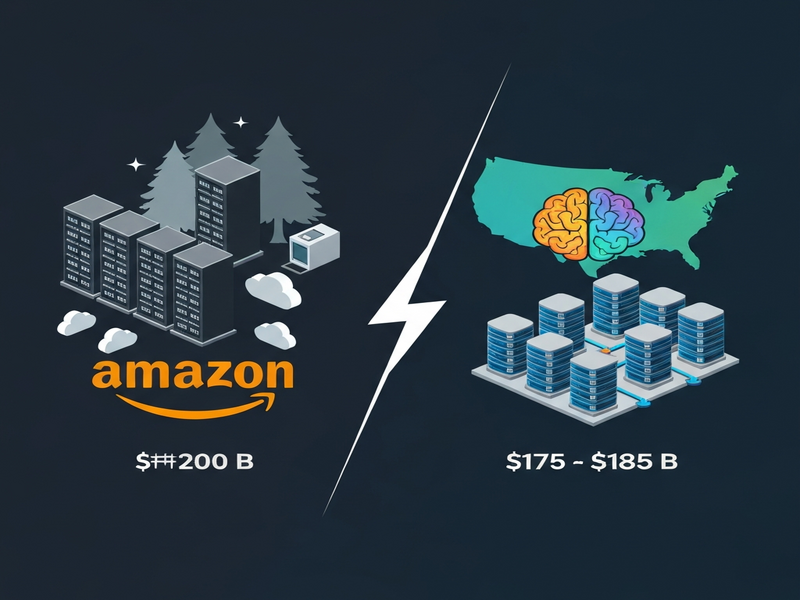
In early February 2026, both Amazon and Google disclosed staggering capital‑expenditure (capex) plans that underscore the intensity of the AI investment battle. The numbers—$200 billion for Amazon and $175‑$185 billion for Google—signal a new era where cloud giants are betting billions on compute, chips, and data‑center infrastructure to dominate the emerging AI economy. For technology investors, corporate strategists, and AI industry watchers, understanding the strategic motives behind these figures is essential for navigating the fast‑moving market.
Read the full TechCrunch article for the original reporting.
Overview of 2026 AI Capex Figures
Both companies released their 2026 outlooks during quarterly earnings calls, highlighting AI as a core growth engine. Below is a concise breakdown:
| Company | 2026 Capex Range | Key Focus Areas |
|---|---|---|
| Amazon | $200 billion | AI, custom chips, robotics, low‑earth‑orbit satellites |
| Google (Alphabet) | $175‑$185 billion | AI, TPU development, data‑center expansion, cloud services |
| Meta | $115‑$135 billion | AI research, metaverse infrastructure, content moderation |
| Oracle | $50 billion | Enterprise AI, cloud migration tools |
Amazon’s capex jump from $131.8 billion in 2025 to $200 billion reflects a strategic pivot toward AI‑centric hardware and services, while Google’s range marks a near‑doubling of its 2025 spend of $91.4 billion.
Competitive Landscape and Strategic Implications
The AI capex race is not merely a numbers game; it reshapes the competitive dynamics of the cloud and AI markets.
Why Amazon’s Lead Matters
- Vertical Integration: Amazon can funnel AI compute directly into its retail, logistics, and AWS ecosystems, creating cross‑selling opportunities.
- Robotics & Satellite Edge: The inclusion of robotics and low‑earth‑orbit satellites expands AI workloads beyond traditional data centers, giving Amazon a unique edge in edge‑AI services.
- Economies of Scale: Massive capex enables bulk procurement of custom silicon, driving down per‑unit costs for AWS customers.
Google’s Counter‑Strategy
- TPU Dominance: Google’s investment in Tensor Processing Units (TPUs) reinforces its position as the go‑to platform for high‑performance AI training.
- Data‑Center Footprint: Expanding its global data‑center network improves latency for AI services, crucial for real‑time applications.
- AI‑First Cloud Vision: Google Cloud’s AI‑first product suite (Vertex AI, Gemini models) leverages the capex to accelerate feature roll‑outs.
Both firms are also racing to secure the next generation of AI talent, partnering with universities and launching internal AI research labs. The AI trends page on UBOS highlights how these investments are accelerating the adoption of generative AI across industries.
Market Reaction and Investor Perspective
Despite the strategic logic, the market response has been mixed. Share prices for both Amazon and Alphabet dipped in the weeks following the announcements, reflecting investor anxiety over the sheer scale of spending.
Key Investor Concerns
- Return on Investment (ROI): Analysts question how quickly the massive capex will translate into profitable AI services.
- Capital Allocation Discipline: With competing priorities (e.g., Amazon’s logistics network, Google’s ad business), investors worry about over‑extension.
- Macroeconomic Headwinds: Inflationary pressures and potential recession scenarios could tighten corporate budgets, making high‑risk AI bets less attractive.
Nevertheless, many long‑term investors view the spending as a necessary hedge against a future where AI compute becomes the most valuable commodity. As noted on the cloud investments page, the shift toward AI‑centric infrastructure is reshaping valuation models for cloud providers.
Future Outlook for AI Investment in 2026
Looking ahead, the AI capex race is expected to intensify, with several trends emerging:
- Hybrid Edge‑AI Deployments: Companies will blend massive central data centers with edge nodes (satellites, on‑prem hardware) to meet latency‑sensitive workloads.
- Open‑Source Model Ecosystems: Both Amazon and Google are contributing to open‑source AI frameworks, reducing development costs while fostering community adoption.
- AI‑Driven Cloud Services Monetization: New pricing models (pay‑per‑token, compute‑as‑a‑service) will emerge to monetize the massive compute capacity.
- Regulatory Scrutiny: As AI becomes more pervasive, regulators may impose compliance costs that affect capex allocation.
For startups and SMBs, the expanding AI infrastructure offers unprecedented access to world‑class compute at lower entry costs. UBOS’s solutions for SMBs illustrate how smaller players can leverage these cloud resources without bearing the capital burden.
Conclusion
The 2026 AI capex race between Amazon and Google is a clear indicator that the future of technology will be defined by who controls the compute pipeline. While investors remain cautious, the strategic imperatives—speed to market, vertical integration, and AI‑first product strategies—suggest that both giants are positioning themselves for long‑term dominance.
For decision‑makers seeking to stay ahead of the curve, monitoring these capex trends and aligning your own AI roadmap with the evolving cloud landscape is essential. Explore UBOS’s platform overview to discover how you can integrate cutting‑edge AI services without the massive upfront spend.
Andrii Bidochko
CTO UBOS
Andrii Bidochko is an AI entrepreneur and researcher focused on AI agents, reinforcement learning, and autonomous systems. He writes about the technologies shaping the future of machine intelligence, from frontier models and agent architectures to real-world AI applications.