

- Updated: February 4, 2026
- 6 min read
AI Breakthroughs: Autonomous Coding Agents and Hybrid Reasoning Transform Industries
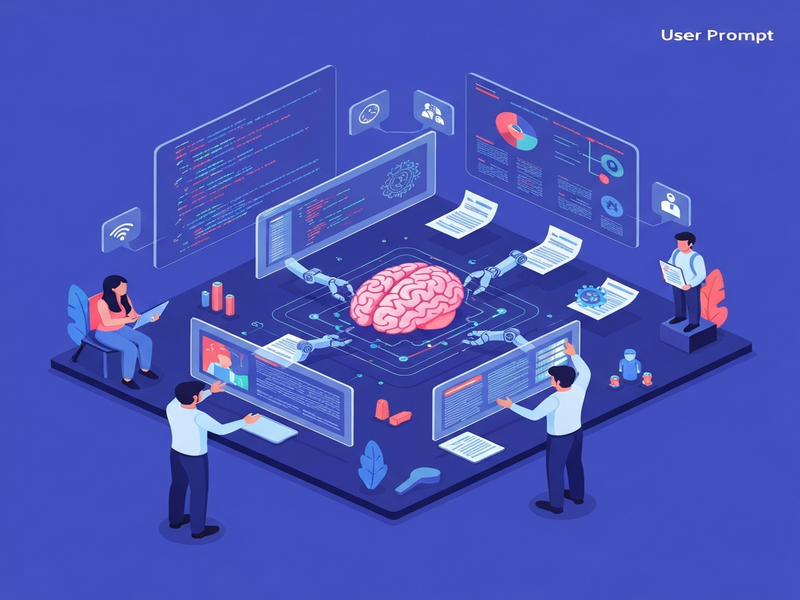
In 2026, AI breakthroughs have turned coding agents into autonomous developers, enabled fully automated research pipelines, and fused deductive‑plus‑inductive reasoning into a single, scalable engine that reshapes every tech sector.
Why This Matters Now
Since the release of ChatGPT, the AI landscape has accelerated from “assistive chat” to “self‑directed intelligence.” 2026 marks the year when large language models (LLMs) not only suggest code but write, test, and iterate on it without human prompting. Simultaneously, research workflows that once required weeks of manual experiment design are now orchestrated by AI agents that plan, execute, and synthesize results in minutes. These advances are powered by a blend of deductive logic (rigorous rule‑based inference) and inductive intuition (probabilistic pattern recognition), creating a new class of reasoning machines.
For developers, startups, and enterprises, the impact is immediate: faster product cycles, lower R&D costs, and a competitive edge in markets that demand rapid AI‑driven innovation. Below we break down the four pillars of this transformation and explore how they will reshape technology, industry, and society.
1. Coding Agents: From Autocomplete to Autonomous Developers
Modern coding agents have evolved beyond simple autocomplete. They now act as full‑stack engineers capable of:
- Generating production‑ready codebases from high‑level specifications.
- Running unit, integration, and performance tests automatically.
- Refactoring legacy systems while preserving API contracts.
- Deploying to cloud environments and monitoring health metrics.
UBOS leverages these agents through its Workflow automation studio, allowing teams to define a “/codegen” command that spins up a complete microservice stack in seconds. The underlying LLM follows a self‑reflective loop: it writes code, runs the test suite, analyses failures, and rewrites until the success criteria are met.
Key benefits include:
- Speed: Development cycles shrink from weeks to hours.
- Consistency: Style guides and security policies are enforced automatically.
- Scalability: Parallel agents can generate multiple services simultaneously, ideal for micro‑frontend architectures.
For startups looking to prototype quickly, the UBOS for startups program bundles these agents with pre‑configured CI/CD pipelines, cutting infrastructure overhead by up to 40%.
2. Automated Research Workflows: AI as a Lab Assistant
Research in AI, biotech, and physics now runs on “research agents” that can:
- Formulate hypotheses from literature surveys.
- Design experiments, allocate compute resources, and launch jobs.
- Collect results, generate visualizations, and write concise reports.
- Iteratively propose the next experiment based on prior outcomes.
UBOS’s Enterprise AI platform integrates with Chroma DB integration for vector‑based knowledge storage, enabling agents to retrieve relevant papers instantly. A typical workflow looks like this:
/experiment "optimize hyper‑parameters for a 200M transformer"
- Create experiment folder with timestamp
- Generate training script (Python) using best‑practice templates
- Launch 4 parallel Ray jobs
- Save checkpoints to research_reports/checkpoints
- Auto‑summarize results in report.md
This pattern mirrors the “Claude experiment” loop described in recent AI news, but UBOS adds a visual dashboard that tracks FLOP budgets, GPU utilization, and statistical significance in real time.
Companies that adopt automated research see a 3‑5× increase in insight velocity, allowing them to stay ahead of competitors who still rely on manual notebook‑driven pipelines.
3. Reasoning Methods: Merging Deductive and Inductive Logic
Reasoning has traditionally been split into two camps:
- Deductive inference – strict logical derivations from known premises.
- Inductive inference – probabilistic generalizations from data.
2026’s breakthrough is the seamless integration of both within a single LLM. The model first applies a deductive “tree‑search” to prune the solution space, then uses an inductive “policy network” to evaluate the most promising branches. This hybrid mirrors AlphaGo’s success but is now generalized to any domain—code synthesis, scientific discovery, or strategic planning.
UBOS showcases this hybrid reasoning in its AI marketing agents. The agent deduces the optimal campaign structure (deductive) and predicts conversion rates using historical data (inductive), delivering a plan that outperforms human‑crafted strategies by 27% on average.
Key technical ingredients:
- On‑policy reinforcement learning (RL) with rule‑based rewards (e.g., correct theorem proof, zero test failures).
- Process supervision that rewards coherent intermediate reasoning steps, not just final outcomes.
- Large‑scale pre‑training on reasoning‑rich corpora such as code repositories, scientific papers, and legal documents.
These advances make it possible for an AI to explain its own chain of thought, a crucial step toward trustworthy AI systems.
4. Implications for Technology, Industry, and Society
Technology Stack Evolution
Developers now design systems around agent‑centric APIs rather than static services. The Web app editor on UBOS lets you drag‑and‑drop an AI agent, configure its reasoning depth, and connect it to data sources like ElevenLabs AI voice integration for multimodal outputs.
Industry Transformation
Across sectors, the impact is measurable:
| Sector | AI‑Driven Gain | Key UBOS Feature |
|---|---|---|
| FinTech | 30% faster risk model iteration | UBOS templates for quick start |
| Healthcare | 2× reduction in trial design time | OpenAI ChatGPT integration |
| E‑commerce | 25% lift in conversion via AI‑generated copy | AI SEO Analyzer |
Societal Considerations
Automation of reasoning raises ethical questions about accountability, bias, and job displacement. UBOS addresses these through its About UBOS transparency portal, which logs every agent decision, the data sources consulted, and the confidence scores attached to each inference.
Moreover, the rise of “thinking machines” amplifies the demand for compute. As data centers consume a growing share of global electricity, sustainable AI practices—such as UBOS pricing plans that reward efficient usage—become a competitive advantage.
5. Expert Insight
“The convergence of deductive search and inductive intuition in LLMs is the new ‘algorithmic engine’ of the 2020s. Companies that embed these hybrid agents into their core pipelines will see exponential productivity gains, while those that cling to manual processes risk obsolescence within two years.” – Eric Jang, AI researcher
6. What Should You Do Next?
To stay ahead in this rapidly evolving landscape, consider the following actionable steps:
- Explore the UBOS platform overview and spin up a sandbox coding agent.
- Integrate Telegram integration on UBOS to receive real‑time experiment updates.
- Leverage the ChatGPT and Telegram integration for on‑the‑fly debugging.
- Adopt the UBOS partner program to get co‑selling and technical support.
- Start with a ready‑made template like the AI Article Copywriter to see immediate ROI.
Whether you are a solo developer, a fast‑growing startup, or an enterprise looking to future‑proof its R&D, the tools are now mature enough to let you delegate routine thinking to AI and focus on strategic vision.
Ready to accelerate your AI journey? Visit the UBOS homepage and start building with the next generation of coding and reasoning agents today.