

- Updated: February 26, 2026
- 6 min read
Agent Swarm: Open‑Source AI Orchestration Framework Boosts Development Efficiency
Agent Swarm is an open‑source AI orchestration framework that enables developers to coordinate multiple autonomous AI agents—lead and worker bots—through Docker isolation, real‑time dashboards, and native integrations with Slack, GitHub, email, and Sentry.
Agent Swarm: The Next‑Generation Open Source AI Orchestration Platform
In a landscape where single‑purpose LLMs struggle to handle end‑to‑end development pipelines, Agent Swarm offers a modular, scalable solution for building self‑organizing teams of AI agents. Launched by the Agent Swarm GitHub repository, the framework blends the power of Claude, Gemini, and other coding assistants with Docker‑based sandboxing, giving enterprises and indie developers alike a reliable automation backbone.
For SaaS product teams, AI researchers, and tech enthusiasts, the platform promises faster code delivery, reduced manual triage, and a continuously learning knowledge base—exactly the ingredients needed to stay competitive in 2026.
Core Features & Architecture
- Lead/Worker Coordination: A single lead agent receives tasks, decomposes them, and dispatches subtasks to isolated worker containers.
- Docker Isolation: Each worker runs in its own Docker image with a full development stack (Node, Python, Git, etc.), guaranteeing reproducibility.
- Persistent Memory: Agents store session summaries, task outcomes, and custom notes in an OpenAI‑powered vector store, enabling compounding knowledge across runs.
- Real‑Time Dashboard UI: A React‑based monitoring console shows live agent chats, task queues, and performance metrics.
- Multi‑Channel Input: Create tasks via Slack DM, GitHub @mentions, email, or direct API calls.
- Priority Queues & Scheduling: Built‑in cron support lets you automate recurring jobs.
- Service Discovery: Workers can expose HTTP endpoints that other agents discover and invoke on‑the‑fly.
Architecture Diagram (Simplified)
You (Slack / GitHub / Email / CLI)
   ↓
Lead Agent ↔ MCP API Server ↔ SQLite DB
   ↓                     ↓
Worker 1   Worker 2   Worker N (Docker containers)
The lead agent acts as the brain, while the MCP (Multi‑Channel Processor) API routes messages, persists state, and coordinates workers.
Why Developers & Enterprises Choose Agent Swarm
Accelerated Development Cycles
By delegating repetitive coding tasks—unit test generation, boilerplate scaffolding, dependency updates—to autonomous workers, teams shave days off sprint timelines.
Reduced Human Error
Each worker runs in a clean container, eliminating “works on my machine” issues. The persistent memory also records failed attempts, preventing the same mistake from re‑occurring.
Scalable Knowledge Base
Agents continuously ingest embeddings from completed tasks, creating a searchable repository of code patterns, architectural decisions, and best‑practice snippets.
Compliance & Auditing
All actions are logged in SQLite and mirrored in the dashboard, providing a tamper‑evident audit trail required for regulated industries.
Quick‑Start: Get Agent Swarm Running in Minutes
Follow these three steps to spin up a full swarm on your local machine.
- Prerequisites: Install Docker & Docker‑Compose, and obtain a Claude Code OAuth token (named
CLAUDE_CODE_OAUTH_TOKEN). - Clone & Configure:
git clone https://github.com/desplega-ai/agent-swarm.git cd agent-swarm cp .env.docker.example .env # Edit .env → set API_KEY and CLAUDE_CODE_OAUTH_TOKEN - Launch with Docker‑Compose:
docker compose -f docker-compose.example.yml --env-file .env up -dThe API will listen on
localhost:3013and the dashboard becomes available athttp://localhost:5173.
For production deployments, see the Enterprise AI platform by UBOS guide, which outlines systemd services, multi‑node scaling, and secure secret management.
Integration Landscape: Slack, GitHub, Email, Sentry & More
Agent Swarm’s modular design lets you plug in virtually any communication channel.
- Slack: Create a Slack App with Socket Mode, grant
chat:writeandchannels:historyscopes, then setSLACK_BOT_TOKENin.env. Mention the bot in a channel to spawn a new coding task. - GitHub: Register a GitHub App, configure webhook URL
/api/github/webhook, and setGITHUB_APP_IDandGITHUB_APP_PRIVATE_KEY. The bot will automatically open PRs, comment on issues, and react to CI failures. - Email (AgentMail): Forward incoming messages to
/api/agentmail/webhook. The lead agent treats each email as a ticket, enabling asynchronous task creation from any inbox. - Sentry: Provide
SENTRY_AUTH_TOKENandSENTRY_ORGto let workers investigate error events directly from the Sentry UI.
These integrations are defined in the slack-manifest.json and github-manifest.json files, making them version‑controlled and reproducible across environments.
Explore the Source Code
The full codebase, issue tracker, and contribution guidelines are hosted on GitHub. Dive in, star the project, or submit a pull request to help shape the future of AI orchestration.
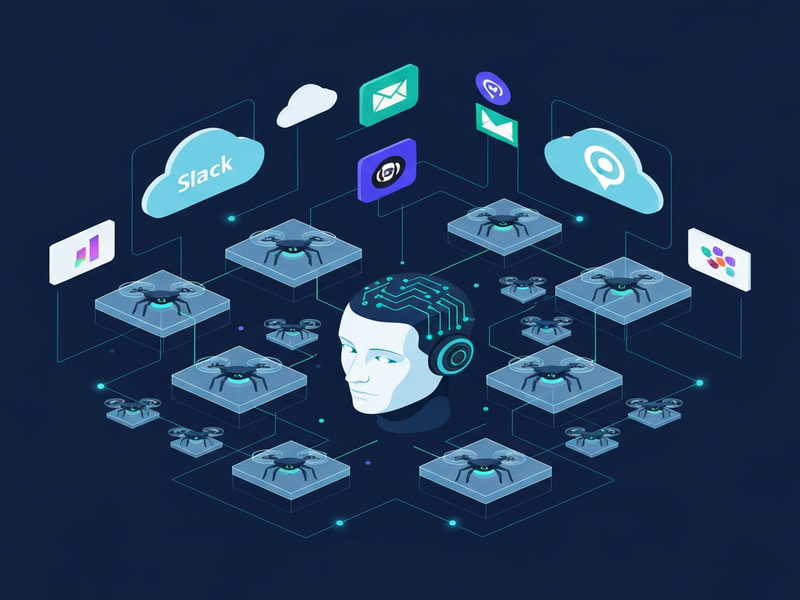
Figure: Real‑time monitoring dashboard for Agent Swarm, showing active agents, task queues, and inter‑agent chat.
Related UBOS Resources
While Agent Swarm handles AI orchestration, UBOS offers a suite of complementary tools that can extend its capabilities:
- UBOS homepage – Overview of the full platform.
- About UBOS – Company mission and team.
- AI tools – A catalog of ready‑made AI services.
- AI marketing agents – Automate copywriting, ad creation, and campaign analysis.
- UBOS partner program – Co‑sell and co‑develop AI solutions.
- UBOS platform overview – Core services, APIs, and security model.
- UBOS for startups – Fast‑track MVPs with AI‑first infrastructure.
- UBOS solutions for SMBs – Scalable AI automation for small businesses.
- Enterprise AI platform by UBOS – Governance, compliance, and multi‑tenant deployment.
- Web app editor on UBOS – Drag‑and‑drop UI builder for AI‑driven apps.
- Workflow automation studio – Visual orchestration of API calls, webhooks, and AI agents.
- UBOS pricing plans – Transparent, usage‑based pricing.
- UBOS portfolio examples – Real‑world case studies.
- UBOS templates for quick start – Pre‑built AI app blueprints.
- AI SEO Analyzer – Instantly audit site SEO with LLMs.
- AI Article Copywriter – Generate long‑form content at scale.
- AI Video Generator – Turn scripts into videos using generative models.
- GPT-Powered Telegram Bot – Deploy conversational agents on Telegram.
Conclusion & Next Steps
Agent Swarm bridges the gap between isolated LLMs and full‑stack development pipelines, delivering a self‑learning, container‑isolated, and highly extensible AI orchestration layer. Whether you’re a solo developer looking to automate repetitive coding chores or an enterprise seeking a compliant, auditable AI workforce, the framework provides a solid foundation that can grow with your ambitions.
Ready to experiment? Clone the repo, spin up the demo, and integrate it with your existing Workflow automation studio to create end‑to‑end AI‑driven CI/CD pipelines. For deeper guidance, explore the UBOS developer hub and join the community on Slack.
Start building your AI agent swarm today and turn autonomous code generation into a competitive advantage.