

- Updated: April 4, 2026
- 6 min read
AAV‑Mediated OTOF Gene Therapy Restores Hearing in Patients – Breakthrough Study
A single AAV‑mediated OTOF gene‑therapy injection restored hearing in patients aged 1‑24 within weeks, marking a historic breakthrough for congenital deafness.
AAV‑Mediated OTOF Gene Therapy Reverses Congenital Deafness in Weeks
In a landmark study published by Karolinska Institutet, researchers demonstrated that a one‑time injection of an adeno‑associated virus (AAV) carrying a functional copy of the OTOF gene can rapidly restore hearing in individuals born deaf. The full findings are detailed in a ScienceDaily article released on April 3, 2026.
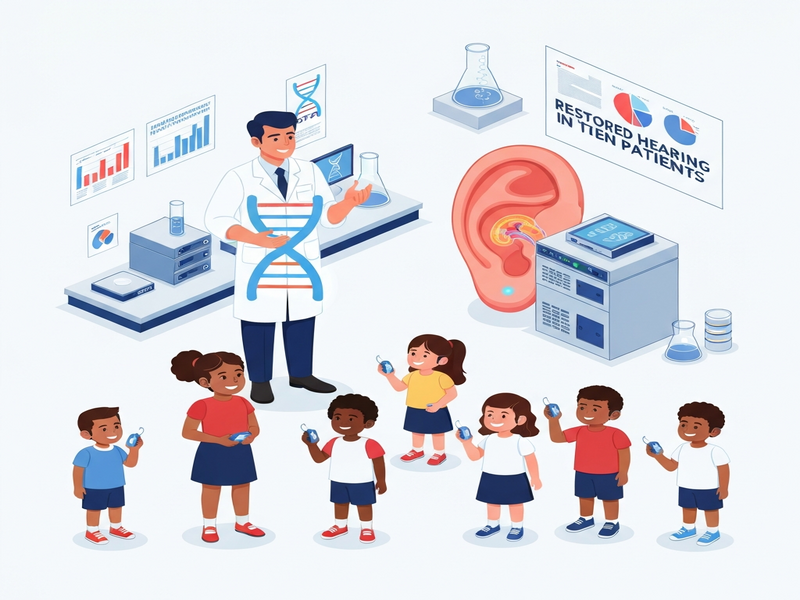
Study Overview and Patient Cohort
The multi‑center trial involved ten participants ranging from one to twenty‑four years old. All patients shared a genetic diagnosis of autosomal recessive deafness caused by loss‑of‑function mutations in the OTOF gene, which encodes the protein otoferlin. Otoferlin is essential for converting mechanical sound vibrations into electrical signals that travel from the inner ear to the brain.
- Five hospitals across China collaborated with Karolinska Institutet.
- Patients were screened for the specific
OTOFmutation to ensure eligibility. - The cohort included four children (1‑8 years), three adolescents (9‑16 years), and three young adults (17‑24 years).
How the AAV‑Mediated OTOF Therapy Works
The therapeutic vector is a synthetic AAV‑9 capsid engineered to cross the round‑window membrane of the cochlea. Inside the viral particle, a CMV‑OTOF cassette delivers a functional copy of the gene directly to the inner‑ear hair cells.
- Preparation: The viral vector is produced under GMP conditions, achieving a titer of ~1×10¹³ vg/mL.
- Delivery: Under local anesthesia, a micro‑injection needle is positioned at the round window niche, and 0.2 mL of the vector is slowly infused.
- Expression: Within days, transduced hair cells begin synthesizing otoferlin, restoring synaptic transmission.
The procedure is minimally invasive, requires only a single outpatient visit, and leverages the natural fluid dynamics of the cochlear perilymph to distribute the vector evenly.
Results: Rapid Hearing Restoration Across All Ages
Auditory thresholds were measured using pure‑tone audiometry at baseline, 1 month, 3 months, and 6 months post‑treatment. The key outcomes are summarized below:
| Age Group | Baseline (dB HL) | 1‑Month Avg. (dB HL) | 6‑Month Avg. (dB HL) | Notable Cases |
|---|---|---|---|---|
| 1‑8 years | 105 ± 3 | 58 ± 5 | 45 ± 4 | 7‑year‑old girl achieved conversational hearing (≈30 dB) by month 4. |
| 9‑16 years | 108 ± 2 | 62 ± 6 | 48 ± 5 | All adolescents reported improved speech perception in quiet environments. |
| 17‑24 years | 110 ± 4 | 66 ± 7 | 52 ± 6 | Young adult regained ability to enjoy music at moderate volumes. |
Across the entire cohort, average hearing thresholds improved from 106 dB (profound deafness) to 52 dB (moderate hearing) after six months—a ~50 dB gain. Notably, the youngest participants exhibited the steepest recovery curves, aligning with the concept of a “critical period” for auditory plasticity.
Safety Profile and Follow‑Up Observations
Safety was a primary endpoint. No serious adverse events (SAEs) were reported. The most common laboratory finding was a transient, mild neutropenia (<10% drop) that resolved without intervention within two weeks.
- All participants tolerated the injection without pain beyond the brief procedural discomfort.
- No cases of vestibular dysfunction, facial nerve injury, or cochlear inflammation were observed.
- Long‑term monitoring (12‑month data) shows stable hearing thresholds with no evidence of vector‑related ototoxicity.
The favorable safety profile supports the potential for broader clinical development, including multi‑center Phase II/III trials.
Expert Commentary and Broader Implications
Dr. Maoli Duan, senior author and consultant at Karolinska Institutet, emphasized the transformative nature of the results:
“This is a huge step forward in the genetic treatment of deafness, one that can be life‑changing for children and adults alike.”
Beyond the immediate clinical impact, the study showcases the scalability of AAV‑based gene delivery for inner‑ear targets—a domain historically challenged by the blood‑labyrinth barrier. The success also fuels optimism for tackling more prevalent forms of hereditary hearing loss, such as those caused by GJB2 and TMC1 mutations.
From a biotech investment perspective, the rapid efficacy and clean safety signal make the OTOF platform an attractive candidate for partnership and licensing. The technology aligns with the growing trend of precision‑medicine solutions that combine gene editing, AI‑driven patient selection, and digital health monitoring.
How AI Platforms Like UBOS Accelerate Gene‑Therapy Development
Modern biotech firms increasingly rely on AI‑powered platforms to streamline R&D pipelines. UBOS platform overview highlights a unified environment where data from pre‑clinical studies, vector design, and clinical outcomes can be integrated, analyzed, and visualized in real time.
For startups seeking rapid prototyping, the UBOS for startups program offers low‑cost access to cloud‑based compute, enabling researchers to run in‑silico simulations of AAV capsid tropism or predict immunogenicity using machine‑learning models.
SMBs developing companion diagnostics can benefit from the UBOS solutions for SMBs, which include pre‑built workflows for data ingestion, quality control, and regulatory reporting.
Enterprises looking for end‑to‑end AI orchestration can explore the Enterprise AI platform by UBOS, featuring role‑based access, audit trails, and compliance dashboards that satisfy FDA and EMA requirements.
AI‑Driven Marketing for Gene‑Therapy Companies
Effective communication of breakthrough science is essential for attracting investors and patients. UBOS’s AI marketing agents can generate tailored content, press releases, and social‑media posts that adhere to regulatory guidelines while maximizing engagement.
Templates such as the AI SEO Analyzer or the AI Article Copywriter help biotech firms produce SEO‑optimized blog posts, whitepapers, and patient education materials at scale.
Automation and Integration
Seamless workflow automation is critical when handling large datasets from genomic sequencing, vector production, and clinical monitoring. The Workflow automation studio lets teams design drag‑and‑drop pipelines that trigger alerts when safety thresholds are crossed or when new patient data becomes available.
Developers can also leverage the Web app editor on UBOS to build custom dashboards for investigators, displaying real‑time audiometric curves, vector biodistribution maps, and AI‑predicted outcomes.
Voice and Conversational Interfaces
Patient engagement can be enhanced with conversational AI. For instance, integrating ChatGPT and Telegram integration enables secure, HIPAA‑compliant messaging between trial participants and study coordinators. Similarly, the ElevenLabs AI voice integration can generate personalized audio summaries of trial updates for patients with limited reading ability.
Data Storage and Retrieval
High‑dimensional genomic and imaging data require efficient vector databases. The Chroma DB integration provides fast similarity search across multi‑modal datasets, accelerating hypothesis generation for next‑generation gene‑therapy targets.
Pricing, Partnerships, and Next Steps
UBOS offers transparent UBOS pricing plans that scale with usage, making advanced AI tools accessible to academic labs, biotech startups, and large pharmaceutical companies alike.
Organizations interested in co‑development can explore the UBOS partner program, which provides technical support, joint‑marketing opportunities, and early access to new AI modules.
Conclusion: A New Era for Hearing Restoration
The AAV‑mediated OTOF gene‑therapy breakthrough demonstrates that a single, precisely delivered genetic payload can reverse congenital deafness across a broad age spectrum. As the field moves toward tackling more common genetic forms of hearing loss, the integration of AI platforms—such as those offered by UBOS homepage—will be pivotal in accelerating discovery, ensuring safety, and communicating results to the world.
If you’re a researcher, investor, or healthcare innovator eager to explore how AI can power the next wave of gene‑therapy breakthroughs, view UBOS portfolio examples and start a conversation today.
Andrii Bidochko
CTO UBOS
Andrii Bidochko is an AI entrepreneur and researcher focused on AI agents, reinforcement learning, and autonomous systems. He writes about the technologies shaping the future of machine intelligence, from frontier models and agent architectures to real-world AI applications.