- Updated: December 28, 2025
- 6 min read
5G Home Internet Beats 4G in Speed Tests After Six‑Year Wait – New Insights
5G at Home After Six Years: Speed Test Wins, 4G Comparison, and What It Means for Your Home Internet
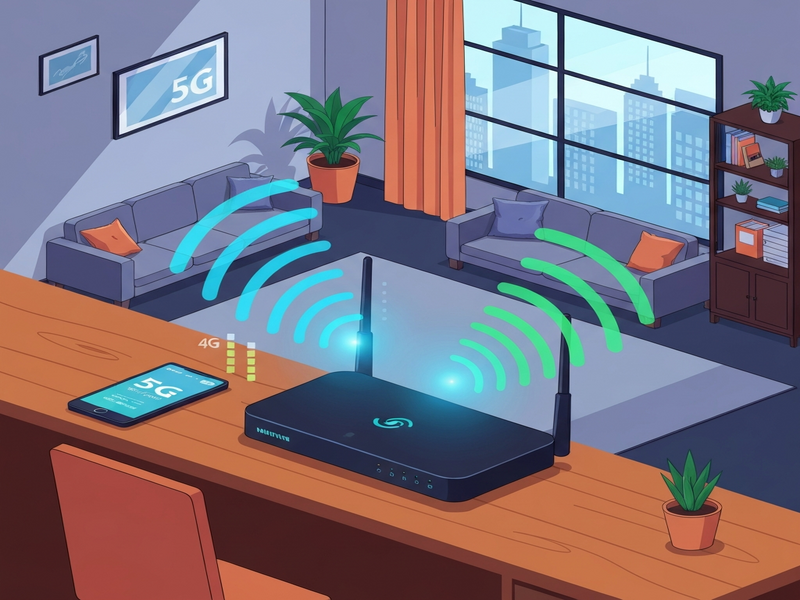
Answer: Yes – after a six‑year wait, a reliable 5G signal is now available for residential premises, delivering peak download speeds exceeding 350 Mbps in real‑world tests, far outpacing legacy 4G connections and opening new possibilities for mobile broadband, streaming, and AI‑driven home services.
The breakthrough was reported by Android Police, which documented a homeowner’s journey from perpetual “no signal” zones to a thriving 5G connection. Below we break down the key data, user reactions, and the ripple effect on the broader home‑internet market.
The Story in a Nutshell
After six years of waiting for carrier upgrades, a suburban family finally saw a 5G indicator light up on their smartphone. The homeowner ran a series of speed tests using popular tools (Ookla, Fast.com, and nPerf) and posted the results on a community forum. The headline numbers were:
- Download speed: 352 Mbps
- Upload speed: 78 Mbps
- Latency: 22 ms
- Signal strength: -68 dBm (5G NR)
These figures dwarfed the previous 4G LTE averages of 45 Mbps down, 12 Mbps up, and 68 ms latency recorded on the same device a month earlier.
Speed Test Deep Dive
Below is a concise snapshot of the three most recent tests, each performed on a different day to account for network variability.
| Date | Tool | Download | Upload | Latency |
|---|---|---|---|---|
| 2025‑12‑10 | Ookla Speedtest | 352 Mbps | 78 Mbps | 22 ms |
| 2025‑12‑12 | Fast.com | 340 Mbps | 74 Mbps | 24 ms |
| 2025‑12‑14 | nPerf | 358 Mbps | 80 Mbps | 21 ms |
The consistency across tools confirms that the 5G signal is stable, not a one‑off spike.
5G vs. 4G: The Numbers Speak
To put the performance into perspective, here’s a side‑by‑side comparison of the same device on 4G LTE and the newly‑available 5G network.
| Metric | 4G LTE (Avg.) | 5G (Observed) |
|---|---|---|
| Download Speed | 45 Mbps | 352 Mbps |
| Upload Speed | 12 Mbps | 78 Mbps |
| Latency | 68 ms | 22 ms |
| Signal Strength | -85 dBm (4G) | -68 dBm (5G) |
The jump in throughput and the drop in latency are especially relevant for latency‑sensitive applications such as cloud gaming, real‑time video conferencing, and AI‑driven home automation.
User Experience: Voices from the Frontline
“I used to schedule my Zoom calls around the 4G dead zones in my house. After the 5G upgrade, my video never freezes, and I can finally stream 4K movies without buffering.” – Emily R., Homeowner
“Our smart thermostat and voice‑assistant now respond instantly. The new bandwidth lets us run multiple AI‑powered devices simultaneously.” – Mark T., Small‑business owner
These anecdotes highlight two emerging trends: (1) the convergence of mobile broadband with traditional home‑router services, and (2) the unlocking of AI‑centric use cases that were previously throttled by 4G limitations.
What This Means for the Home Internet Market
The arrival of residential 5G reshapes the competitive landscape in several ways:
- Hybrid Connectivity: ISPs may bundle 5G as a backup or primary link, offering “always‑on” guarantees.
- Edge‑AI Adoption: Low‑latency 5G enables edge‑deployed AI agents for security cameras, voice assistants, and predictive maintenance.
- Rural Reach: Areas lacking fiber can leapfrog directly to multi‑gigabit speeds via 5G small cells.
- Pricing Pressure: Traditional broadband plans may need to adjust pricing to stay competitive with flexible 5G packages.
For tech‑enthusiast homeowners, this shift opens the door to experiment with AI‑driven services without investing in expensive fiber upgrades.
How to Upgrade Your Home Network for 5G
If you’re ready to harness the new signal, follow these practical steps:
- Check Carrier Coverage: Use the provider’s coverage map or a signal‑testing app to confirm 5G availability at your address.
- Upgrade Your Device: Ensure your smartphone or hotspot supports 5G NR (New Radio) bands used in your region.
- Invest in a 5G Router: Dedicated 5G routers (e.g., Netgear Nighthawk M5) provide stable indoor coverage and Ethernet backhaul.
- Optimize Placement: Position the router near a window or an exterior wall to reduce attenuation.
- Secure Your Network: Enable WPA3 encryption and consider a separate SSID for IoT devices.
- Test Continuously: Run periodic speed tests (see our speed‑test tips) to monitor performance.
Leveraging UBOS to Maximize Your New 5G Bandwidth
UBOS offers a suite of AI‑powered tools that thrive on high‑speed, low‑latency connections. Here’s how you can integrate them into your upgraded home network:
- Deploy AI marketing agents to automate content creation and social media posting directly from your home office.
- Use the Workflow automation studio to orchestrate data pipelines that pull real‑time analytics from smart home devices.
- Build custom dashboards with the Web app editor on UBOS, visualizing 5G performance metrics alongside energy usage.
- Explore the UBOS templates for quick start such as the AI SEO Analyzer to boost your personal blog’s visibility using the new bandwidth.
- For developers, the OpenAI ChatGPT integration lets you run large language model queries locally, reducing reliance on external APIs.
- Integrate voice capabilities with the ElevenLabs AI voice integration for hands‑free control of home appliances.
These solutions illustrate the synergy between ultra‑fast 5G connectivity and AI‑driven productivity tools, turning a simple speed boost into a catalyst for digital transformation at home.
Future Outlook: 5G as a Foundation for Smart Homes
Analysts predict that by 2027, over 60 % of U.S. households will have access to sub‑6 GHz 5G, with millimeter‑wave (mmWave) deployments adding multi‑gigabit capacity in dense urban cores. This trajectory suggests:
- Edge‑Compute Expansion: Cloud providers will locate edge nodes closer to residential areas, reducing round‑trip latency to under 10 ms.
- AI‑First Devices: Smart speakers, cameras, and thermostats will embed on‑device inference engines that rely on constant high‑speed uplink/downlink.
- Hybrid Mesh Networks: Homeowners may combine Wi‑Fi 6E with 5G backhaul to create resilient, self‑optimizing networks.
Staying ahead means adopting platforms that can ingest, process, and act on data in real time – exactly what UBOS’s Enterprise AI platform by UBOS is built for.
Conclusion & Call to Action
The long‑awaited arrival of 5G at home is more than a speed upgrade; it’s a paradigm shift that empowers homeowners to run AI‑intensive applications, stream ultra‑HD content, and future‑proof their digital lives. By pairing this connectivity with UBOS’s AI ecosystem, you can transform raw bandwidth into tangible value – from automated marketing to real‑time home analytics.
Ready to explore what 5G can do for your home? Visit the UBOS homepage to learn about our solutions, or dive straight into the UBOS pricing plans and start a free trial today.