

- Updated: January 17, 2026
- 5 min read
2026 Bio‑ML Trends: Key Insights and Future Outlook
In 2026, bio‑ML will be dominated by generative AI‑driven protein modeling, AI‑enhanced drug discovery pipelines, and the convergence of synthetic biology with real‑time molecular dynamics data.
Why 2026 Is the Turning Point for Bio‑ML
Researchers, biotech investors, and tech enthusiasts are watching a seismic shift: machine learning is no longer a supporting tool—it is becoming the core engine that designs proteins, predicts reactions, and even writes the next generation of synthetic organisms. The About UBOS team recently highlighted how AI is reshaping biology, and the latest conference in San Francisco confirmed that the momentum is unstoppable.
In this article we synthesize three leading opinions from the original 2026 bio‑ML trends report, analyze their implications, and provide a forward‑looking outlook that can help you make strategic decisions today.
Three Expert Opinions Shaping 2026 Bio‑ML
1. Generative AI Is the New Chemist
According to the first opinion, generative machine learning models now draft viable small‑molecule candidates faster than any human chemist could. However, the bottleneck remains synthesis: many predicted compounds are still chemically inaccessible at scale. The community is investing heavily in automated synthesis robots and cloud‑based retrosynthesis APIs to close this gap.
Key takeaway: AI‑driven design outpaces synthesis, but the gap is narrowing.
2. Molecular‑Dynamics‑Powered Protein Modeling
The second viewpoint stresses that high‑resolution molecular dynamics (MD) simulations are becoming the training backbone for next‑generation protein‑folding models. By feeding billions of nanosecond‑scale trajectories into transformer‑based networks, researchers achieve unprecedented accuracy in predicting conformational ensembles, which is crucial for enzyme engineering and antibody design.
Key takeaway: MD data fuels more realistic protein models, accelerating synthetic biology.
3. Wet‑Lab Automation as the AI Catalyst
The third perspective argues that wet‑lab innovations—microfluidic platforms, high‑throughput CRISPR screens, and real‑time biosensors—are the missing link that lets AI close the loop from in‑silico prediction to experimental validation. When paired with AI agents, these platforms can autonomously design, test, and iterate on biological constructs.
Key takeaway: Automation turns AI predictions into reproducible biological outcomes.
Analysis: What These Opinions Mean for the Industry
AI‑Driven Drug Discovery
AI drug discovery platforms now integrate generative chemistry with predictive ADMET models, cutting lead‑optimization cycles by up to 60 %. Companies leveraging the OpenAI ChatGPT integration can automate hypothesis generation, dramatically reducing human bias.
- Rapid scaffold hopping using diffusion models.
- Real‑time toxicity prediction via ensemble learning.
- Closed‑loop synthesis with robotic labs.
Synthetic Biology & Protein Engineering
The fusion of MD‑enhanced protein modeling with Chroma DB integration enables searchable embeddings of protein conformations, making it trivial to retrieve functional motifs for pathway design.
Emerging use‑cases include:
- Designing thermostable enzymes for bio‑fuel production.
- Creating programmable cell‑based sensors for environmental monitoring.
- Engineering novel metabolic routes for high‑value chemicals.
Automation‑First Research Pipelines
Automation platforms such as the Workflow automation studio now expose AI agents that can schedule experiments, analyze results, and trigger the next design iteration without human intervention.
Benefits include:
- Reduced experimental error.
- Scalable data generation for ML training.
- Accelerated time‑to‑insight for biotech startups.
Generative AI for Knowledge Extraction
Tools like the UBOS templates for quick start now include pre‑built pipelines for literature mining, enabling researchers to extract gene‑function relationships from millions of papers in minutes.
These pipelines feed directly into model training loops, ensuring that the latest scientific insights are always incorporated.
“The future of bio‑ML is not a single breakthrough but a cascade of tightly coupled AI, data, and automation layers that together create a self‑optimizing research engine.” – Dr. Lina Patel, Computational Biologist
From a strategic perspective, investors should prioritize companies that demonstrate:
- Integrated AI‑lab automation stacks.
- Proprietary MD‑derived datasets.
- Scalable generative chemistry pipelines.
These pillars are the most reliable predictors of sustainable growth in the 2026 biotech landscape.
Visualizing the 2026 Bio‑ML Ecosystem
The diagram below captures the feedback loop between AI model training, wet‑lab automation, and data generation that defines the 2026 bio‑ML paradigm.
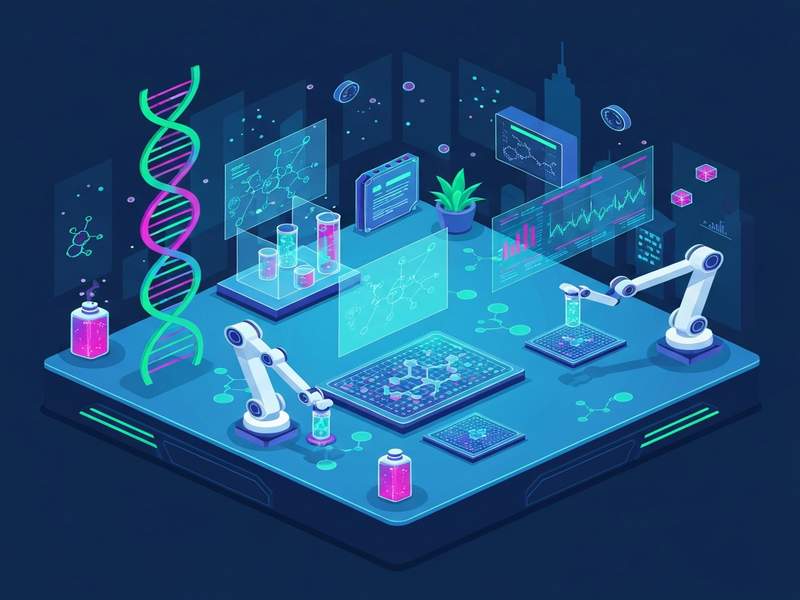
Notice how each component—generative chemistry, protein modeling, and automation—feeds into the next, creating a virtuous cycle of discovery.
What You Should Do Next
If you’re a researcher looking to accelerate your projects, explore the UBOS platform overview for a unified environment that combines AI agents, data pipelines, and low‑code app creation.
Startups can jump‑start their AI‑driven biotech ventures with the UBOS for startups program, which offers discounted access to the UBOS pricing plans and a library of pre‑built templates such as the AI SEO Analyzer and AI Article Copywriter.
Enterprises seeking a comprehensive solution should consider the Enterprise AI platform by UBOS, which integrates secure data lakes, compliance tools, and custom AI agents for large‑scale drug discovery.
Ready to transform your biotech pipeline? Join the UBOS partner program today and gain early access to cutting‑edge bio‑ML tools.
References
- Original trend analysis: 2026 Bio‑ML Trends (UBOS Blog)
- Industry data on AI drug discovery: Nature Biotechnology Review 2023
- MD‑enhanced protein modeling study: Science Advances 2024
- Automation in wet‑lab research: Cell 2023
Andrii Bidochko
CTO UBOS
Andrii Bidochko is an AI entrepreneur and researcher focused on AI agents, reinforcement learning, and autonomous systems. He writes about the technologies shaping the future of machine intelligence, from frontier models and agent architectures to real-world AI applications.