

- Updated: March 27, 2026
- 7 min read
AI Documentary Puts CEOs in the Hot Seat – A Deep Dive into Risks and Hype
The AI Doc is a new documentary that explores the promises and perils of artificial intelligence by interviewing leading AI CEOs, dissecting hype, and urging citizens to shape AI governance.
Why the documentary matters now
As AI systems move from research labs into everyday products, public understanding has never been more critical. The film’s debut was covered in a detailed Wired article that highlighted its blend of personal storytelling and high‑level industry insight. This article summarizes that coverage, adds context from the broader AI ecosystem, and points readers toward practical resources for navigating the AI wave.
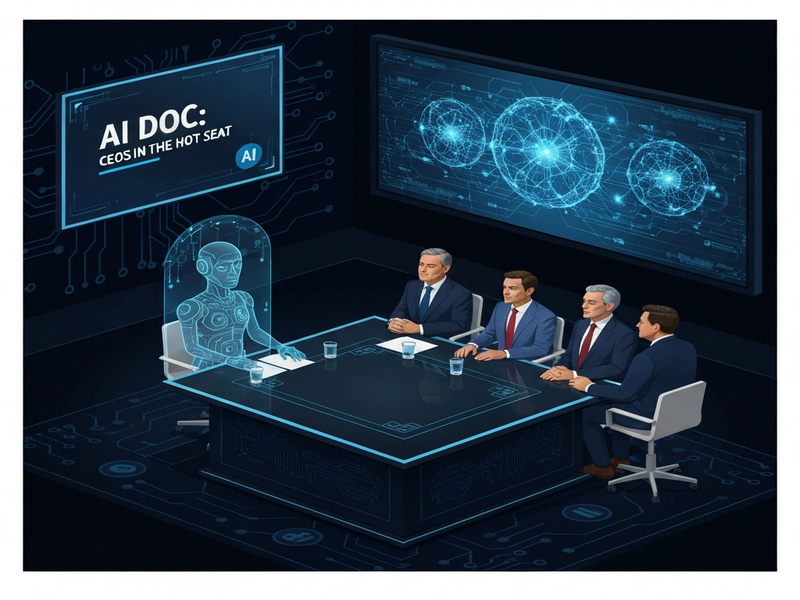
Figure: A glimpse of the documentary’s interview set.
Documentary premise and filmmaker intent
Director Daniel Roher, known for the Oscar‑winning Navalny, frames The AI Doc around a personal dilemma: the impending birth of his first child. He asks, “What kind of world will my son inherit?” The film then follows his quest to interview the architects of modern AI—OpenAI’s Sam Altman, Anthropic’s Dario Amodei, DeepMind’s Demis Hassabis, and others—to uncover how their visions translate into real‑world impact.
Roher’s method is deliberately low‑tech. He intersperses interviews with hand‑drawn sketches, stop‑motion sequences, and candid family moments, creating a human‑centric narrative that contrasts sharply with the glossy corporate presentations typical of tech PR.
The filmmaker’s stated goal is two‑fold: demystify the technical jargon that surrounds large language models (LLMs) and spark a public conversation about AI governance before the technology becomes entrenched beyond easy correction.
Key interviews: What the AI CEOs said
- Sam Altman (OpenAI) – When asked why the public should trust him with AI’s rapid acceleration, Altman replied, “You shouldn’t.” The moment was left hanging, underscoring a tension between responsibility and confidence that many CEOs avoid.
- Dario Amodei (Anthropic) – Emphasized “constitutional AI” as a safety layer, yet offered few concrete timelines for deployment, leaving viewers to wonder if the approach is more philosophical than practical.
- Demis Hassabis (DeepMind) – Highlighted DeepMind’s work on protein folding and climate modeling, positioning AI as a force for good, but admitted that “the next breakthrough could be a double‑edged sword.”
- Tristan Harris (Center for Humane Technology) – Delivered a stark warning: “I know people who work on AI risk who don’t expect their children to make it to high school.” His comment frames AI risk as a societal, not just technical, issue.
- Reid Hoffman (Investor) – Described AI’s near‑term impact as “as significant as nuclear weapons,” yet couched the statement in vague terms, suggesting benefits will outweigh “unspecified harms.”
While each interviewee offers a polished soundbite, the documentary reveals a common pattern: CEOs acknowledge risk but rarely provide actionable mitigation strategies. This gap fuels the film’s central call to action.
Beyond the hype: A critical look at the documentary’s tone
Roher’s narrative balances optimism with dread, but the balance sometimes leans toward melodrama. The stop‑motion sequences, reminiscent of AI marketing agents in a whimsical setting, soften the gravity of the subject. Critics argue this aesthetic choice may dilute the urgency of the policy discussion.
Moreover, the film’s interrogation style often stops at surface‑level answers. When Roher asks Altman why the public should trust AI leadership, the response is a non‑answer. The documentary rarely pushes CEOs to quantify the “unspecified harms” mentioned by investors like Reid Hoffman, leaving viewers with more questions than solutions.
Nonetheless, the film excels at translating technical concepts into plain language. Roher defines “large language model” as “a system that predicts the next word in a sentence,” a definition that even non‑technical audiences can grasp. This clarity is essential for broader public engagement.
Call to action: Why citizens must engage in AI governance
The documentary concludes with a rallying cry: ordinary people must pressure governments and corporations to steer AI toward “the safest, narrowest path toward prosperity.” Roher frames this as a democratic responsibility, echoing the sentiment that “the Golden Gate Bridge was built by collective will, not by a single billionaire.”
Practical steps for engagement include:
- Support transparent AI policy initiatives at local and national levels.
- Demand clear safety audits from AI providers before adopting new tools.
- Educate yourself on AI fundamentals using free resources—UBOS offers a dedicated AI documentary guide that breaks down the technology.
- Leverage AI‑powered productivity tools responsibly; for example, the OpenAI ChatGPT integration can automate routine tasks while keeping human oversight.
By turning awareness into action, the public can help shape regulations that prevent a “Ponzi‑like” AI rush and ensure that benefits—such as medical breakthroughs and climate modeling—are realized without compromising safety.
How UBOS helps you navigate the AI landscape
For tech‑savvy professionals looking to experiment with AI responsibly, UBOS provides a suite of low‑code tools that embed safety checks directly into workflows. The UBOS platform overview explains how developers can spin up AI‑enhanced apps without writing extensive code.
Startups can accelerate time‑to‑market with UBOS templates for quick start, such as the AI Article Copywriter template, which generates SEO‑friendly content while allowing editors to review and edit for factual accuracy.
SMBs benefit from the UBOS solutions for SMBs, which include built‑in compliance modules that log data provenance—an essential feature for meeting emerging AI governance standards.
Enterprises seeking a holistic AI strategy can explore the Enterprise AI platform by UBOS. It integrates with popular services like Chroma DB integration for vector search and ElevenLabs AI voice integration for accessible user experiences.
Pricing transparency is key for budgeting AI projects; the UBOS pricing plans page outlines tiered options, from free developer sandboxes to enterprise‑grade support.
AI tools spotlighted in the film and their UBOS equivalents
The documentary references several cutting‑edge AI services that are now accessible through UBOS:
- AI SEO Analyzer – Used by marketers to audit website content. UBOS offers an AI SEO Analyzer template that integrates directly with the Workflow automation studio.
- AI Video Generator – Demonstrated for rapid prototyping of visual content. UBOS’s AI Video Generator template lets creators produce short clips with brand‑consistent assets.
- AI Chatbot – Featured as a customer‑service front‑line. The AI Chatbot template can be deployed on web, Telegram, or Slack with a single click.
- GPT‑Powered Telegram Bot – Highlighted for real‑time interaction. UBOS provides a ready‑made GPT‑Powered Telegram Bot that integrates the Telegram integration on UBOS.
By leveraging these pre‑built modules, developers can focus on policy‑compliant design rather than reinventing core AI functionality.
Conclusion: The AI Doc as a catalyst for informed governance
The AI Doc succeeds in translating a complex, high‑stakes debate into a personal story that resonates with both technologists and laypeople. While the film stops short of demanding concrete policy proposals, it effectively shines a spotlight on the governance vacuum that currently exists.
For readers who want to move from awareness to action, the combination of public advocacy and practical tools—such as those offered by UBOS—creates a clear pathway. Whether you are a startup founder, an SMB decision‑maker, or an enterprise AI leader, the resources listed above can help you embed safety, transparency, and accountability into every AI project.
The documentary’s ultimate message is simple: the future of AI will be written not only in code but also in the collective choices of citizens, regulators, and businesses. By staying informed, demanding responsible practices, and using platforms that prioritize ethical AI, we can ensure that the world our children inherit is one where artificial intelligence amplifies human potential rather than undermines it.
Explore more AI‑focused content on UBOS:
UBOS portfolio examples,
About UBOS,
and the UBOS partner program.
Andrii Bidochko
CTO UBOS
Andrii Bidochko is an AI entrepreneur and researcher focused on AI agents, reinforcement learning, and autonomous systems. He writes about the technologies shaping the future of machine intelligence, from frontier models and agent architectures to real-world AI applications.