

- Updated: April 2, 2026
- 6 min read
Subscription Bombing Threatens Sign‑Up Form Security: Web Security Insights
Subscription bombing is a malicious technique where automated bots repeatedly sign up a victim’s email address on dozens or hundreds of websites, flooding the inbox with unwanted verification, welcome, and password‑reset messages.
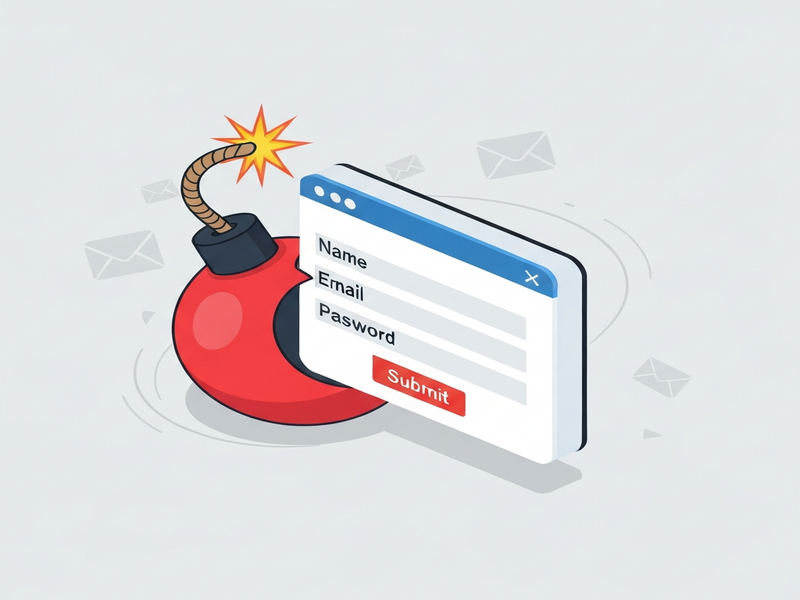
Subscription Bombing, Sign‑Up Form Security, and Web Security: What Every Developer Must Know
What Is Subscription Bombing?
In a subscription‑bombing campaign, attackers target the sign‑up form security of SaaS platforms, newsletters, and e‑commerce sites. By submitting a real victim’s email address with a random or garbage username, the bot triggers three automated emails within seconds:
- Account verification email
- Welcome or onboarding email
- Password‑reset email (often generated by a second request)
The result is a deluge of messages that drowns out legitimate communications such as banking alerts, password changes, or two‑factor authentication codes. The victim may miss a critical security notification, leading to account takeover or financial loss.
How Attackers Exploit Sign‑Up Forms
Most public sign‑up forms accept any email address without immediate verification. This openness is a convenience for genuine users but also a low‑cost entry point for bots.
Bot Behavior and Timing
Bots are programmed to mimic human typing patterns just enough to evade simple heuristics. They:
- Enter characters one at a time with random delays (0.5‑1.2 seconds per keystroke).
- Pause between form fields to simulate thinking.
- Navigate to the “Forgot password” page after registration and request a reset within 60 seconds.
This “slow‑and‑steady” approach keeps request rates below typical rate‑limiting thresholds, making detection harder.
Lack of Immediate Email Verification
When a site sends a welcome email before the user clicks a verification link, the bot’s victim receives multiple unsolicited messages instantly. If the platform also sends a password‑reset email without confirming ownership, the inbox receives three distinct messages from a single sign‑up.
Detection Methodology and Evidence
Security teams can spot subscription bombing by correlating anomalies across user activation metrics and email logs. The original investigation highlighted several tell‑tale signs:
- Sudden spikes in inactive accounts with random usernames (e.g.,
PfVQXvYTXjwSbEeJBjXYy). - High page‑view counts on the “Forgot password” endpoint from the same IP ranges that performed the sign‑up.
- Geographically dispersed traffic with no correlation to typical user time zones.
By cross‑referencing these patterns with email delivery reports, analysts confirmed that each victim received three emails within a minute. The full story is documented in the source article: Subscription Bombing: Your Sign‑Up Form Is a Weapon.
Mitigation Measures
Effective defenses combine network‑level filtering, intelligent CAPTCHAs, and strict email verification workflows.
1. Firewall Rules & Bot Management
Deploy a web‑application firewall (WAF) that blocks known bot signatures and enforces challenge‑response for suspicious traffic. While basic rate limiting is insufficient, a rule set that flags “one request per hour from a new IP” can reduce noise.
2. Cloudflare Turnstile CAPTCHA
Turnstile provides an invisible, behavior‑based challenge that only surfaces when risk scores exceed a threshold. Integration steps:
- Enable Turnstile on the sign‑up, sign‑in, and forgot‑password pages.
- Pass the generated token to the backend via a custom header.
- Reject submissions lacking a valid token.
This approach stopped bot registrations in the original case study within minutes.
3. Email Verification‑First Policy
Send **only** a verification email after sign‑up. Defer all welcome, onboarding, and promotional messages until the user clicks the verification link. For social‑login flows (Google, GitHub), the provider already validates the email, so immediate welcome messages are safe.
4. Rate Limiting & IP Reputation
Implement per‑IP and per‑email throttling:
- Maximum of three sign‑up attempts per email address per hour.
- Block IPs that generate more than five sign‑up attempts across distinct emails within ten minutes.
5. AI‑Driven Threat Detection
Leverage machine‑learning models that analyze request headers, mouse movements, and timing patterns. Our AI‑driven threat detection service can flag anomalous sign‑up flows in real time, allowing security teams to intervene before inboxes are flooded.
Broader Implications for Sign‑Up Form Security and Web Security
Subscription bombing illustrates a shift from traditional denial‑of‑service attacks to “noise‑as‑a‑service” attacks that target the victim’s communication channels. The consequences extend beyond user annoyance:
- Reputation Damage: Email service providers may flag your domain for high bounce or spam rates.
- Legal Exposure: Regulations such as GDPR and CAN‑SPAM require consent before sending marketing emails.
- Operational Overhead: Support teams spend time handling abuse reports and cleaning polluted user databases.
Addressing these risks aligns with core web security best practices, including principle‑of‑least‑privilege for API endpoints, secure defaults for email workflows, and continuous monitoring.
Actionable Checklist for Developers and Security Teams
- Audit all public sign‑up forms for missing email verification steps.
- Integrate an invisible CAPTCHA like Cloudflare Turnstile on authentication flows.
- Configure your WAF to challenge traffic with abnormal typing patterns.
- Implement per‑email and per‑IP throttling thresholds.
- Enable AI‑driven anomaly detection for real‑time alerts.
- Log and monitor “forgot password” requests for spikes.
- Regularly review email deliverability reports for sudden spikes.
Next Steps with UBOS
UBOS offers a suite of tools to harden your sign‑up flow:
- UBOS platform overview – a low‑code environment that lets you embed Turnstile and custom validation logic without writing extensive backend code.
- Workflow automation studio – automate email verification pipelines and incident response playbooks.
- UBOS pricing plans – choose a tier that includes AI‑driven threat detection and advanced WAF rules.
By adopting these solutions, you can protect both your users and your brand from the growing threat of subscription bombing.
Conclusion
Subscription bombing exploits weak sign‑up form security to weaponize email inboxes, turning a harmless registration process into a vector for large‑scale harassment and credential theft. Detecting the attack requires careful analysis of user activation data, while mitigation hinges on a layered approach: firewall rules, invisible CAPTCHAs, strict email verification, and AI‑driven monitoring. Implementing these safeguards not only shields victims but also upholds the integrity of your web services.
For a deeper dive into the original incident, refer to the source article: Subscription Bombing: Your Sign‑Up Form Is a Weapon.
Andrii Bidochko
CTO UBOS
Andrii Bidochko is an AI entrepreneur and researcher focused on AI agents, reinforcement learning, and autonomous systems. He writes about the technologies shaping the future of machine intelligence, from frontier models and agent architectures to real-world AI applications.