

- Updated: March 28, 2026
- 5 min read
Mathematicians Boycott 2026 International Congress Over US Policies
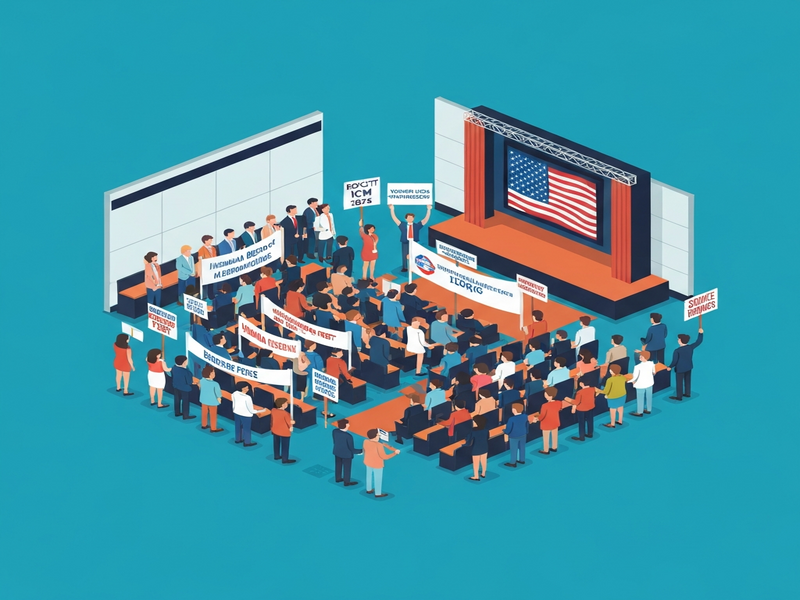
Mathematicians are boycotting the 2026 International Congress of Mathematicians (ICM) in Philadelphia because they view U.S. immigration policies, recent military actions, and human‑rights concerns as incompatible with the congress’s mission of fostering global scientific unity.
Introduction: A historic protest in the making
The mathematics community, traditionally known for its collaborative spirit, is confronting a moral crossroads. More than 1,500 researchers have signed a petition demanding that the ICM be relocated outside the United States. The movement, sparked by recent U.S. foreign‑policy decisions and aggressive immigration enforcement, has quickly become a flashpoint for broader debates about academic freedom, human rights, and the responsibility of scientific societies.
Background: What the ICM is and why 2026 matters
The International Congress of Mathematicians
Since its inception in 1897, the ICM has served as the premier gathering for mathematicians worldwide. Held every four years, the congress showcases breakthrough research, awards the prestigious Fields Medal, and sets the agenda for future mathematical inquiry. Its rotating venues have historically reflected a commitment to geographic diversity and international cooperation.
Why the 2026 venue is controversial
Philadelphia marks the first U.S. host in four decades, a milestone that should have been celebrated. Instead, the location has ignited controversy because of three intertwined issues:
- U.S. military interventions in Venezuela and Iran, which many mathematicians view as violations of international law.
- The suspension of visas for citizens of more than 75 countries, creating barriers for scholars from the Global South.
- The pervasive presence of Immigration and Customs Enforcement (ICE) agents in major U.S. cities, raising safety concerns for international attendees.
Petition and mathematicians’ concerns
The petition, launched in early March, outlines a clear set of demands:
- Relocate the congress to a country that upholds the principles of free academic exchange.
- Secure a visa‑free travel corridor for participants from nations currently under U.S. travel bans.
- Obtain a public commitment from the International Mathematical Union (IMU) to prioritize human‑rights considerations in future venue selections.
Signatories include more than 50 former Fields Medalists and a cross‑section of leading researchers from Europe, Asia, Africa, and the Americas. Their collective voice reflects a growing sentiment that scientific gatherings cannot be insulated from geopolitical realities.
Reactions from societies and institutions
National societies weigh in
The French Mathematical Society (UBOS for startups) was among the first to announce a boycott, citing concerns for its members traveling from the Global South. The Society of Mathematical Sciences in Canada issued a statement urging the IMU to “listen to the collective conscience of the global mathematics community.”
International bodies respond
The IMU, which oversees the ICM, has not yet issued a formal response. However, the UBOS partner program released a brief comment emphasizing the importance of “transparent decision‑making that respects the diverse needs of the worldwide research community.” The Simons Foundation, a major sponsor of the 2026 congress, declined to comment for publication.
Significance and broader implications
Academic freedom meets human rights
The boycott underscores a pivotal shift: scholars are no longer willing to separate their scientific work from the ethical context of the host nation. This mirrors earlier protests, such as the 1950 ICM in Cambridge, Massachusetts, which faced criticism over Cold‑War visa restrictions. Historian Michael J. Barany notes that “internationalism in science has always been a negotiation between ideals and real‑world politics.”
A precedent for future conferences
If the IMU decides to relocate the congress, it could set a new standard for how academic societies evaluate venue suitability. The decision may influence other high‑profile gatherings, from the International Conference on Machine Learning (ICML) to the World Economic Forum, prompting them to adopt more rigorous human‑rights screening processes.
Conclusion and call to action
The mathematicians’ boycott of the 2026 ICM is more than a logistical dispute; it is a moral statement that the global research community will not tolerate policies that undermine the free exchange of ideas. Scholars, institutions, and funding bodies are urged to:
- Amplify the petition’s demands through academic networks and social media.
- Engage with the IMU to seek a transparent, rights‑based venue selection process.
- Support alternative platforms—such as virtual workshops and Web app editor on UBOS—that can host collaborative research without geographic constraints.
For a deeper dive into the original reporting, read the Scientific American article. The outcome of this protest will shape not only the future of the ICM but also the broader conversation about the responsibilities of scientific institutions in a politically charged world.
Explore related UBOS tools that empower academic collaboration
While the mathematics community debates venue ethics, UBOS offers a suite of AI‑driven solutions that can keep research collaboration fluid and secure:
- Enterprise AI platform by UBOS – scalable AI pipelines for large research projects.
- AI marketing agents – automate outreach for conference announcements.
- UBOS templates for quick start – launch collaborative notebooks in minutes.
- Workflow automation studio – streamline data‑processing pipelines across institutions.
- UBOS pricing plans – flexible options for universities and research labs.
- UBOS portfolio examples – see how other academic groups have leveraged AI.
- AI SEO Analyzer – ensure your research outputs are discoverable.
- AI Article Copywriter – generate clear summaries for grant proposals.
- AI Survey Generator – collect feedback from conference participants.
- AI Video Generator – create engaging visual abstracts.
Andrii Bidochko
CTO UBOS
Andrii Bidochko is an AI entrepreneur and researcher focused on AI agents, reinforcement learning, and autonomous systems. He writes about the technologies shaping the future of machine intelligence, from frontier models and agent architectures to real-world AI applications.