

- Updated: March 28, 2026
- 5 min read
Ötzi the Iceman’s DNA Reveals Living Descendant in North Africa – Breakthrough Study
Ötzi the Iceman’s DNA reveals a living maternal relative in North Africa, confirming the rare mitochondrial haplogroup K1f and illuminating Neolithic long‑range migrations across the Mediterranean.
A 5,000‑Year‑Old Mystery Solved
When the Alpine mummy Ötzi was discovered in the Ötztal Alps in 1991, scientists immediately recognized him as the oldest naturally preserved human in Europe. Decades of research have uncovered his clothing, diet, health, and even his tattoos. Yet his maternal lineage was long thought to have vanished. A breakthrough study, reported by FamilyTreeDNA, shows that a modern North African man shares Ötzi’s mitochondrial DNA, proving that the lineage survived.
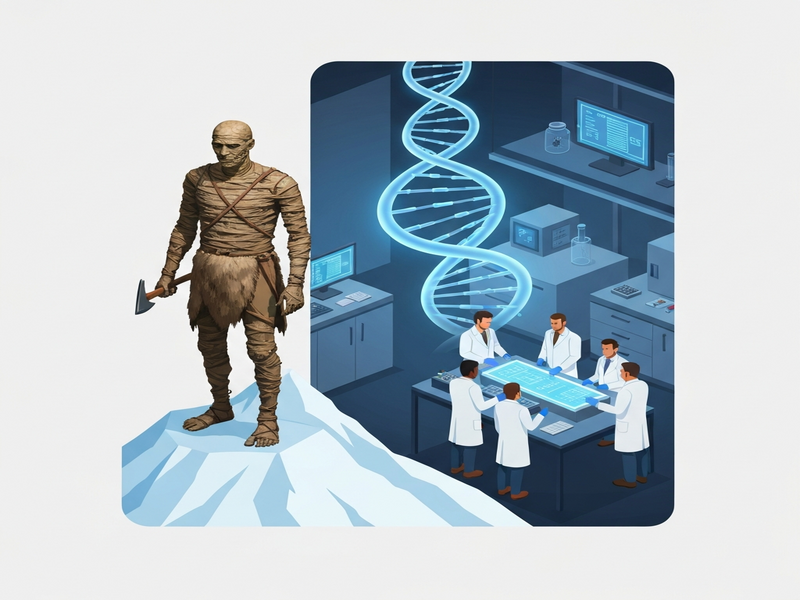
Ötzi DNA and the Rare Haplogroup K1f
Ancient DNA analysis extracted Ötzi’s mitochondrial genome from his preserved tissue. The results placed him in mitochondrial haplogroup K1, but with two unique mutations that define a sub‑clade now labeled K1f. This sub‑clade had never been observed in modern genetic databases, leading researchers to conclude that Ötzi’s maternal line was extinct.
Recent re‑analysis, however, identified a living individual whose mtDNA matches the exact K1f signature, confirming that the lineage persisted at a very low frequency. The modern match carries the original two mutations plus three additional changes that accumulated over the past several millennia, indicating a shared maternal ancestor roughly 7,000 years ago.
From the Alps to North Africa: The Living Descendant
The modern carrier of K1f is a French citizen of Berber descent whose maternal grandmother belongs to the Shawiya community in northeastern Algeria. His mitochondrial DNA was submitted to a large‑scale mtDNA tree built by FamilyTreeDNA, where the rare K1f signature stood out.
Because mitochondrial DNA is passed exclusively from mother to child, the connection does not imply that Ötzi is a direct ancestor. Instead, both Ötzi and the modern individual trace back to a common ancient grandmother who lived around 7,000 years ago, before the spread of Neolithic farming cultures.
This discovery underscores how ancient lineages can survive in unexpected places, hidden within small, isolated populations.
Neolithic Migration Across the Mediterranean
Neolithic farmers migrated from the Near East into Europe and North Africa around 9,000–6,000 years ago, bringing agriculture, pottery, and new genetic lineages. The presence of K1f in both Alpine and North African contexts suggests a second, previously undocumented maritime corridor linking Italy and the Maghreb.
Archaeogenetic studies have already identified Y‑chromosome haplogroup R‑V88 moving from the Near East into West Africa via the Mediterranean. The Ötzi K1f connection adds a maternal counterpart to this pattern, highlighting that prehistoric peoples were not isolated but engaged in long‑distance exchange of people, goods, and ideas.
These findings reshape our understanding of Neolithic migration, showing that the Alpine region and North Africa were part of a broader network of human movement.
What This Means for Genealogy Research and DNA Heritage
For genealogy enthusiasts, the Ötzi K1f story offers several actionable insights:
- Rare lineages can survive unnoticed. Even if a haplogroup appears extinct in public databases, expanding the dataset can reveal living carriers.
- Geographic assumptions may be misleading. An Alpine mummy’s maternal line can surface in North Africa, reminding researchers to consider distant regions when interpreting DNA matches.
- Ancient DNA enriches modern family trees. Integrating ancient genomes into mtDNA trees provides deeper context for personal ancestry.
Tools like the AI SEO Analyzer and AI Article Copywriter can help genealogists craft compelling narratives around their findings, while platforms such as the Enterprise AI platform by UBOS enable large‑scale data integration for research institutions.
Leveraging Modern AI Platforms for Ancient DNA Projects
Researchers studying ancient DNA can benefit from the robust capabilities of the UBOS platform overview. Its modular architecture supports data ingestion, analysis, and visualization, making it ideal for handling fragmented ancient genomes.
Startups focusing on heritage tech can accelerate development with UBOS for startups, while small‑to‑medium businesses can adopt UBOS solutions for SMBs to manage large genetic datasets without heavy infrastructure costs.
For teams that need rapid prototyping, the Web app editor on UBOS lets developers build custom dashboards for visualizing haplogroup distributions. The Workflow automation studio can automate repetitive tasks such as sequence alignment and variant calling.
Pricing is transparent, with options detailed on the UBOS pricing plans. Organizations can explore real‑world use cases in the UBOS portfolio examples, and jump‑start projects using pre‑built UBOS templates for quick start.
Communication and collaboration are further enhanced by the Telegram integration on UBOS, which can be combined with ChatGPT and Telegram integration for real‑time query answering. Direct access to the OpenAI ChatGPT integration enables natural‑language interaction with complex genetic datasets.
Data scientists can store vector embeddings in the Chroma DB integration, while the ElevenLabs AI voice integration can generate audio summaries of research findings for broader outreach.
Marketing teams promoting heritage projects can deploy AI marketing agents to personalize outreach, and partners can join the UBOS partner program to co‑develop specialized tools for archaeogenetics.
Conclusion: A Living Link Across Millennia
The Ötzi DNA discovery bridges a 5,000‑year gap, proving that even the rarest maternal lineages can endure. It enriches our understanding of Neolithic migration, expands the toolkit for genealogy research, and showcases how modern AI platforms like UBOS can accelerate ancient DNA studies.
As more ancient genomes are sequenced and integrated into global databases, we can expect additional surprises—living relatives of other historic figures may yet emerge, reshaping both science and personal heritage narratives.
Meta description: Ötzi the Iceman’s DNA reveals a living North African relative, confirming mitochondrial haplogroup K1f and highlighting Neolithic migration patterns—essential reading for history buffs, archaeology students, and genealogy researchers.
Andrii Bidochko
CTO UBOS
Andrii Bidochko is an AI entrepreneur and researcher focused on AI agents, reinforcement learning, and autonomous systems. He writes about the technologies shaping the future of machine intelligence, from frontier models and agent architectures to real-world AI applications.