

- Updated: March 27, 2026
- 6 min read
Anthropic Secures Injunction Against Trump Administration Over Defense Department AI Restrictions
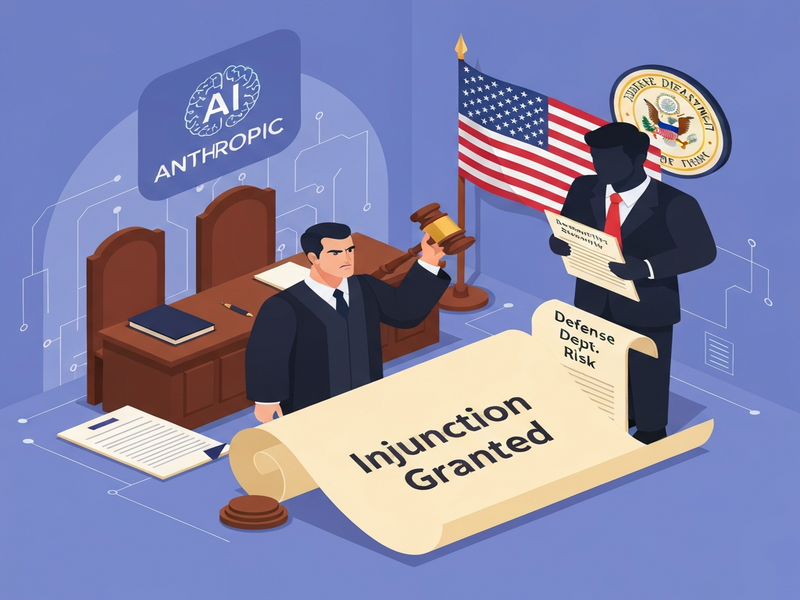
Anthropic secured a federal injunction that forces the Trump administration to withdraw its “supply chain risk” designation and to stop ordering federal agencies to cut ties with the AI company.
Headline: Anthropic Wins Injunction Against Trump Administration Over Defense Department AI Restrictions
In a decisive legal victory, a Northern District of California judge ordered the Trump administration to rescind its recent classification of Anthropic as a national‑security threat and to halt the mandated disengagement of federal agencies from the company’s AI services. The ruling, announced on March 26, 2026, marks a pivotal moment in the ongoing clash between AI innovators and a government seeking tighter control over advanced machine‑learning tools.
Background: Trump Administration’s Aggressive AI Restrictions
The conflict began in early March when the Department of Defense, under direct orders from President Donald Trump, labeled Anthropic—a leading developer of large language models—as a “supply chain risk.” This designation is traditionally reserved for foreign entities that could compromise critical infrastructure. The administration’s rationale was two‑fold:
- Concern that Anthropic’s models might be repurposed for autonomous weapons or mass surveillance.
- Political pressure to curb what officials described as “radical‑left, woke” technology firms.
Following the designation, the White House issued an executive directive instructing all federal agencies to terminate contracts, data‑sharing agreements, and any ongoing research collaborations with Anthropic. The company, which had previously negotiated strict usage limits for its models—including bans on weaponization—found itself suddenly barred from the very government customers it sought to serve responsibly.
The Federal Judge’s Order: What the Injunction Actually Says
U.S. District Judge Rita F. Lin presided over the case after Anthropic filed a lawsuit alleging that the administration’s actions violated the company’s First‑Amendment rights and constituted an unlawful ex‑parte seizure of its intellectual property. In a concise opinion, Judge Lin concluded:
“The government’s abrupt classification of Anthropic as a supply‑chain risk, without providing a clear evidentiary basis, appears designed to cripple the company’s ability to operate. This order infringes upon protected speech and commercial expression.”
The injunction contains three core components:
- Immediate Rescission: The “supply chain risk” label must be removed from all federal records within ten business days.
- Cease‑and‑Desist on Agency Orders: All federal agencies are prohibited from terminating contracts or refusing to engage with Anthropic until a full administrative review is completed.
- Preservation of Evidence: The government must preserve all communications related to the designation for future discovery.
Judge Lin also granted Anthropic a temporary restraining order, effectively pausing any further punitive measures while the case proceeds to a full trial.
Implications for AI Policy and the Defense Sector
The ruling reverberates across several dimensions of AI governance:
1. Legal Precedent for AI‑Related Speech Protections
By framing the “supply chain risk” designation as a potential violation of free speech, the decision may set a benchmark for future disputes where governments attempt to silence or restrict AI developers based on policy disagreements rather than concrete security threats.
2. Re‑evaluation of Defense‑Sector Procurement Policies
The Department of Defense now faces pressure to develop transparent, evidence‑based criteria for labeling AI technologies as security risks. Industry analysts predict a shift toward more collaborative risk‑assessment frameworks that involve both government and private‑sector experts.
3. Market Confidence for AI Start‑ups
Investors have welcomed the injunction as a signal that the U.S. judiciary can act as a check against politically motivated overreach. Venture capital flows into AI startups are expected to remain robust, especially for firms that adopt responsible‑use policies similar to Anthropic’s.
4. International Ripple Effects
Allied nations observing the case may reconsider their own AI export‑control regimes. The decision underscores the importance of aligning national security concerns with the broader goal of fostering innovation.
Statements from Anthropic and Industry Experts
Anthropic CEO Dario Amodei issued a statement shortly after the ruling:
“We are grateful to the court for moving swiftly and for recognizing that our commitment to safe, responsible AI aligns with America’s national interests. While we will continue to protect our technology, our focus remains on constructive collaboration with the government to ensure that AI benefits every American.”
Legal scholar Dr. Maya Patel of Stanford Law School commented on the broader significance:
“This injunction is a reminder that policy tools must be grounded in transparent evidence. The decision reinforces that even in the realm of emerging technologies, constitutional safeguards remain paramount.”
From the industry side, John Liu, senior analyst at AI news, noted:
“Anthropic’s victory could catalyze a new wave of legal challenges against over‑broad government designations. Companies will likely be more emboldened to push back when they feel their rights are being infringed.”
What This Means for the Future of AI Regulation
While the injunction does not resolve the underlying policy dispute, it forces the administration to adopt a more measured approach. The following trends are likely to emerge:
- Increased Transparency: Agencies will be required to publish detailed risk assessments before labeling any AI firm as a threat.
- Stakeholder Engagement: Expect formal advisory panels that include AI researchers, ethicists, and industry leaders.
- Regulatory Harmonization: Coordination between the Department of Defense, the Commerce Department, and the National Institute of Standards and Technology (NIST) to create unified standards.
These developments align with the broader push for responsible AI governance championed by organizations such as the Enterprise AI platform by UBOS, which offers tools for compliance, risk monitoring, and ethical model deployment.
How Companies Can Prepare for Similar Legal Challenges
For AI firms navigating the increasingly politicized regulatory landscape, the following best practices are recommended:
- Document Usage Policies: Maintain clear, publicly accessible guidelines on prohibited applications (e.g., autonomous weapons, mass surveillance).
- Engage Legal Counsel Early: Proactively assess potential government actions and prepare injunction‑ready arguments.
- Leverage Compliance Platforms: Solutions like the Workflow automation studio can streamline policy enforcement across product lines.
- Build Public Trust: Transparent communication, as demonstrated by Anthropic’s press releases, helps mitigate political backlash.
Related Resources on UBOS
For readers interested in building AI‑driven applications that comply with emerging regulations, UBOS offers a suite of resources:
- UBOS homepage – Overview of the platform’s capabilities.
- About UBOS – Company mission and leadership.
- AI news – Up‑to‑date coverage of AI policy and technology.
- Legal updates – Insight into regulatory changes affecting AI.
- AI marketing agents – Automate campaign creation with compliant AI.
- UBOS platform overview – Technical deep‑dive into the architecture.
- UBOS templates for quick start – Pre‑built app templates, including the AI SEO Analyzer and AI Article Copywriter.
Conclusion: A Landmark Decision Shaping the AI Landscape
The injunction granted to Anthropic is more than a courtroom win; it is a signal that the United States’ legal system will scrutinize executive actions that threaten the growth of responsible AI. As the defense sector recalibrates its procurement strategies and lawmakers consider new oversight mechanisms, AI companies must stay vigilant, transparent, and prepared to defend their rights.
For a full read of the original reporting, see the TechCrunch article. Stay informed with our ongoing coverage of AI policy, legal battles, and emerging technologies.
Andrii Bidochko
CTO UBOS
Andrii Bidochko is an AI entrepreneur and researcher focused on AI agents, reinforcement learning, and autonomous systems. He writes about the technologies shaping the future of machine intelligence, from frontier models and agent architectures to real-world AI applications.