

- Updated: March 26, 2026
- 7 min read
Overplowing Weakens Soil: New Research Reveals Flood Risks
Overplowing fundamentally weakens soil by shattering its intricate internal capillary networks, which severely diminishes its ability to absorb and retain water, thereby increasing flood risk and erosion. Groundbreaking research from the University of Washington, utilizing fiber-optic seismic sensing, has provided unprecedented evidence of this degradation, confirming that conventional tilling destroys the soil’s natural sponge-like structure.
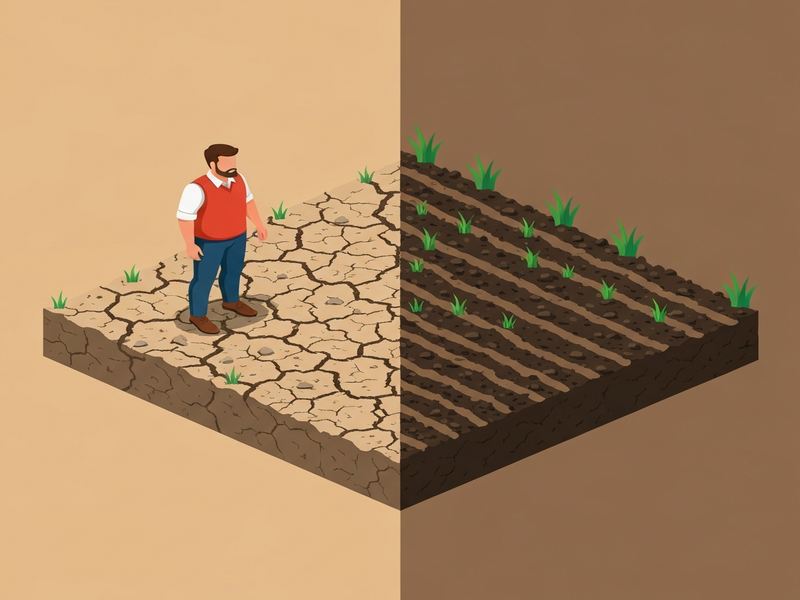
The Hidden Fracture: How Tilling Shatters Soil’s Inner Architecture
For millennia, the act of plowing, or tilling, has symbolized the very beginning of the agricultural cycle. It is a ritual of preparation, turning over the earth to welcome new seeds. The conventional belief holds that this process aerates the soil and improves the circulation of water and nutrients. However, this age-old practice is now facing a seismic reassessment, revealing a counterintuitive and damaging truth: overplowing systematically weakens the very foundation of our food systems.
The soil beneath our feet is not merely inert dirt; it is a complex, living ecosystem structured by a delicate network of microscopic channels and pores. This is the soil’s capillary network, an intricate web that functions like a natural sponge. It is this structure that allows soil to absorb rainfall, hold moisture for plant roots during dry spells, and prevent nutrient-rich topsoil from washing away. Tilling, especially when combined with the immense weight of modern tractors causing soil compaction, acts as a blunt force instrument, pulverizing this fragile architecture. Instead of creating pathways for water, it collapses them, leading to a cascade of negative consequences for soil health and climate resilience.
“This study offers a clear explanation for why the process of tillage, one ofhumanity’s oldest agricultural activities, changes the structure of soil in ways that affect how it soaks up water,” stated David Montgomery, a UW professor and co-author of the study.
Listening to the Earth: A Revolutionary Approach to Soil Science
The definitive link between overplowing and soil weakening has long been suspected, but observing the mechanism in real-time has been a monumental challenge. A team of researchers from the University of Washington, however, ingeniously repurposed a technology from an entirely different field—earthquake science—to listen to the soil’s response to stress. Their findings, published in the journal Science, provide the most compelling evidence to date of the damage caused by tilling.
The team employed a technique known as Distributed Acoustic Sensing (DAS), which uses fiber-optic cables as a vast network of seismic sensors. By sending pulses of light down the cable and measuring the minuscule backscatter, scientists can detect vibrations and strain in the ground with incredible precision. This method is so sensitive it can measure the speed at which sound waves travel through a substance—its seismic velocity.
The Experimental Farm: A Perfect Laboratory
Their testing ground was an experimental farm in the United Kingdom, where different plots of land had been subjected to consistent cultivation methods for over two decades. This provided a perfect, controlled environment to compare:
- No-Till Rows: Land left undisturbed, allowing natural soil structures to form.
- Shallow-Till Rows: Soil tilled to a depth of 10 centimeters.
- Deep-Till Rows: Soil aggressively tilled to 25 centimeters.
The researchers laid fiber-optic cables alongside these plots and recorded continuous ground motion data for 40 hours, capturing a period of light to moderate rainfall. The core principle was simple yet brilliant: the seismic velocity of soil changes dramatically with its moisture content. Dry, well-structured soil transmits sound waves differently than wet, compacted mud. This allowed the scientists to effectively watch how each plot absorbed—or repelled—the rain.
The Verdict from the Vibrations: Tilled Soil Fails the Test
The data collected through the DAS system painted a stark and unambiguous picture. The no-till plots demonstrated the behavior of a healthy, resilient sponge. As rain fell, the seismic velocity changed in a way that indicated water was being efficiently absorbed and distributed throughout the soil profile. The intricate capillary network was intact and functioning perfectly, drawing moisture down to be stored for later use.
In stark contrast, the tilled plots, particularly the deep-tilled ones, told a story of structural failure. The initial rainfall caused the loose, pulverized top layer to become saturated almost instantly. This created a muddy, impermeable crust on the surface. Subsequent rain pooled on top instead of soaking in, leading to runoff and increasing the potential for erosion and localized flooding. The seismic data confirmed that the water was not penetrating deep into the soil, a clear sign that the vital capillary networks had been destroyed. This is a critical insight for anyone looking to build resilient systems, from agriculture to urban planning. The ability to manage data and automate responses is where a powerful Workflow automation studio becomes an indispensable tool for modern environmental management.
From Local Farms to Global Consequences: The Ripple Effect of Soil Degradation
The implications of this research extend far beyond the individual farm. The widespread practice of overplowing contributes to a host of interconnected environmental challenges that affect us all.
Amplified Flood and Drought Cycles
When soil loses its ability to absorb water, it transforms from a buffer into an accelerator of climate extremes. During heavy rainfall, water that should be soaking into the ground sheets off the compacted surface, overwhelming streams and rivers and causing more frequent and severe floods. Conversely, during dry periods, the lack of stored soil moisture means that drought conditions intensify much more quickly, stressing crops and natural ecosystems. This cycle of flood and drought is a hallmark of poor soil health.
The Promise of Technology in Sustainable Agriculture
This new understanding of soil mechanics, powered by advanced sensing technology, opens the door for a technological revolution in agriculture. The challenge is no longer just about planting and harvesting; it’s about managing a complex ecosystem with precision. This is where AI and automation become critical allies. For large-scale operations, a comprehensive Enterprise AI platform by UBOS can integrate data from various sensors—like the fiber-optic cables in the study—to provide a real-time dashboard of soil health.
Imagine AI-driven systems that can predict how a field will respond to an incoming storm based on its tillage history and current moisture levels. Farmers could receive alerts to implement mitigation strategies, and water resource managers could get more accurate flood forecasts. Startups in the agritech space can leverage platforms like UBOS for startups to rapidly develop and deploy these innovative solutions without massive upfront investment in infrastructure. You can even build custom applications using a no-code Web app editor on UBOS to visualize soil data or manage irrigation schedules.
Furthermore, integrating various communication and data processing tools is key. For instance, setting up a ChatGPT and Telegram integration could allow farm managers to receive instant, natural-language summaries of soil conditions directly on their phones. The core of these solutions often relies on powerful AI models, making an OpenAI ChatGPT integration a foundational element for building intelligent agricultural tools.
Building a Resilient Foundation for the Future
The University of Washington’s research is a powerful call to action. It scientifically validates the principles of regenerative agriculture and conservation tillage, urging a shift away from destructive, short-sighted practices. The path forward lies in a synergy of ancient wisdom—understanding the importance of undisturbed soil—and cutting-edge technology that allows us to monitor, manage, and restore soil health at scale.
For businesses, researchers, and innovators, the opportunities are immense. Developing tools that help farmers transition to no-till methods, creating better models for climate resilience, and educating the public are all critical tasks. The UBOS platform overview showcases how a unified system can bring together the necessary components—data integration, AI processing, and application building—to tackle these complex challenges. Whether you are a small business or a large enterprise, understanding the available UBOS pricing plans can help you budget for innovation in this vital sector.
The ground beneath us is not just a medium for growing food; it is one of our most critical pieces of infrastructure for managing water, sequestering carbon, and ensuring a stable climate. By abandoning the destructive habit of overplowing and embracing a new era of data-driven, sustainable land management, we can begin to repair the hidden fractures in our soil and build a more resilient and prosperous future for generations to come. Learning more About UBOS and its mission can provide further insight into how technology partners are facilitating this crucial transition.
Andrii Bidochko
CTO UBOS
Andrii Bidochko is an AI entrepreneur and researcher focused on AI agents, reinforcement learning, and autonomous systems. He writes about the technologies shaping the future of machine intelligence, from frontier models and agent architectures to real-world AI applications.