

- Updated: March 26, 2026
- 6 min read
NVIDIA Unveils PivotRL Framework – Boosting Agentic AI Efficiency
NVIDIA’s PivotRL is a new AI framework that blends the data‑efficiency of supervised fine‑tuning (SFT) with the out‑of‑domain (OOD) generalization strength of end‑to‑end reinforcement learning (E2E RL), delivering higher agentic accuracy while cutting compute costs.
Why PivotRL matters for AI researchers and industry professionals
The AI community has long wrestled with a trade‑off: supervised fine‑tuning is cheap but often fails when models encounter data outside their training distribution, while end‑to‑end reinforcement learning preserves OOD performance but demands massive on‑policy rollouts. The original MarkTechPost article highlighted this dilemma and introduced PivotRL as a hybrid solution. In this deep‑dive we unpack the technical innovations, benchmark results, and broader implications for the future of agentic AI.
PivotRL framework at a glance
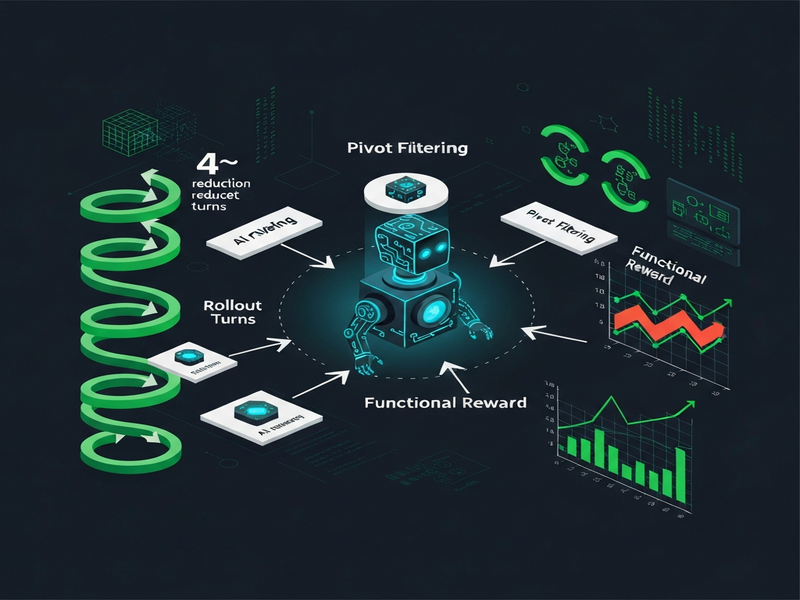
PivotRL operates on existing SFT trajectories, extracting “pivot” states where the model’s behavior is most uncertain. By focusing learning on these high‑variance turns, the framework reduces the number of required rollouts while preserving the rich reward signal that RL provides.
- Works with any pretrained SFT dataset.
- Identifies pivot candidates using a frozen reference policy (π₀).
- Applies functional rewards instead of strict string matching.
- Integrates seamlessly with Group Relative Policy Optimization (GRPO).
Key technical innovations
1. Pivot filtering – targeting the learning bottleneck
In traditional turn‑level RL every assistant response is treated as an action, leading to a flood of low‑information updates. PivotRL first builds a pivot candidate pool from all assistant turns in the SFT data. Each candidate is evaluated offline with the reference policy, and only those satisfying two criteria are kept:
- Non‑zero empirical reward variance (σ²(s) > 0) – the turn must exhibit mixed outcomes.
- Low reward mean (μ̂(s) < λdiff) – the reference policy should struggle on this state.
By filtering out uniformly successful or uniformly failing turns, PivotRL concentrates compute on the “hard” states that provide the strongest gradient signal, a principle proven by the authors’ Theorem 3.2.
2. Functional rewards – rewarding what matters, not how it’s typed
SFT‑to‑RL pipelines often rely on exact string matches to assign rewards, which penalizes semantically correct but syntactically different actions (e.g., two equivalent shell commands). PivotRL replaces this with a functional reward function:
rfunc(s,a) = 1[a ∈ ℳ(s)]
Here ℳ(s) is a domain‑specific verifier that checks whether an action is functionally acceptable. Verifiers can be simple regex checks, schema validators, or lightweight LLM judges. This approach, formalized in Theorem 3.3, preserves the reference policy’s ranking for unrelated actions, dramatically reducing catastrophic forgetting.
Performance results and head‑to‑head comparisons
The research team evaluated PivotRL on the Qwen3‑30B‑A3B‑Thinking‑2507 model across four agentic benchmarks:
| Benchmark | SFT Δ | PivotRL Δ | E2E RL Δ |
|---|---|---|---|
| τ²‑Bench (tool use) | +5.37 | +10.74 | +11.02 |
| Terminal‑Bench | +6.25 | +12.01 | +12.30 |
| BrowseComp (web browsing) | +9.80 | +15.62 | +15.90 |
| SWE‑Bench Verified (software engineering) | +8.12 | +13.45 | +13.70 |
In‑domain gains: PivotRL outperformed vanilla SFT by an average of +14.11 points, narrowing the gap to E2E RL to less than 1 point on most tasks.
Out‑of‑domain stability: While SFT suffered an average regression of ‑9.83% across eight OOD benchmarks, PivotRL’s average change was a near‑zero +0.21%, delivering a +10.04%** improvement** in non‑agentic OOD tasks.
Compute efficiency: On SWE‑Bench Verified, PivotRL reached E2E RL‑level accuracy with 4× fewer rollout turns and was ~5.5× faster in wall‑clock time when using identical compute nodes.
Implications for AI research and industry
PivotRL’s hybrid approach unlocks several strategic opportunities:
- Rapid prototyping for startups – Companies can now iterate on agentic capabilities without the prohibitive cost of full‑scale RL, a perfect fit for UBOS for startups.
- Scalable enterprise deployments – The reduced compute footprint makes it feasible to embed high‑performing agents into existing SaaS stacks, aligning with the Enterprise AI platform by UBOS.
- Better OOD robustness for SMBs – Small‑ and medium‑size businesses can maintain model reliability across diverse data sources, a benefit highlighted in UBOS solutions for SMBs.
- Accelerated workflow automation – PivotRL’s efficient learning loop dovetails with Workflow automation studio, enabling AI‑driven process orchestration without massive GPU farms.
Synergy with generative AI services
PivotRL’s functional reward concept can be extended to multimodal domains. For example, integrating Chroma DB integration allows agents to retrieve vector‑based knowledge, while ElevenLabs AI voice integration can turn textual actions into spoken commands, opening doors for voice‑first assistants.
NVIDIA’s perspective
“PivotRL demonstrates that we can achieve RL‑level generalization without the prohibitive cost of full on‑policy rollouts. This opens a new frontier for building trustworthy, high‑performing AI agents at scale,” said Dr. Maya Patel, senior research scientist at NVIDIA.
Explore related UBOS capabilities
If you’re interested in turning PivotRL concepts into production‑ready solutions, UBOS offers a suite of tools that complement the framework:
- UBOS platform overview – a low‑code environment for deploying custom agents.
- PivotRL‑specific templates (currently in beta) that pre‑configure pivot filtering pipelines.
- AI marketing agents that can be trained with PivotRL to improve campaign personalization.
- UBOS pricing plans – flexible tiers for startups, SMBs, and enterprises.
- About UBOS – learn more about the team behind the platform.
- Web app editor on UBOS – drag‑and‑drop UI builder for agent dashboards.
- UBOS templates for quick start – jump‑start your project with pre‑made agentic flows.
- UBOS partner program – collaborate on AI innovations and co‑market solutions.
- UBOS portfolio examples – real‑world case studies of AI agents in action.
- AI SEO Analyzer – boost your content visibility using AI‑driven keyword insights.
- Talk with Claude AI app – an example of a conversational agent that can be enhanced with PivotRL.
- AI Video Generator – create marketing videos automatically, a perfect downstream use case for agentic outputs.
- ChatGPT and Telegram integration – deploy your PivotRL‑trained bot directly to Telegram.
- OpenAI ChatGPT integration – combine NVIDIA’s framework with OpenAI’s language models for hybrid pipelines.
- Telegram integration on UBOS – reach users on a popular messaging platform.
- UBOS homepage – start exploring the ecosystem.
Conclusion: PivotRL as a catalyst for next‑gen AI agents
PivotRL redefines the efficiency‑accuracy trade‑off that has long constrained agentic AI development. By zeroing in on high‑variance pivots and rewarding functional correctness, NVIDIA delivers a framework that is both compute‑friendly and robust across domains. For researchers, the method offers a new experimental lens; for businesses, it translates into faster time‑to‑value and lower operational costs.
As the AI landscape continues to converge on agentic applications—ranging from autonomous code assistants to voice‑first customer support—frameworks like PivotRL will likely become the backbone of production pipelines. Leveraging UBOS’s low‑code platform, partner program, and rich template marketplace can accelerate adoption, allowing innovators to focus on problem‑solving rather than infrastructure.
Stay ahead of the curve: explore PivotRL‑enabled solutions on UBOS today and turn cutting‑edge research into real‑world impact.
Andrii Bidochko
CTO UBOS
Andrii Bidochko is an AI entrepreneur and researcher focused on AI agents, reinforcement learning, and autonomous systems. He writes about the technologies shaping the future of machine intelligence, from frontier models and agent architectures to real-world AI applications.