

- Updated: March 18, 2026
- 6 min read
CFTC Scrutinizes Insider Trading on Prediction Markets: Kalshi and Polymarket
CFTC’s Struggle with Insider Trading on Kalshi & Polymarket: What Investors Must Know
The Commodity Futures Trading Commission (CFTC) is currently the only federal agency with authority over prediction markets, but its limited enforcement resources make policing insider trading on platforms like Kalshi and Polymarket a daunting challenge for regulators and investors alike.
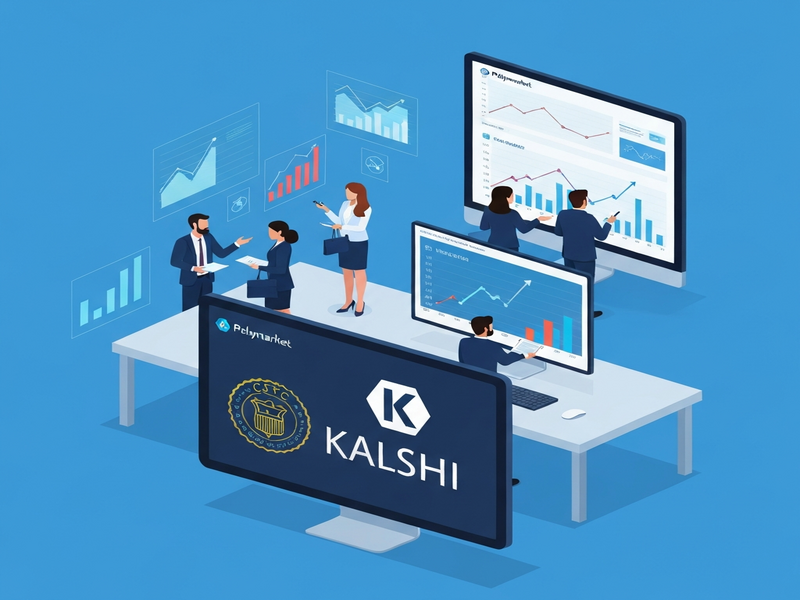
Prediction markets have exploded from academic curiosities into multi‑billion‑dollar ecosystems where users bet on everything from election outcomes to the next blockbuster movie. Yet, as the original Verge article highlighted, the rapid growth is outpacing the CFTC’s ability to police insider trading—a problem that could reshape the risk profile for tech‑savvy investors.
In this deep‑dive we break down the latest developments, explain the regulatory backdrop, and give you actionable insights to protect your capital while navigating the volatile world of prediction markets.
Kalshi vs. Polymarket: Two Paths, One Regulatory Puzzle
Kalshi—the first U.S.‑registered prediction exchange—has taken a self‑policing stance. After a high‑profile insider‑trading scandal involving a politician and a YouTube influencer’s employee, Kalshi announced it opened more than 200 investigations, froze suspicious accounts, and turned a dozen probes into active cases. The company’s internal enforcement team claims the “volume of suspicious activity” far exceeds public disclosures.
Polymarket, by contrast, operates primarily offshore and has shown little appetite for self‑regulation. The platform continues to list geopolitical contracts—including war‑related bets—generating $425 million in weekly volume despite mounting legal scrutiny in several U.S. states.
Both platforms rely on sophisticated algorithmic monitoring, but their divergent philosophies create a natural experiment for regulators: Should the CFTC enforce a uniform standard, or will market participants gravitate toward the less‑regulated offshore option?
Regulatory Context: The CFTC’s Authority and Its Limits
The CFTC’s jurisdiction over prediction markets stems from the 2010 Dodd‑Frank Act, which extended insider‑trading prohibitions to commodity‑based contracts—including those that settle on real‑world events. However, enforcement has been hampered by three key constraints:
- Staffing shortages: The agency’s enforcement team shrank from 160 full‑time staffers in 2024 to roughly 120 in 2025, even as its oversight portfolio now includes crypto‑futures and agricultural derivatives.
- Budget caps: The 2026 budget request seeks funding for only 114 personnel, limiting the ability to launch large‑scale investigations.
- Legal ambiguity: The CFTC’s insider‑trading rule mirrors the SEC’s but lacks the same depth of case law, resulting in fewer prosecutions and a perception of “soft” enforcement.
In a recent statement, the CFTC emphasized its “full authority” to police illegal trading practices, yet it has yet to bring a high‑profile insider‑trading case against a prediction market to trial. This gap leaves a regulatory vacuum that savvy investors must navigate on their own.
For a broader view of the agency’s evolving stance, see the CFTC updates page on UBOS.
What This Means for Investors: Risks, Opportunities, and Mitigation Strategies
The regulatory uncertainty translates into three practical implications for anyone betting on future events:
- Higher insider‑trading risk: Without robust oversight, insider information can slip through, potentially skewing market prices and harming retail participants.
- Liquidity fragmentation: Traders may split capital between regulated (Kalshi) and unregulated (Polymarket) venues, diluting depth and increasing slippage.
- Legal exposure: Engaging in contracts that violate the “no assassination markets” rule could expose users to civil penalties, especially if the CFTC decides to enforce retroactively.
Actionable Mitigation Tactics
- Use platforms with transparent enforcement dashboards (e.g., Kalshi’s public investigation feed).
- Diversify exposure across multiple prediction markets to reduce single‑point failure risk.
- Leverage AI‑driven analytics to detect anomalous trade patterns—tools like Chroma DB integration can help surface outliers in real time.
- Stay informed on regulatory filings via the market regulation hub on UBOS.
For developers building custom monitoring bots, the ChatGPT and Telegram integration offers a low‑code way to receive instant alerts when suspicious trades are flagged.
How UBOS Helps You Navigate Prediction‑Market Risks
UBOS offers a suite of AI‑powered tools that can turn regulatory uncertainty into a competitive edge:
- UBOS homepage – Central hub for all AI solutions.
- About UBOS – Learn how our team builds compliance‑first AI platforms.
- AI marketing agents – Automate market‑sentiment analysis across prediction‑market forums.
- UBOS platform overview – End‑to‑end workflow automation for data ingestion, risk scoring, and reporting.
- UBOS for startups – Fast‑track your fintech venture with pre‑built compliance modules.
- UBOS solutions for SMBs – Scalable AI that fits small‑team budgets.
- Enterprise AI platform by UBOS – Enterprise‑grade governance and audit trails for regulated markets.
- Web app editor on UBOS – Build custom dashboards without writing code.
- Workflow automation studio – Orchestrate data pipelines that flag insider‑trade signals.
- UBOS pricing plans – Transparent pricing for AI‑driven compliance.
- UBOS portfolio examples – See how other fintechs have mitigated regulatory risk.
- UBOS templates for quick start – Jump‑start your monitoring solution with pre‑built templates.
For developers interested in voice‑enabled alerts, explore the ElevenLabs AI voice integration to receive spoken warnings when the CFTC releases new guidance.
Ready‑Made Templates to Accelerate Your Compliance Workflow
UBOS’s Template Marketplace hosts dozens of plug‑and‑play solutions that can be deployed in minutes. A few that directly address prediction‑market monitoring include:
- AI SEO Analyzer – Ensure your market‑analysis pages stay discoverable.
- AI Survey Generator – Collect trader sentiment data for risk modeling.
- Keywords Extraction with ChatGPT – Auto‑tag suspicious contracts.
- GPT‑Powered Telegram Bot – Real‑time alerts in your favorite messaging app.
Conclusion: Stay Informed, Stay Protected
The CFTC’s limited enforcement capacity does not mean investors must accept higher risk. By leveraging transparent platforms, AI‑driven monitoring tools, and UBOS’s compliance‑focused ecosystem, you can mitigate insider‑trading exposure while still participating in the lucrative world of prediction markets.
Take the next step today: Explore the UBOS partner program to gain early access to advanced analytics, or sign up for a free trial of the Workflow automation studio and start building your own insider‑trade detection pipeline.
Andrii Bidochko
CTO UBOS
Andrii Bidochko is an AI entrepreneur and researcher focused on AI agents, reinforcement learning, and autonomous systems. He writes about the technologies shaping the future of machine intelligence, from frontier models and agent architectures to real-world AI applications.