

- Updated: March 17, 2026
- 6 min read
Claude AI Helps Developers Write Code – Vergecast Summary
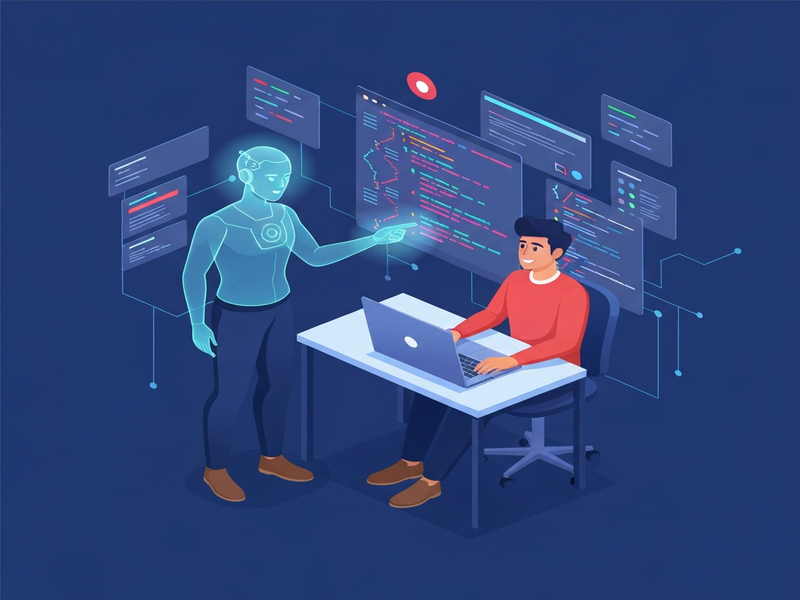
Claude AI is redefining software development by acting as an AI coding assistant that can generate, debug, and explain code in real time, a capability highlighted in the latest Vergecast episode about Claude AI.
Claude AI on Vergecast: How the New Coding Companion Is Changing the Developer Landscape
Episode Overview – What the Hosts Covered
In the March 2026 episode of Vergecast, host Paul Ford sat down with Anthropic’s lead engineer to explore the Claude Code app, a product that lets developers converse with Claude AI to write, refactor, and test code without typing a single line. The conversation moved quickly from demo screenshots to philosophical questions about the future of programming, the balance between human creativity and machine assistance, and the potential impact on developer careers.
The hosts emphasized two core ideas: first, that AI coding assistants are shifting the developer’s role from “code writer” to “prompt engineer” and project orchestrator; second, that the rapid adoption of tools like Claude could accelerate the democratization of software creation, allowing non‑technical founders to prototype products faster than ever before.
While the episode celebrated Claude’s ability to understand context, generate idiomatic code, and even suggest test cases, it also warned about over‑reliance on AI, data privacy concerns, and the need for robust verification pipelines.
Key Discussion Points from the Vergecast
- Prompt‑Driven Development: Claude responds to natural‑language prompts, turning vague ideas into concrete functions.
- Real‑Time Debugging: The AI can spot syntax errors, suggest fixes, and even rewrite sections to improve performance.
- Context Retention: Claude remembers earlier parts of a conversation, enabling multi‑step workflows without re‑entering code.
- Security & Compliance: The hosts discussed how enterprises must audit AI‑generated code for vulnerabilities.
- Economic Impact: By reducing the time spent on boilerplate, Claude could lower development costs and shift hiring priorities.
What This Means for Developers Today
The rise of Claude AI forces developers to rethink their skill set. Below are the most immediate implications:
- Prompt Engineering Becomes Core: Crafting precise, context‑rich prompts is now as valuable as mastering a programming language.
- Shift Toward Architecture: With AI handling routine code, senior engineers can focus on system design, scalability, and security.
- Continuous Learning Loop: Developers must stay updated on AI model capabilities, token limits, and best‑practice prompt patterns.
- Enhanced Collaboration: AI can serve as a shared knowledge base, reducing onboarding time for new team members.
- Quality Assurance Evolution: Automated testing frameworks need to integrate AI‑generated code reviews to catch subtle bugs.
How UBOS Is Positioning Itself in the AI‑Assisted Development Era
While Claude AI garners headlines, the UBOS homepage showcases a broader ecosystem that empowers developers to embed AI capabilities directly into their applications. Below are some of the most relevant UBOS offerings that complement Claude’s functionality:
- OpenAI ChatGPT integration – Seamlessly add ChatGPT-powered code suggestions alongside Claude.
- ChatGPT and Telegram integration – Deploy AI coding bots in Slack‑like environments for instant feedback.
- Telegram integration on UBOS – Enable developers to interact with AI assistants from their mobile devices.
- UBOS platform overview – A low‑code environment where AI modules can be dragged, dropped, and wired together.
- Workflow automation studio – Automate the hand‑off between Claude‑generated code and CI/CD pipelines.
- Web app editor on UBOS – Build full‑stack apps that embed AI assistants without writing boilerplate.
- AI marketing agents – Leverage the same prompting techniques for marketing copy, freeing developers to focus on product logic.
- UBOS pricing plans – Flexible tiers that scale from indie developers to enterprise teams.
- Enterprise AI platform by UBOS – Governance, audit trails, and security controls for AI‑generated code in regulated industries.
- UBOS for startups – Accelerate MVP development with pre‑built AI modules.
- UBOS solutions for SMBs – Affordable AI tooling for small teams that lack dedicated DevOps resources.
UBOS Template Marketplace – Ready‑Made AI Apps for Developers
UBOS’s marketplace offers dozens of plug‑and‑play templates that can be combined with Claude or other LLMs. A few standout examples for developers include:
- Talk with Claude AI app – A starter project that demonstrates how to call Claude’s API from a web UI.
- AI Article Copywriter – Shows how to generate documentation from code comments automatically.
- AI SEO Analyzer – Integrates AI insights into your dev workflow for content‑heavy sites.
- AI Video Generator – Turn code demos into narrated videos with a single click.
- AI Image Generator – Produce UI mockups or asset libraries directly from prompts.
- AI Email Marketing – Automate release notes and developer newsletters.
- AI assistants – A curated collection of bots that can be embedded into any UBOS app.
- Developer tools – SDKs, CLI utilities, and API docs for extending AI capabilities.
- AI coding – In‑depth articles on best practices for integrating LLMs into software pipelines.
Looking Ahead: The Next Wave of AI‑Powered Development
The Vergecast conversation makes it clear that Claude AI is only the beginning. As model sizes grow and context windows expand, we can expect:
- Full‑stack AI agents: Tools that not only write code but also provision cloud resources, configure CI/CD, and monitor production health.
- Multimodal debugging: Combining code, logs, and visual traces into a single AI‑driven diagnostic interface.
- Domain‑specific fine‑tuning: Enterprises will train Claude‑like models on proprietary codebases to enforce style guides and security policies.
- Human‑in‑the‑loop governance: Platforms such as UBOS will embed audit trails, version control, and approval workflows to keep AI output trustworthy.
For developers who adopt these tools early, the competitive advantage will be measurable in faster time‑to‑market, reduced technical debt, and the ability to focus on high‑impact problem solving rather than repetitive coding chores.
Conclusion
Claude AI’s debut on Vergecast signals a turning point: AI is no longer a peripheral assistant but a core collaborator in the software development lifecycle. By pairing Claude’s natural‑language coding power with UBOS’s modular platform, developers can build, test, and deploy AI‑enhanced applications faster than ever before.
Ready to experiment with AI‑driven development? Explore the UBOS templates for quick start, spin up a Talk with Claude AI app, and join the UBOS partner program to stay ahead of the curve.
The future of code is both exciting and terrifying—embrace the AI assistant that helps you write better software, today.
Andrii Bidochko
CTO UBOS
Andrii Bidochko is an AI entrepreneur and researcher focused on AI agents, reinforcement learning, and autonomous systems. He writes about the technologies shaping the future of machine intelligence, from frontier models and agent architectures to real-world AI applications.