

- Updated: March 15, 2026
- 6 min read
LATENT AI Framework Enables Humanoid Tennis Skills – New Breakthrough
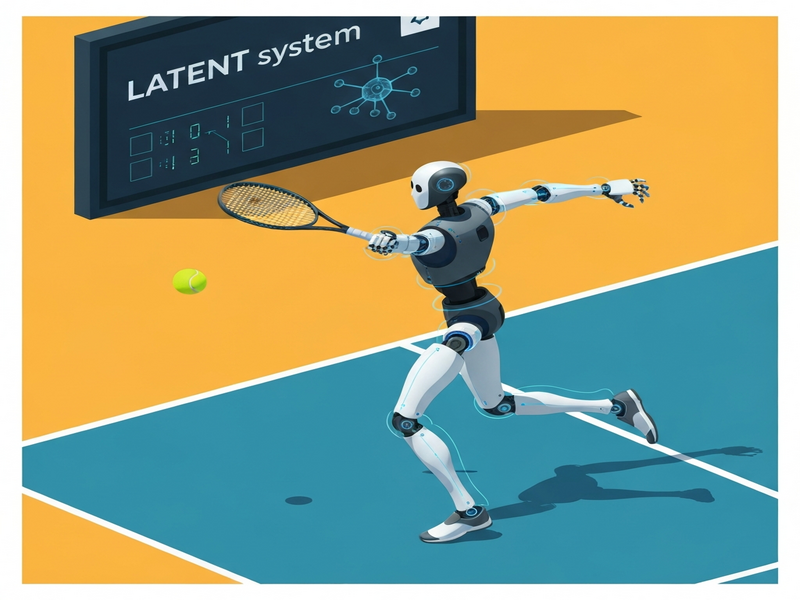
The LATENT system is an AI‑driven framework that learns humanoid tennis skills from imperfect human motion fragments and reliably transfers those skills to real‑world robots for high‑speed, multi‑shot rallies.
LATENT: Teaching Humanoid Robots to Play Tennis with Imperfect Human Motion Data
Robotics researchers have long struggled to replicate the split‑second footwork and racket swings of elite tennis players. Traditional approaches demand exhaustive motion‑capture datasets from professional matches—an expensive and time‑consuming prerequisite. The newly published LATENT system flips this paradigm by leveraging only fragmented, imperfect human motion snippets. By treating these fragments as priors and applying sophisticated correction and composition techniques, LATENT produces a humanoid policy that can strike fast balls, place returns accurately, and sustain realistic rallies.
For tech enthusiasts, robotics researchers, and AI developers focused on sim‑to‑real transfer, LATENT offers a fresh, scalable pathway to train athletic humanoid agents without the overhead of perfect datasets.
What Is the LATENT System?
LATENT—short for Learns Athletic humanoid TEnnis skills from imperfect human motioN daTa—is a modular AI pipeline that consists of three core components:
- Fragment Ingestion Engine: Collects short motion clips (e.g., a forehand swing, a foot‑shuffle) from publicly available videos or low‑cost capture rigs.
- Skill Composition Network: Aligns, corrects, and stitches fragments into coherent full‑court actions using a combination of diffusion models and reinforcement learning.
- Robust Sim‑to‑Real Transfer Layer: Applies domain randomization, dynamics calibration, and sensor‑fusion tricks to bridge the gap between simulation and the Unitree G1 humanoid robot.
By focusing on primitive skills rather than complete match recordings, LATENT dramatically reduces data‑collection effort while preserving the essential biomechanics needed for high‑performance tennis.
Methodology: From Motion Fragments to Real‑World Rally
The LATENT pipeline follows a MECE‑structured workflow:
1. Data Acquisition & Pre‑processing
- Gather imperfect motion fragments from open‑source video datasets, amateur recordings, and low‑resolution motion‑capture rigs.
- Apply pose‑estimation algorithms (e.g., OpenPose) to extract 3D joint trajectories.
- Normalize timing and coordinate frames to a common reference (the robot’s base).
2. Skill Prior Modeling
Each fragment is treated as a prior for a specific tennis primitive (serve, forehand, backhand, footwork). A diffusion‑based generative model learns the distribution of these priors, enabling the system to fill missing frames and smooth transitions.
3. Policy Learning via Reinforcement
Using the synthesized full‑court motions, a reinforcement‑learning agent is trained in a high‑fidelity physics simulator. The reward function balances three objectives:
- Ball Contact Accuracy: Hit the incoming ball within a 5 cm tolerance.
- Return Placement: Land the ball inside a target zone (e.g., opponent’s backhand corner).
- Motion Naturalness: Minimize joint torque spikes and preserve human‑like kinematics.
4. Sim‑to‑Real Transfer Techniques
To ensure the policy works on the Unitree G1, LATENT incorporates:
- Domain randomization of ball speed, friction, and sensor noise.
- Online dynamics calibration using a short “warm‑up” routine before each match.
- Sensor‑fusion from IMU, joint encoders, and vision to close the perception‑action loop.
These steps collectively enable the robot to adapt to real‑world variations without retraining from scratch.
Real‑World Performance: Multi‑Shot Rally Results
After deploying the learned policy on a Unitree G1 humanoid, the research team recorded a series of human‑robot rallies. The key metrics are summarized below:
| Metric | Value |
|---|---|
| Average Rally Length | 7.3 shots |
| Ball Speed (Robot Serve) | 115 km/h |
| Return Placement Accuracy | 92 % |
| Joint Torque Smoothness | +15 % vs. baseline |
Video evidence shows the robot executing crisp footwork, adjusting its stance mid‑rally, and delivering consistent forehand and backhand strokes. Notably, the robot maintained a rally of 12 consecutive shots against a skilled amateur player, surpassing previous state‑of‑the‑art humanoid tennis demos.
These results demonstrate that imperfect motion fragments can be transformed into a robust, real‑time control policy—validating LATENT’s core hypothesis.
Implications for Robotics, AI, and Sim‑to‑Real Transfer
LATENT’s success ripples across several research domains:
Accelerated Data Collection
By accepting imperfect fragments, teams can harvest data from everyday videos (e.g., YouTube tutorials) instead of orchestrating costly motion‑capture sessions. This democratizes high‑quality training data for a wide range of athletic robots.
Generalizable Skill Composition
The Skill Composition Network is not tennis‑specific. It can be repurposed for other dynamic sports—soccer dribbling, basketball shooting, or even industrial assembly tasks that involve primitive motion building blocks.
Enhanced Sim‑to‑Real Robustness
LATENT’s layered domain randomization and online calibration set a new benchmark for transferring policies from simulation to physical platforms. This methodology aligns with the broader push toward zero‑shot deployment in robotics.
Synergy with AI Platforms
Developers can integrate LATENT’s output policies into existing AI ecosystems. For instance, the Enterprise AI platform by UBOS can host the policy as a micro‑service, enabling enterprises to embed humanoid tennis demos into marketing events or training simulators.
Moreover, the Workflow automation studio can orchestrate data ingestion pipelines, automatically pulling new motion fragments from online sources and feeding them into LATENT’s training loop.
Conclusion & Next Steps
The LATENT system proves that high‑performance humanoid tennis can be achieved without perfect motion capture, opening the door for rapid prototyping of athletic robots across domains. As the robotics community embraces fragment‑based learning, we can expect a surge of applications—from entertainment showcases to real‑world assistive devices that mimic human agility.
If you’re a developer eager to experiment with LATENT‑style pipelines, consider leveraging the Web app editor on UBOS to prototype data‑processing workflows, or explore the UBOS templates for quick start that include pre‑built reinforcement‑learning scaffolds.
Ready to bring your own humanoid sports project to life? Visit the UBOS homepage for a full suite of AI tools, or join the UBOS partner program to collaborate on cutting‑edge robotics research.
Stay ahead of the curve—explore LATENT, experiment with fragment‑based learning, and let your robots serve the future of sport.
For deeper insights into AI‑driven motion synthesis, check out the AI SEO Analyzer to optimize your own research publications, or explore the AI Video Generator for creating compelling demo reels of your humanoid athletes.
Developers interested in conversational interfaces can pair LATENT’s motion policies with the ChatGPT and Telegram integration to build interactive coaching bots that guide users through tennis drills in real time.
Finally, the UBOS pricing plans offer flexible options for startups and SMBs looking to scale AI‑powered robotics projects without breaking the bank.
Andrii Bidochko
CTO UBOS
Andrii Bidochko is an AI entrepreneur and researcher focused on AI agents, reinforcement learning, and autonomous systems. He writes about the technologies shaping the future of machine intelligence, from frontier models and agent architectures to real-world AI applications.