

- Updated: March 13, 2026
- 6 min read
75,000‑Year‑Old Neanderthal Female Face Reconstruction Reveals New Insights
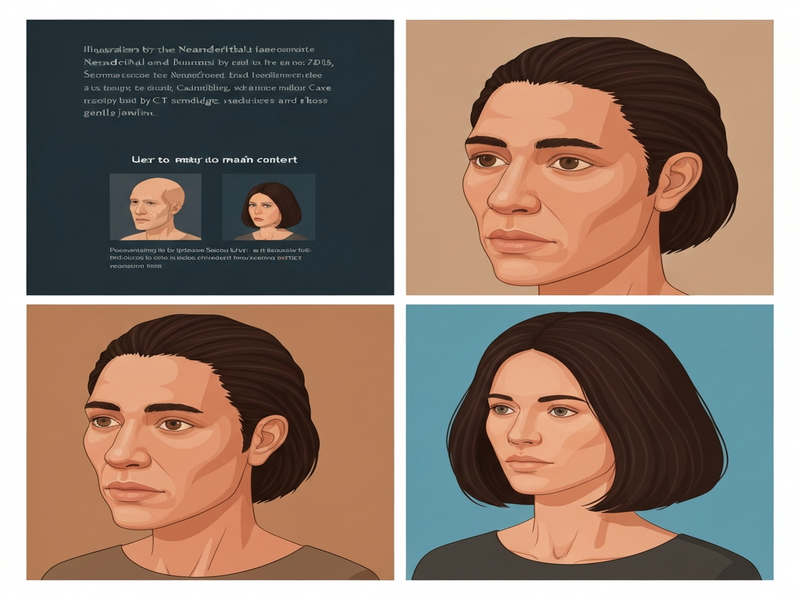
The 75,000‑year‑old Neanderthal female known as Shanidar Z has been digitally reconstructed, revealing a surprisingly modern‑looking face and offering fresh insights into human evolution.
Discovery of Shanidar Z: A Rare Find in Iraqi Kurdistan
In 2018, a multinational team led by the University of Cambridge uncovered a heavily compressed skull deep inside Shanidar Cave, Iraqi Kurdistan. The fragmentary remains, later identified as a female Neanderthal aged around 75,000 years, represent the most complete Neanderthal skull recovered from the site in over half a century. The skull’s extreme flattening—down to just two centimetres thick—posed a formidable challenge, but also promised a unique window into Neanderthal morphology.
Archaeology researchers, students, and history enthusiasts have long debated the appearance of Neanderthals. This reconstruction, powered by cutting‑edge CT scanning and 3D modelling, finally provides a tangible answer.
From Bone Fragments to a 3‑D Face: The Scanning Process
Micro‑CT Scanning of Every Block
Each of the dozens of foil‑wrapped blocks containing bone fragments was first subjected to high‑resolution micro‑CT scanning. These scans captured the internal density of the bone and surrounding sediment at a sub‑millimetre scale, allowing researchers to virtually “see through” the consolidant glue that had been applied on‑site to stabilise the fragile fragments.
Using specialised software, the team generated voxel‑based 3‑D models of every fragment. The resulting digital library served as a precise blueprint for the painstaking manual reassembly.
Digital Jigsaw: Aligning the Fragments
Conservators then employed a combination of automated surface‑matching algorithms and expert visual inspection to align the fragments. The process resembled a high‑stakes 3‑D jigsaw puzzle: each piece was rotated, translated, and scaled until the curvature of the original skull emerged.
Once the virtual skull was complete, a surface scan captured its external geometry. This data was fed into a high‑resolution 3‑D printer, producing a physical replica that could be handled, examined, and further refined by palaeo‑artists.
From Print to Portrait: Adding Muscles and Skin
World‑renowned palaeo‑artists, the Kennis twins, used the printed skull as a scaffold. By layering silicone‑based “muscle” and “skin” analogues, they reconstructed facial soft tissue based on established Neanderthal tissue depth standards. The final result—a lifelike bust—was rendered in photorealistic detail, showing a broad nose, modest brow ridge, and a subtle chin, challenging the stereotype of a “primitive” Neanderthal visage.
Why This Reconstruction Matters
- Human Evolution Insight: The face demonstrates that Neanderthals shared many facial features with modern humans, supporting genetic evidence that interbreeding was possible and frequent.
- Methodological Breakthrough: Combining micro‑CT, AI‑assisted alignment, and 3‑D printing sets a new standard for reconstructing heavily damaged fossils.
- Educational Value: The digital model can be shared globally, enabling museums, universities, and even high‑school classrooms to explore Neanderthal anatomy without handling the fragile original.
- Cross‑Disciplinary Collaboration: The project united archaeologists, conservators, computer scientists, and artists, illustrating the power of interdisciplinary research.
Beyond the scientific community, the reconstruction has cultural resonance. It reminds us that the people who lived 75,000 years ago were not alien “others” but close relatives whose lives, deaths, and rituals echo our own.
Read the Full Academic Report
For a detailed scientific account, see the original Cambridge University news article that chronicles the excavation, scanning, and artistic reconstruction process.
How UBOS Powers Modern Research and Innovation
While the Shanidar Z reconstruction showcases the frontier of archaeology, similar high‑tech workflows are now accessible to startups and enterprises through platforms like UBOS platform overview. Researchers can automate data pipelines, integrate AI models, and visualise results without writing extensive code.
For emerging teams, the UBOS for startups program offers scalable compute resources and pre‑built templates such as the AI SEO Analyzer or AI Article Copywriter, accelerating the creation of research‑driven content.
Small‑to‑medium businesses can also benefit from UBOS solutions for SMBs, which include the Workflow automation studio for orchestrating complex data‑processing tasks—perfect for handling large CT‑scan datasets.
Enterprises seeking a comprehensive AI stack can explore the Enterprise AI platform by UBOS. Its modular architecture supports integrations like OpenAI ChatGPT integration and Chroma DB integration, enabling rapid retrieval of scanned image metadata.
Developers looking to prototype quickly can leverage the Web app editor on UBOS alongside ready‑made UBOS templates for quick start. For example, the Talk with Claude AI app template demonstrates how to embed large‑language‑model chat interfaces directly into research portals.
Marketing teams can harness AI marketing agents to promote scientific discoveries, while the UBOS partner program offers co‑branding opportunities for museums and academic institutions.
To see real‑world applications, browse the UBOS portfolio examples, which include AI‑enhanced visualisations for archaeological sites, similar to the Shanidar Z project.
Pricing is transparent and flexible; explore the UBOS pricing plans to find a tier that matches your research budget.
Future Directions: AI‑Driven Archaeology
The success of the Shanidar Z reconstruction hints at a future where AI assists every stage of archaeological inquiry—from automated fragment identification to predictive modelling of burial practices. Platforms like UBOS make it feasible for labs worldwide to adopt these tools without massive infrastructure investments.
Imagine a scenario where a field team uploads raw CT data to a cloud workspace, triggers an AI‑powered alignment pipeline, and receives a printable 3‑D model within hours. Such workflows could accelerate discoveries, democratise access to heritage, and inspire the next generation of scholars.
Conclusion
The 75,000‑year‑old Neanderthal female from Shanidar Cave has emerged from stone to screen, reshaping our perception of our ancient cousins. The blend of meticulous CT scanning, sophisticated 3‑D reconstruction, and artistic expertise not only revives a face lost to time but also sets a benchmark for future paleo‑anthropological research.
Whether you are an archaeologist seeking powerful data pipelines, a startup aiming to showcase AI‑enhanced visualisations, or a history enthusiast eager to explore humanity’s deep past, the tools and templates offered by UBOS homepage can help you turn complex data into compelling stories.
Ready to bring your own ancient mysteries to life? Dive into the About UBOS page, explore the AI Video Generator for dynamic presentations, and start building your next breakthrough today.
Andrii Bidochko
CTO UBOS
Andrii Bidochko is an AI entrepreneur and researcher focused on AI agents, reinforcement learning, and autonomous systems. He writes about the technologies shaping the future of machine intelligence, from frontier models and agent architectures to real-world AI applications.