

- Updated: March 12, 2026
- 6 min read
Google Maps Introduces Ask Maps: Gemini‑Powered AI for Smarter Navigation

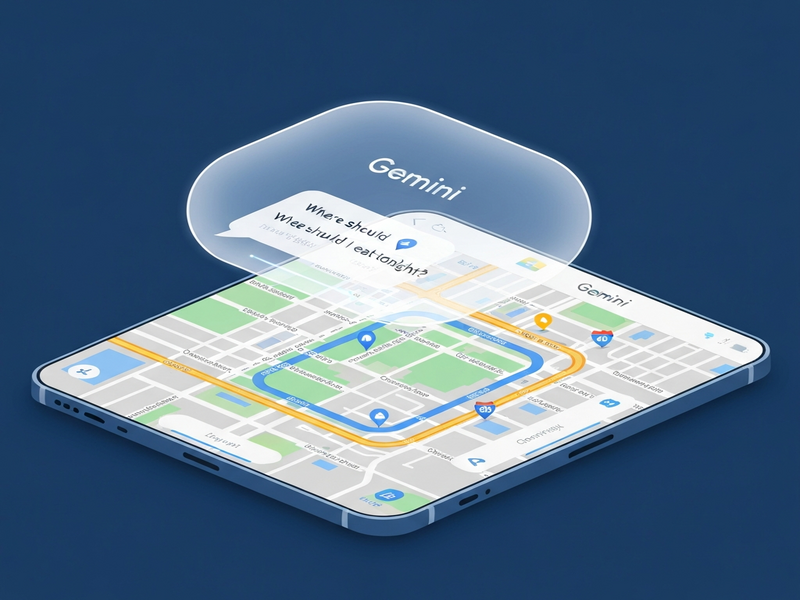
Google Maps’ new Ask Maps feature, powered by the Gemini generative‑AI model, lets users ask natural‑language questions about routes, places, and itineraries and receive AI‑crafted navigation answers instantly.
Why Ask Maps matters for today’s tech‑savvy professionals
Navigation apps have evolved from static maps to dynamic assistants, but most still require users to click through menus or type precise queries. Ask Maps changes that paradigm by embedding a conversational AI directly into Google Maps, allowing users to say “Find a scenic drive from San Francisco to Big Sur with vegan lunch stops” and receive a ready‑to‑follow plan. For AI enthusiasts, frequent travelers, and businesses that rely on location intelligence, this is the first truly generative AI navigation experience on a mainstream platform.
Feature overview: How Ask Maps works
Ask Maps appears as a new tab under the search bar on mobile devices. When tapped, the interface offers prompt suggestions based on the user’s location, search history, and preferences. The Gemini engine then:
- Interprets natural‑language queries about destinations, routes, and activities.
- Combines real‑time traffic, public‑transport data, and local business listings.
- Generates step‑by‑step itineraries, complete with time estimates, points of interest, and personalized recommendations.
- Allows follow‑up questions, enabling a back‑and‑forth conversation similar to a chat with a human travel agent.
The feature is currently limited to Android and iOS, with a desktop rollout promised later this year. Users cannot disable the tab, mirroring Google’s broader strategy of making AI assistance a default part of its ecosystem.
Gemini AI integration: The engine behind the conversation
Gemini is Google’s next‑generation multimodal model, designed to understand text, images, and even limited audio inputs. In Ask Maps, Gemini leverages:
- Contextual awareness: It pulls from a user’s Google account data (e.g., saved places, calendar events) to tailor suggestions.
- Real‑time data fusion: Traffic conditions, road closures, and live business hours are merged with the model’s knowledge base.
- Generative itinerary creation: Instead of returning a static list, Gemini writes a narrative plan, adding tips like “reserve a sunset spot at Point Lobos” or “bring a reusable water bottle for the hike.”
This integration is part of Google’s broader push to embed Gemini across its suite— from Docs to Gmail— and marks the first time the model directly influences a consumer‑facing navigation product.
Rollout timeline: When you can try Ask Maps
The initial launch targets users in the United States and India, with a phased expansion to additional markets based on language support and data‑privacy regulations. The schedule looks like this:
| Phase | Region | Availability |
|---|---|---|
| 1 | US & India (mobile) | April 2026 (live) |
| 2 | EU, Canada, Australia (mobile) | Q3 2026 |
| 3 | Desktop web (global) | Late 2026 |
Google has not announced a way to opt out, but the company says it will respect privacy settings and allow users to delete conversational history from their Google Account.
User benefits: Real‑world use cases
Ask Maps is more than a novelty; it solves concrete problems for several personas:
Business travelers
A sales rep can ask, “Plan a route to visit three clients in Chicago tomorrow, with coffee breaks near each office.” Gemini returns a time‑optimized schedule, accounting for traffic and public‑transport options, saving hours of manual planning.
Event organizers
Organizers of a city‑wide festival can generate a “visitor guide” that highlights nearby attractions, dining options for different dietary preferences, and accessibility routes—all in one conversational flow.
Family road trips
Parents can request, “A kid‑friendly road trip from Denver to Yellowstone with stops for playgrounds and pet‑friendly hotels.” The AI suggests rest areas, pet‑friendly eateries, and even suggests a short hike at each major stop.
Local discovery for millennials
A user in Berlin might ask, “Find hidden street‑art spots near Kreuzberg and the best vegan brunch nearby.” Gemini pulls from recent reviews, user‑generated photos, and local event calendars to curate a personalized list.
For developers and AI platform providers, Ask Maps demonstrates a template for AI‑powered maps that can be replicated in custom solutions. UBOS, for example, offers a UBOS platform overview that lets enterprises embed generative AI into their own location‑based services, leveraging the same Gemini‑style conversational flow.
How Ask Maps stacks up against competing AI navigation tools
Several players have introduced AI‑enhanced navigation, but Google’s deep data reservoir gives Ask Maps a distinct edge. Below is a quick MECE comparison:
| Feature | Ask Maps (Google) | Apple Maps + Siri | Here Technologies AI |
|---|---|---|---|
| Natural‑language conversation | Yes – Gemini chatbot | Limited – Siri commands only | Basic Q&A, no multi‑turn |
| Real‑time traffic integration | Full integration | Full integration | Partial |
| Personalized recommendations (diet, interests) | Deep Google‑account context | Limited to Apple ecosystem | None |
| Multi‑modal output (text + map preview) | Yes – inline map snippets | No | No |
While Apple’s Siri can set a destination with a voice command, it does not generate a narrative itinerary. Here’s AI tools are strong in offline routing but lack the conversational depth that Gemini provides. For businesses seeking a fully integrated AI navigation stack, Google’s Ask Maps currently leads the pack.
Building on Ask Maps: Extending AI navigation with UBOS
Companies that want to embed similar capabilities into their own products can leverage UBOS’s Workflow automation studio and Web app editor on UBOS. By connecting the OpenAI ChatGPT integration or the Chroma DB integration, developers can create custom “Ask Maps”‑style assistants for niche verticals such as logistics, field service, or tourism.
For a quick start, UBOS offers ready‑made templates like the AI SEO Analyzer or the AI Article Copywriter. These templates demonstrate how to combine LLM prompts with data sources, a pattern that can be replicated for location‑based queries.
Cost considerations: From free consumer use to enterprise licensing
Ask Maps is free for end‑users within the supported regions, but enterprises that wish to embed the Gemini API into proprietary apps must negotiate a commercial agreement with Google Cloud. For organizations already using the Enterprise AI platform by UBOS, the incremental cost of adding a Gemini‑backed navigation module is typically lower than building a model from scratch.
UBOS’s own pricing is transparent: see the UBOS pricing plans for tiered options ranging from a free starter tier (ideal for startups) to an enterprise tier with dedicated support and SLA guarantees.
What’s next? Try Ask Maps and explore AI‑enhanced navigation
If you’re a tech‑savvy professional eager to test the limits of generative AI in everyday tools, update your Google Maps app today and tap the “Ask Maps” tab. For developers and businesses, consider how UBOS can accelerate your own AI‑driven location services using the same principles that power Gemini.
Ready to build your own AI navigation assistant? Explore the UBOS partner program and get early access to Gemini‑compatible APIs.
For the original reporting, see the original Wired article.
Andrii Bidochko
CTO UBOS
Andrii Bidochko is an AI entrepreneur and researcher focused on AI agents, reinforcement learning, and autonomous systems. He writes about the technologies shaping the future of machine intelligence, from frontier models and agent architectures to real-world AI applications.