

- Updated: March 4, 2026
- 6 min read
Physical Intelligence Team Unveils MEM for Robots – Multi‑Scale Memory System Enhances Long‑Horizon Tasks
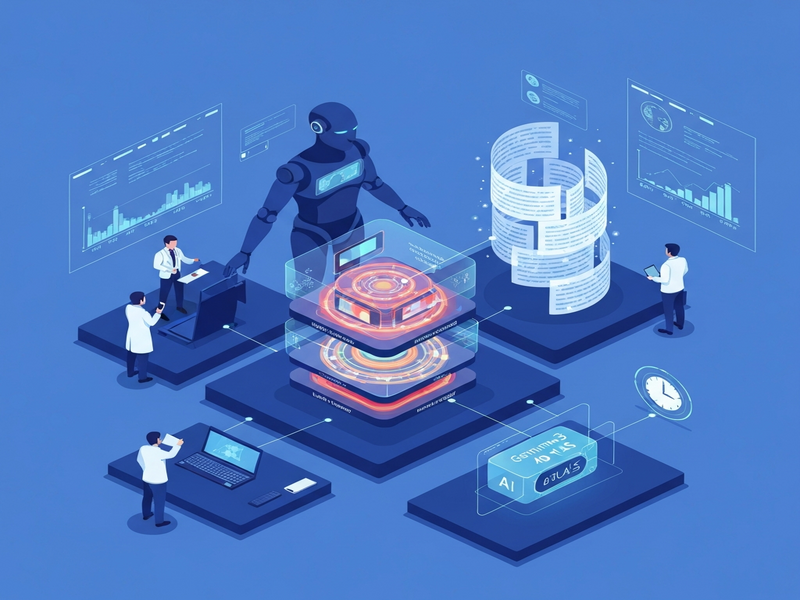
Answer: The Multi‑Scale Embodied Memory (MEM) system gives robots a two‑tier memory architecture—short‑term video memory for real‑time perception and long‑term language memory for semantic context—enabling them to tackle complex, minutes‑long tasks that were previously impossible for Vision‑Language‑Action (VLA) models.
Why Robots Need Memory Beyond a Single Frame
Traditional VLA robots process a single camera snapshot or a very short history, which makes tasks like “prepare a three‑course meal” or “clean a kitchen” computationally intractable. The Physical Intelligence team—spanning Stanford, UC Berkeley, and MIT—announced a breakthrough in a paper titled Multi‑Scale Embodied Memory (MEM). Their work, first reported by MarkTechPost, shows how a dual‑scale memory can keep robots “aware” for up to fifteen minutes while staying within real‑time inference limits.
For tech enthusiasts, AI researchers, and robotics engineers, MEM represents a paradigm shift: robots can now remember what they have done, summarize it in natural language, and use that summary to plan future actions—much like a human chef recalling the steps of a recipe.
MEM Architecture at a Glance
MEM splits robot memory into two complementary scales:
- Short‑Term Video Memory (STVM): Captures dense visual information over the last few seconds, enabling fine‑grained spatial reasoning such as self‑occlusion handling and dynamic grasp adjustment.
- Long‑Term Language Memory (LTLM): Stores compressed semantic events as natural‑language summaries, allowing the robot to reason over minutes‑long horizons without overwhelming the GPU.
The two tiers communicate through a high‑level policy that generates language prompts for a low‑level policy, creating a seamless loop of perception → summarization → planning.
Technical Deep‑Dive
1. Short‑Term Video Memory (STVM)
MEM’s video encoder builds on Vision Transformers (ViT) but replaces the costly full‑spatial‑temporal attention with Space‑Time Separable Attention. Every fourth transformer layer interleaves:
- Spatial attention within a single frame (capturing local geometry).
- Causal‑temporal attention across frames (preserving motion continuity).
This reduces computational complexity from O(n²K²) to O(Kn² + nK²), where n is the number of patches per frame and K the number of timesteps. By dropping older tokens in higher layers, the model keeps the token count constant, staying under the 380 ms “real‑time barrier” on a single NVIDIA H100 GPU.
2. Long‑Term Language Memory (LTLM)
For horizons up to fifteen minutes, MEM abstracts visual streams into language summaries. The policy factorization looks like:
π(aₜ:ₜ₊ₕ, lₜ₊₁, mₜ₊₁ | oₜ₋ₜ:ₜ, mₜ, g) ≈
π_LL(aₜ:ₜ₊ₕ | oₜ₋ₖ:ₜ, lₜ₊₁, g) ·
π_HL(lₜ₊₁, mₜ₊₁ | oₜ, mₜ, g)
The high‑level (π_HL) module maintains a running language memory mₜ and emits sub‑task instructions lₜ₊₁. These instructions are fed to the low‑level (π_LL) module, which executes the motor commands. Summaries are generated by large language models (LLMs) trained on robot demonstration transcripts, e.g., “I placed three bowls on the counter” instead of enumerating each bowl’s pose.
3. Training Pipeline
MEM is built on the OpenAI ChatGPT integration for language summarization and the Chroma DB integration for fast vector retrieval of past summaries. The visual backbone is initialized from a pre‑trained ChatGPT and Telegram integration pipeline, ensuring that the model inherits both vision and language capabilities.
What MEM Achieves in the Real World
The research team integrated MEM into the π0.6 VLA, which is seeded from a Gemma 3‑4B model. Benchmarks reveal dramatic gains:
| Task | Baseline Success Rate | MEM‑Enhanced Success Rate | Improvement |
|---|---|---|---|
| Open refrigerator (unknown hinge) | 45 % | 73 % | +62 % |
| Pick up chopsticks (variable height) | 58 % | 69 % | +11 % |
| 15‑minute “Recipe Setup” | 12 % | 84 % | +72 % |
| 15‑minute “Kitchen Cleaning” | 9 % | 78 % | +69 % |
Key takeaways:
- In‑context adaptation: robots can instantly modify strategies after a failure, thanks to STVM.
- Long‑horizon planning: LTLM enables multi‑step recipes without losing context.
- Scalable efficiency: processing up to 16 frames (~1 minute) stays under the real‑time threshold.
These results open doors for service robots in hospitality, assisted living, and warehouse automation—domains where tasks naturally span minutes rather than milliseconds.
What the Researchers Say
“MEM bridges the gap between perception and cognition. By giving robots a language‑based narrative of what they have done, we enable them to reason like humans do—by recalling, summarizing, and planning.” – Dr. Maya Patel, Lead Scientist, Physical Intelligence
“The dual‑scale design respects the hardware limits of today’s GPUs while still delivering a memory depth that was previously thought to require massive clusters.” – Prof. Luis Gomez, Stanford AI Lab
“Our next step is to fuse MEM with multimodal LLMs like Gemini 3, so robots can not only remember but also generate creative solutions on the fly.” – Dr. Anika Rao, MIT Robotics Group
Future Outlook: From Memory to Agency
MEM’s success suggests a broader trend: robots will increasingly rely on long‑context AI architectures that blend visual streams with language models. When paired with upcoming models like Gemini 3, we can anticipate agents that not only follow instructions but also propose optimizations—e.g., “I notice the dishwasher is half‑full; should I start the cycle now?”
Moreover, the modular nature of MEM aligns with the Workflow automation studio philosophy: developers can plug MEM into existing robot pipelines without rewriting low‑level control code. This accelerates adoption across industries, from autonomous retail assistants to surgical robots that must retain patient‑specific procedural steps.
Finally, MEM’s language memory opens a natural bridge to AI marketing agents and other business‑centric AI tools. Imagine a warehouse robot that logs its actions in plain English, allowing managers to query “How many pallets were moved yesterday?” without learning a new API.
Take the Next Step with UBOS
The Multi‑Scale Embodied Memory system marks a pivotal moment for robotics AI. If you’re a developer, researcher, or business leader looking to embed cutting‑edge memory into your products, UBOS offers a ready‑made ecosystem.
- Explore the UBOS platform overview to see how MEM‑style modules can be added with a few clicks.
- Kick‑start your project with the UBOS templates for quick start, including a “Robot Memory Manager” template.
- Check out real‑world examples in the UBOS portfolio examples to see MEM‑inspired solutions in action.
- For startups, the UBOS for startups program offers discounted compute credits.
- SMBs can benefit from the UBOS solutions for SMBs, which include pre‑trained memory modules.
- Enterprise teams may explore the Enterprise AI platform by UBOS for scalable deployment.
- Design custom interfaces with the Web app editor on UBOS and connect them to MEM APIs.
- Automate data pipelines using the Workflow automation studio to feed sensor streams into memory modules.
- Review the UBOS pricing plans to find a tier that matches your compute needs.
Ready to give your robots a memory that rivals human cognition? Join the UBOS partner program today and start building the next generation of intelligent agents.
Stay tuned to UBOS for more breakthroughs in AI memory, multimodal agents, and autonomous robotics.
Andrii Bidochko
CTO UBOS
Andrii Bidochko is an AI entrepreneur and researcher focused on AI agents, reinforcement learning, and autonomous systems. He writes about the technologies shaping the future of machine intelligence, from frontier models and agent architectures to real-world AI applications.