

- Updated: March 4, 2026
- 5 min read
Gary Marcus Unveils AI Claims Dataset with Evidence Scoring for Machine Learning Research
The Marcus Claims dataset, curated by AI skeptic Gary Marcus, contains 2,218 testable AI‑related claims that have been systematically scored against publicly available evidence, providing a valuable benchmark for machine‑learning researchers and data scientists.
Who Is Gary Marcus and Why His Claims Matter
Gary Marcus, a renowned cognitive scientist and vocal critic of unchecked AI hype, has spent the last four years publishing over 470 Substack posts that dissect the promises and pitfalls of modern artificial intelligence. His reputation for rigorous, evidence‑driven analysis makes the AI claims dataset a unique resource for anyone seeking to separate hype from reality in the fast‑moving machine learning landscape.
For teams looking to accelerate AI‑driven product development, the UBOS homepage offers a suite of tools that can ingest such datasets and turn them into actionable insights.
Dataset Size, Structure, and Methodology
The dataset comprises 2,218 individual claims extracted from Marcus’s Substack archive (May 2022 – March 2026). These claims are organized into 54 thematic clusters, ranging from “LLM security vulnerabilities” to “AI market bubbles.” Each claim is stored in a JSONL format with the following fields:
- Original quote
- Timestamp of the source post
- Cluster identifier
- Evidence‑scoring label (Supported, Mixed, Contradicted)
The extraction pipeline employed two independent large‑language‑model (LLM) systems—Claude (Opus 4.6) and ChatGPT (Codex). After parallel processing, a custom reconciliation layer merged the outputs, ensuring both claim‑level granularity and thematic consistency. Full methodological details are documented in the DATASET_GUIDE.md file within the repository.
Developers interested in rapid prototyping can leverage the Web app editor on UBOS to visualize and manipulate the JSONL records without writing a single line of code.
Evidence Scoring Process Explained
Each claim was evaluated against publicly available evidence as of 2 March 2026. The scoring algorithm follows a three‑tier rubric:
- Supported – The preponderance of verifiable sources confirms the claim.
- Mixed – Evidence is ambiguous or partially supportive.
- Contradicted – Reliable sources directly refute the claim.
Because the scoring was performed by LLMs, the authors caution users to treat the labels as “LLM‑scored” rather than human‑verified. Nevertheless, the aggregate results reveal striking patterns:
| Score | Percentage |
|---|---|
| Supported | 59.9 % |
| Mixed | 33.7 % |
| Contradicted | 6.4 % |
These figures suggest that, contrary to popular belief, a well‑informed skeptic can be more right than wrong when claims are grounded in technical detail. For teams building AI marketing agents, the dataset offers a ready‑made testbed for claim‑verification modules.
Why the Dataset Is a Game‑Changer for Machine Learning Research
Benchmarking claim‑verification models has historically suffered from a lack of high‑quality, labeled data. The Marcus Claims dataset fills this gap by providing:
- A large, diverse set of real‑world AI statements.
- Fine‑grained evidence labels that enable supervised learning.
- Clustered themes that support multi‑task learning approaches.
Researchers can train classifiers to predict the evidence scoring of unseen statements, evaluate retrieval‑augmented generation pipelines, or fine‑tune retrieval models such as Chroma DB integration. Early experiments reported in the repository’s outputs/chatgpt folder show that a simple BERT‑based classifier reaches an F1‑score of 0.78 on the “Supported vs. Contradicted” binary task.
Beyond pure research, the dataset can accelerate product validation for Enterprise AI platform by UBOS, where automated fact‑checking is a core differentiator for compliance‑heavy industries.
Accessing the Marcus Claims Dataset
The full repository is publicly available on GitHub. To download the data, clone the repository or fetch the claude_claims_final.jsonl file directly:
git clone https://github.com/davegoldblatt/marcus-claims-dataset.gitFor a quick start, the GitHub repository also includes a Jupyter notebook that demonstrates how to load the JSONL, compute cluster statistics, and visualize evidence distributions.
UBOS users can import the dataset into the Workflow automation studio to build end‑to‑end pipelines that automatically flag questionable AI claims in internal documents.
Visual Illustration of the Dataset
The image below captures the high‑level architecture of the data extraction and scoring workflow. It highlights the dual‑LLM pipeline, the reconciliation layer, and the final evidence‑scored output that feeds downstream analytics.
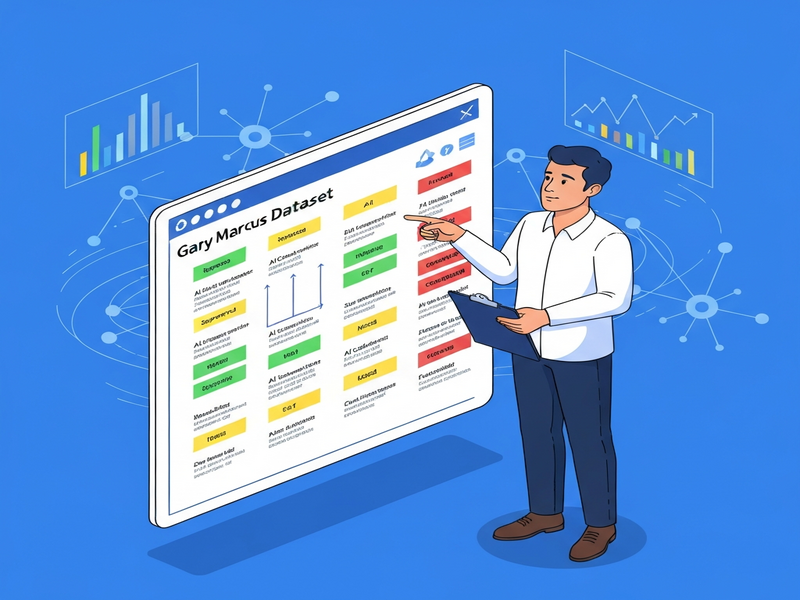
“The dataset not only quantifies the accuracy of a prolific AI skeptic but also provides a reproducible benchmark for future claim‑verification research.” – Dataset authors
For developers who prefer a template‑driven approach, the UBOS templates for quick start include a pre‑configured data‑ingestion workflow that can be adapted to this dataset in under ten minutes.
Conclusion: Leverage the Dataset to Elevate Your AI Research
The Marcus Claims dataset offers a rare, meticulously scored collection of AI statements that can serve as a gold standard for claim verification, bias detection, and model robustness testing. By integrating this resource with UBOS’s low‑code environment, data scientists and machine‑learning engineers can accelerate the development of trustworthy AI systems.
Ready to explore? Visit the UBOS partner program to get dedicated support for large‑scale data projects, or check out the UBOS pricing plans to find a tier that matches your team’s needs.
Stay ahead of the curve—use the Marcus Claims dataset today and contribute to a more transparent, evidence‑driven AI future.
Andrii Bidochko
CTO UBOS
Andrii Bidochko is an AI entrepreneur and researcher focused on AI agents, reinforcement learning, and autonomous systems. He writes about the technologies shaping the future of machine intelligence, from frontier models and agent architectures to real-world AI applications.