

- Updated: February 28, 2026
- 5 min read
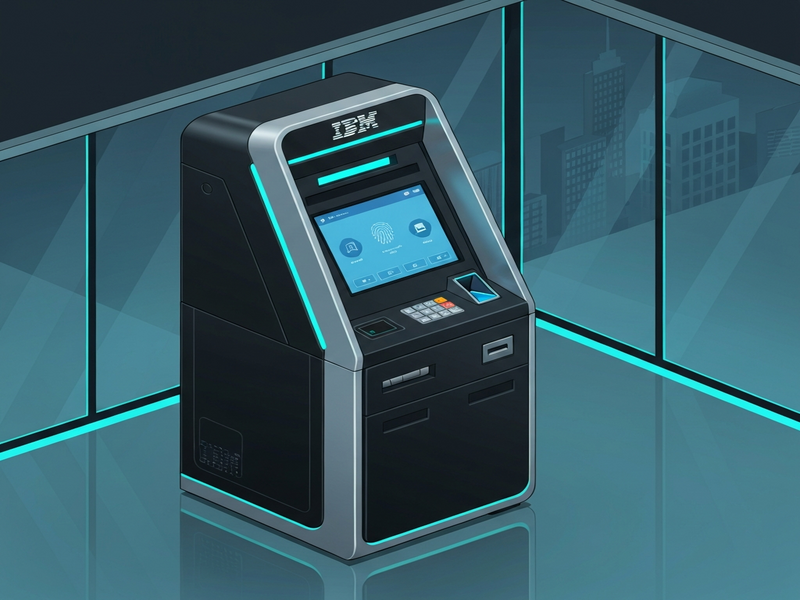
IBM’s Evolution of ATMs: From Cash Issuance to AI-Driven Future
IBM’s ATM Innovations: From Token Machines to Real‑Time Encryption
IBM’s ATM innovations introduced real‑time encryption, the first PIN‑offset algorithm, and networked peripheral architectures that still define modern cash‑handling devices today.
Why IBM’s ATM Story Matters to Today’s FinTech Landscape
Tech‑savvy professionals, banking analysts, and fintech enthusiasts are witnessing a rapid shift from cash‑heavy branches to digital‑first experiences. Yet the ATM remains a critical touchpoint for cash‑dependent customers. Understanding IBM’s pioneering work helps explain why today’s machines can securely dispense cash, verify identities, and even integrate AI‑driven analytics—all while staying compliant with stringent banking regulations.
In this deep‑dive we will trace IBM’s journey from the early token‑based dispensers to the encrypted, network‑aware terminals that set the stage for modern Enterprise AI platform by UBOS. Along the way we’ll sprinkle practical insights on how current AI SEO Analyzer tools can help banks market these services more effectively.
Historical Context of IBM ATM Development
The story begins in the 1950s, when banks still relied on manual ledgers and paper passbooks. IBM, already a leader in unit‑record equipment, supplied banks with check‑proofing machines (IBM 801‑803) that automated the tedious task of posting daily totals.
By the early 1960s, the About UBOS era of business automation was already in full swing, and IBM’s expertise in magnetic‑ink character recognition (MICR) paved the way for the first electronic cash‑handling concepts.
- 1959 – Introduction of ERMA (Electronic Recording Machine, Accounting) by General Electric, a direct competitor that forced IBM to accelerate its own ATM research.
- 1961 – IBM’s 1210 document reader/sorter paired with the IBM 1401 mainframe, enabling near‑real‑time check processing.
- 1967 – First token‑based cash dispensers appeared in the UK, but IBM was already prototyping a magnetic‑card solution.
Key Innovations and Milestones
IBM 2984 Cash Issuing Terminal (1971)
IBM’s first true ATM, the 2984, debuted in Lloyds Bank’s “Cashpoint” in the United Kingdom. It introduced three breakthroughs that still echo in today’s machines:
- Real‑time account verification via a Bisync link to a System/360 mainframe.
- Encrypted communications using a modified Feistel cipher (the precursor to the Data Encryption Standard, DES).
- PIN‑offset algorithm that stored a “natural PIN” on the card and allowed banks to rewrite the offset without re‑issuing cards.
Although the 2984 was expensive and limited to a few banks, its architecture became the blueprint for the later 3614/3624 series.
IBM 3614 & 3624 Consumer Transaction Facility (Late 1970s)
The 3614 and its successor, the 3624, were the first IBM ATMs to ship as catalog items. They added:
- Envelope deposit slots with automatic receipt printing.
- Standardized magnetic‑stripe writing capability.
- Improved cash cartridge modules for easier maintenance.
- Full‑screen CRT displays, moving away from the earlier VFD panels.
These models were widely installed across Europe and set the stage for the UBOS portfolio examples of modern banking automation.
IBM 4700 Finance Communication System (Early 1980s)
The 4700 series introduced distributed processing with the 4701 Communications Controller, allowing ATMs to operate offline for short periods and sync later. This concept foreshadowed today’s edge‑computing models used in Workflow automation studio.
InterBold: IBM + Diebold (1995‑1998)
After a decade of limited success, IBM partnered with Diebold to create the InterBold line (e.g., IBM 478x / Diebold 1000). The joint venture delivered:
- Standardized OS/2 operating system for ATMs.
- Enhanced security modules that later evolved into modern TPM (Trusted Platform Module) chips.
- Global distribution that made IBM‑branded ATMs common in the UK, while Diebold dominated the U.S. market.
The partnership ended when Diebold bought IBM’s share in 1998, but the technology legacy lives on in today’s AI Chatbot template solutions for customer service.
Impact on the Banking Industry
IBM’s innovations reshaped banking in three measurable ways:
| Area | IBM Contribution | Resulting Benefit |
|---|---|---|
| Security | DES‑derived encryption & PIN‑offset algorithm | Reduced fraud, industry‑wide adoption of encrypted ATM networks |
| Operational Efficiency | Distributed 4700 system with offline cash handling | Lower branch staffing costs, higher uptime |
| Customer Experience | Envelope deposit, receipt printing, real‑time balance checks | 24/7 self‑service, higher satisfaction scores |
Modern banks now leverage these foundations to embed AI‑driven analytics, such as predictive cash‑replenishment and personalized offers delivered via the ATM screen. For example, the AI marketing agents can analyze transaction patterns in real time and push targeted promotions directly to the user’s mobile device.
Future Outlook: From IBM’s Legacy to AI‑Powered Cash Hubs
As cash usage declines in many regions, ATMs are evolving from simple dispensers to multifunctional financial hubs. The next wave will likely combine IBM’s architectural principles with UBOS’s low‑code AI platform:
- Edge AI for fraud detection – Real‑time video analytics processed locally, reducing latency.
- Voice‑enabled services – Integration with ElevenLabs AI voice integration to guide users through complex transactions.
- ChatGPT‑powered assistance – Using the OpenAI ChatGPT integration, ATMs can answer regulatory questions or help with account opening.
- Data lake connectivity – Leveraging Chroma DB integration for semantic search across transaction histories.
Banks that adopt these capabilities can differentiate themselves in a crowded market. The UBOS templates for quick start already include a “Cash‑Hub Blueprint” that bundles the above services into a single deployable package.
Moreover, the rise of AI SEO Analyzer tools enables banks to optimize their digital presence around ATM‑related queries, driving foot traffic to physical locations while maintaining a strong online brand.
Conclusion
IBM’s ATM journey—from token dispensers to encrypted, network‑aware terminals—laid the technical and security foundations that modern fintech platforms still rely on. By understanding this lineage, banking leaders can better evaluate emerging AI‑driven extensions and avoid repeating past missteps.
Ready to modernize your ATM fleet with AI‑enabled services? Explore the UBOS pricing plans, try a Web app editor on UBOS, or contact our UBOS partner program for a tailored roadmap.
For a full technical deep‑dive, read the original news article that sparked this analysis.
Andrii Bidochko
CTO UBOS
Andrii Bidochko is an AI entrepreneur and researcher focused on AI agents, reinforcement learning, and autonomous systems. He writes about the technologies shaping the future of machine intelligence, from frontier models and agent architectures to real-world AI applications.