

- Updated: February 28, 2026
- 6 min read
Pentagon Flags Anthropic as AI Supply‑Chain Risk – Implications for Defense Contractors
The U.S. Department of Defense has officially designated Anthropic as a supply‑chain risk, prohibiting any contractor, supplier, or partner that does business with the military from conducting commercial activities with the AI startup.
Pentagon Labels Anthropic a Supply‑Chain Risk: What It Means for Generative AI, Defense Contracts, and Industry Regulation
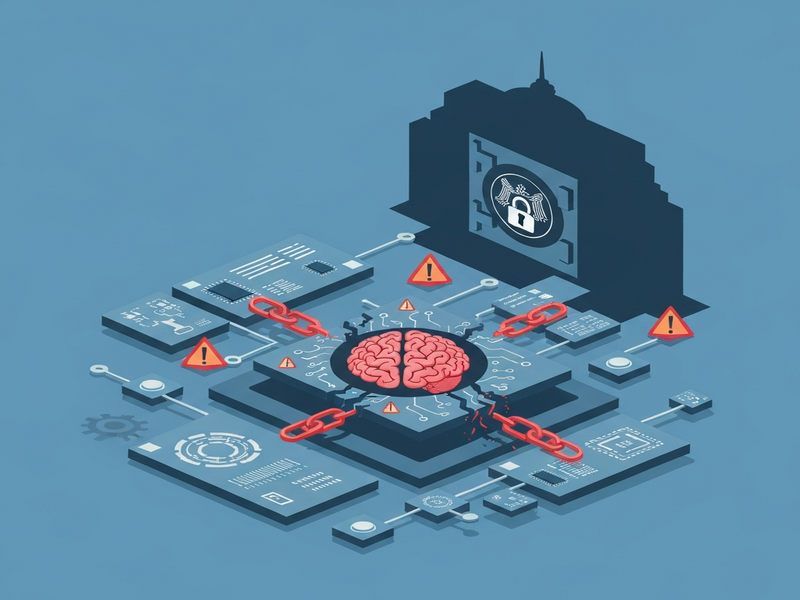
In a surprise move announced on Friday, Secretary of Defense Pete Hegseth used a social‑media post to declare Anthropic—a leading creator of the Claude family of large language models—a “supply‑chain risk” for the Department of Defense (DoD). The designation immediately restricts any defense contractor from engaging in commercial transactions with Anthropic, raising urgent questions for tech firms, policymakers, and AI enthusiasts about the future of AI integration in national security.
Anthropic’s Rise and the Pentagon’s Growing Appetite for Generative AI
Founded in 2020 by former OpenAI researchers, Anthropic quickly became known for its safety‑first approach to AI, launching Claude 2 and Claude 3 as direct competitors to OpenAI’s ChatGPT. The company secured a multi‑year contract with the DoD earlier this year to explore “lawful uses” of its models for mission‑critical tasks such as data analysis, decision‑support, and rapid prototyping.
The Pentagon’s interest stems from a broader AI supply chain risk strategy that aims to protect classified systems from potential vulnerabilities—whether they arise from foreign ownership, data leakage, or ethical concerns like autonomous weapons. Anthropic’s refusal to embed “mass domestic surveillance” or fully autonomous weapon capabilities into its contracts initially aligned with the DoD’s safety principles, but the lack of explicit carve‑outs for “all lawful uses” sparked a standoff.
About UBOS notes that transparency and governance are critical when integrating AI into high‑stakes environments, a theme echoed throughout the Pentagon‑Anthropic negotiations.
What the Supply‑Chain Risk Designation Actually Means
Under 10 U.S.C. § 3252, a supply‑chain risk designation allows the DoD to:
- Restrict or exclude vendors deemed to pose security vulnerabilities.
- Require risk assessments and congressional notification before enforcement.
- Potentially invoke the Defense Production Act to compel compliance.
In practice, the designation does not automatically terminate existing contracts. Instead, it creates a compliance hurdle that can halt new procurement and force contractors to reassess their supply chains. For Anthropic, the immediate impact is a chilling effect on any defense‑related partnership that also serves commercial customers.
The DoD’s statement emphasized “effective immediately,” but legal experts, such as Alex Major of McCarter & English, caution that the authority “is not clearly defined in current statutes,” leaving room for litigation.
Anthropic’s Counter‑Move: Legal Challenge and Public Defense
Anthropic responded the same evening with a blog post asserting that the DoD “does not have statutory authority” to impose the blanket restriction. The company pledged to “challenge any supply‑chain risk designation in court,” arguing that the move sets a dangerous precedent for any American firm negotiating with the government.
The startup also highlighted that it had not received any direct communication from the Pentagon or the White House, suggesting a breakdown in diplomatic channels. “Secretary Hegseth’s implication that anyone doing business with the military cannot work with Anthropic is legally unfounded,” the post read.
In parallel, Anthropic’s leadership reached out to industry allies, urging a collective response to protect AI innovation from “over‑reaching government mandates.”
Industry Shockwaves: From Silicon Valley to Defense Contractors
The announcement ignited a flurry of reactions across tech and defense circles:
- OpenAI’s response: CEO Sam Altman announced a separate agreement with the DoD that includes explicit safety carve‑outs, positioning OpenAI as a “compliant” alternative.
- Venture capitalists: Several investors warned that the decision could deter future funding for AI startups seeking government contracts.
- Defense contractors: Companies like Microsoft, Amazon, and Nvidia—already deep in DoD supply chains—are reviewing legal counsel to determine whether existing collaborations with Anthropic must be paused.
The broader implication is a potential “regulatory chill” that could slow AI adoption in defense. As UBOS AI regulation analysts note, a precedent of blanket risk designations may push firms toward more conservative, less innovative AI solutions.
Moreover, the incident underscores the need for clearer policy frameworks that balance national security with the rapid pace of AI development—a theme explored in depth on the UBOS AI news portal.
Strategic Takeaways for AI Supply‑Chain Risk Management
For organizations that rely on generative AI, the Anthropic case offers three actionable insights:
- Map contractual dependencies: Identify every vendor that could be classified as a supply‑chain risk under DoD rules.
- Embed safety clauses early: Negotiate explicit carve‑outs for prohibited uses (e.g., autonomous weapons, mass surveillance) before contracts are signed.
- Maintain legal agility: Prepare for rapid litigation or policy shifts by establishing a dedicated compliance team.
Companies can also leverage UBOS’s Workflow automation studio to automate risk‑assessment workflows, ensuring continuous monitoring of vendor status.
UBOS Tools That Help Navigate AI Regulation and Supply‑Chain Risks
UBOS offers a suite of platforms designed to simplify AI governance:
- UBOS platform overview – a unified dashboard for AI model monitoring and compliance.
- Enterprise AI platform by UBOS – scalable for large defense contractors.
- UBOS templates for quick start – includes the “AI SEO Analyzer” and “AI Article Copywriter” templates for rapid policy documentation.
- AI marketing agents – automate stakeholder communications about compliance updates.
- UBOS pricing plans – flexible tiers for startups and SMBs navigating new regulations.
For developers looking for ready‑made AI applications, the AI SEO Analyzer and AI Article Copywriter can accelerate content compliance checks, while the GPT‑Powered Telegram Bot (via the Telegram integration on UBOS) enables real‑time alerts for policy changes.
Read the Full Story on Wired
For a comprehensive account of the Pentagon’s decision, the legal back‑and‑forth, and reactions from industry leaders, see the original Wired article:
Anthropic Designated a Supply‑Chain Risk by the Pentagon – Wired
Key Takeaways
The Pentagon’s supply‑chain risk designation of Anthropic marks a pivotal moment in the intersection of AI innovation and national security policy. While the move aims to safeguard defense systems, it also introduces legal uncertainty that could slow AI adoption across the sector. Companies must now prioritize transparent contracts, robust compliance frameworks, and agile legal strategies to navigate this evolving landscape.
As the debate unfolds, platforms like UBOS are positioned to help organizations automate risk assessments, maintain regulatory compliance, and continue leveraging generative AI responsibly.
Andrii Bidochko
CTO UBOS
Andrii Bidochko is an AI entrepreneur and researcher focused on AI agents, reinforcement learning, and autonomous systems. He writes about the technologies shaping the future of machine intelligence, from frontier models and agent architectures to real-world AI applications.