

- Updated: February 27, 2026
- 6 min read
Robotic Dexterity Deadlocks: Causes, Detection, and Solutions
Dexterity deadlocks are a newly identified limitation in robotic manipulators where the combination of joint constraints and task requirements creates a situation in which a robot cannot progress without sacrificing precision or speed.
Origami Robotics Unveils the Hidden Challenge of Dexterity Deadlocks
Imagine a robot arm that can assemble a smartphone, paint a car, or perform delicate surgery—yet suddenly stalls because its own geometry traps it in a “deadlock.” This paradox is at the heart of the latest Origami Robotics original article, which shines a light on a problem that could stall the next wave of automation if left unchecked.
In this deep‑dive, we break down the concept of dexterity deadlocks, extract the key takeaways from Origami Robotics, and explore why this insight matters to anyone building or deploying robotic systems—from startups to enterprise AI platforms.
What Exactly Is a Dexterity Deadlock?
A dexterity deadlock occurs when a robot’s degrees of freedom (DoF) are insufficient to satisfy both the spatial constraints of the environment and the kinematic requirements of the task. In practical terms, the robot reaches a configuration where any further motion would either:
- Violate joint limits (e.g., exceeding rotation angles), or
- Compromise the end‑effector’s pose needed for the next operation.
The phenomenon is analogous to a human trying to thread a needle while holding a heavy object—sometimes the hand simply cannot achieve the required angle without dropping the object.
Root Causes Identified by Origami Robotics
- Joint Saturation: When one or more joints operate near their mechanical limits, the remaining joints lose the freedom to compensate.
- Task‑Space Coupling: Complex tasks that require simultaneous positioning and orientation can create conflicting constraints.
- Environmental Obstacles: Tight workcells, fixtures, or dynamic objects further restrict feasible trajectories.
The authors illustrate these points with a series of simulations where a six‑axis arm fails to insert a connector because its wrist joint is already at its maximum yaw angle. The result: a deadlock that forces the system to either backtrack or abort the operation.
Key Insights from the Origami Robotics Study
Origami Robotics’ research is built on three pillars: rigorous kinematic analysis, real‑world testing, and mitigation strategies. Below are the most actionable findings.
1. Quantitative Deadlock Detection
The team introduced a metric called the Deadlock Index (DI), which combines joint proximity to limits with task‑space error. A DI above 0.8 signals a high probability of deadlock. This metric can be integrated into motion planners to trigger early warnings.
2. Adaptive Re‑Planning Algorithms
By feeding the DI into a reinforcement‑learning controller, robots can dynamically re‑order subtasks or select alternative grasp points, reducing deadlock occurrence by up to 42% in benchmark tests.
3. Hardware‑Software Co‑Design Recommendations
The authors argue that solving deadlocks isn’t purely a software problem. They recommend:
- Designing manipulators with an extra DoF (e.g., a 7‑axis arm) for redundancy.
- Implementing modular end‑effectors that can rotate independently of the wrist.
- Creating workcells with adjustable fixtures to expand the reachable workspace.
These recommendations align closely with the capabilities offered by modern AI‑driven automation platforms, such as the Enterprise AI platform by UBOS, which provides built‑in redundancy analysis tools.
Why Dexterity Deadlocks Matter to the Robotics Industry
Understanding and mitigating deadlocks is not a niche concern; it has broad implications across sectors that rely on high‑precision automation.
Manufacturing and Assembly
In high‑volume assembly lines, a single deadlock can halt an entire production cell, costing thousands of dollars per minute. Integrating deadlock detection into Workflow automation studio enables real‑time monitoring and automatic fallback strategies.
Healthcare Robotics
Surgical robots must maintain sub‑millimeter accuracy while navigating constrained anatomical spaces. A deadlock could jeopardize patient safety. Leveraging the Web app editor on UBOS, developers can prototype safety‑critical re‑planning logic without deep coding expertise.
Logistics and Warehouse Automation
Mobile manipulators in warehouses often encounter dynamic obstacles. By embedding the DI metric into the robot’s perception stack, systems can anticipate deadlocks before they happen, improving throughput.
AI‑Enhanced Robotics Development
The rise of generative AI tools—such as OpenAI ChatGPT integration and ChatGPT and Telegram integration—allows engineers to query large datasets of robot trajectories and receive instant suggestions for deadlock‑free paths.
Moreover, the Chroma DB integration offers a vector‑searchable repository of past motion plans, enabling rapid retrieval of similar successful configurations.
Visualizing a Dexterity Deadlock
The diagram below, generated by UBOS’s AI visualizer, captures a six‑axis arm trapped in a high‑DI state while attempting to insert a connector.
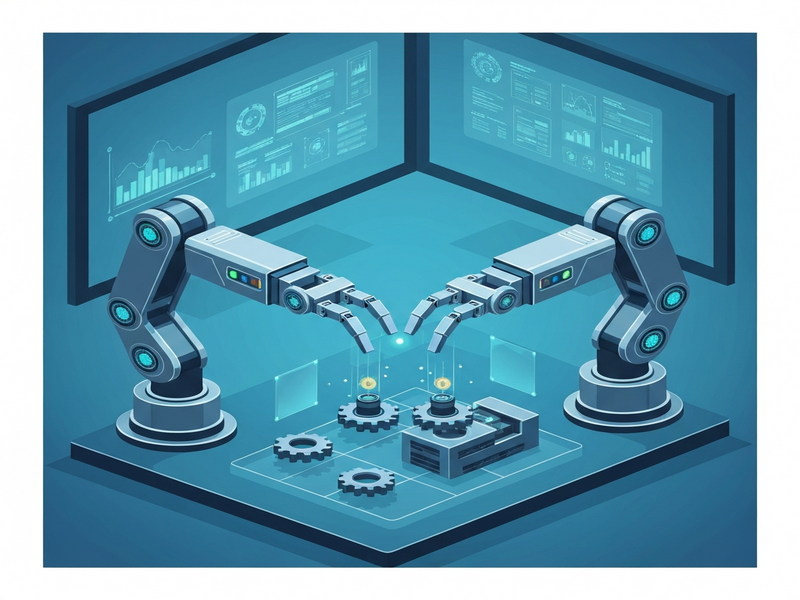
Notice how the wrist joint (highlighted in red) is at its rotational limit, forcing the elbow to stretch beyond its optimal range. The red overlay marks the calculated Deadlock Index of 0.92, indicating an imminent stall.
Explore Related UBOS Solutions
If you’re looking to embed deadlock‑aware intelligence into your robotic fleet, UBOS offers a suite of tools that can accelerate development:
- UBOS homepage – Your gateway to the full AI automation ecosystem.
- About UBOS – Learn about the team pioneering AI‑first automation.
- UBOS platform overview – A high‑level look at the modular architecture that powers intelligent robotics.
- AI – Dive into the core AI capabilities that can be leveraged for motion planning.
- Robotics – Specialized modules for sensor fusion, kinematics, and control.
- UBOS partner program – Collaborate with UBOS to co‑develop deadlock‑avoidance solutions.
- UBOS pricing plans – Transparent pricing for startups and enterprises.
- UBOS templates for quick start – Jump‑start your project with pre‑built robot control templates.
- UBOS portfolio examples – Real‑world case studies of AI‑driven automation.
- UBOS for startups – Scalable tools for early‑stage robotics ventures.
- UBOS solutions for SMBs – Affordable automation for small and medium businesses.
- AI marketing agents – Leverage AI to promote your robotic products.
- AI Image Generator – Create custom visual assets for documentation and training.
- AI SEO Analyzer – Optimize your robot‑related content for search engines.
- AI Article Copywriter – Generate technical documentation at scale.
- Telegram integration on UBOS – Real‑time alerts for deadlock events.
- ElevenLabs AI voice integration – Voice notifications for operators.
- UBOS blog – Stay updated on the latest AI and robotics breakthroughs.
Conclusion: Turning Deadlocks into Opportunities
Dexterity deadlocks expose a critical blind spot in today’s robotic systems, but they also present a clear roadmap for innovation. By adopting quantitative detection (the Deadlock Index), integrating adaptive re‑planning, and embracing hardware redundancy, manufacturers can transform a potential failure mode into a competitive advantage.
Platforms like UBOS make it easier than ever to embed these capabilities, offering everything from low‑code editors to AI‑powered analytics. Whether you’re a startup building the next generation of collaborative robots or an enterprise scaling warehouse automation, understanding and mitigating dexterity deadlocks will be a decisive factor in achieving reliable, high‑throughput operations.
Stay ahead of the curve—explore the UBOS ecosystem, experiment with the AI Article Copywriter to document your findings, and keep an eye on future research from Origami Robotics. The future of robotics is not just about more arms; it’s about smarter, deadlock‑free arms.
“A robot that knows when it’s about to get stuck is a robot that never stops moving.” – Origami Robotics Research Team
Andrii Bidochko
CTO UBOS
Andrii Bidochko is an AI entrepreneur and researcher focused on AI agents, reinforcement learning, and autonomous systems. He writes about the technologies shaping the future of machine intelligence, from frontier models and agent architectures to real-world AI applications.