

- Updated: February 25, 2026
- 6 min read
Anthropic Claude AI Safeguards Under US Military Pressure – Latest Developments
The U.S. Department of Defense met with Anthropic on 24 February 2026, and Defense Secretary Pete Hegseth gave CEO Dario Amodei a deadline to relax Claude’s safety safeguards or face contract penalties.
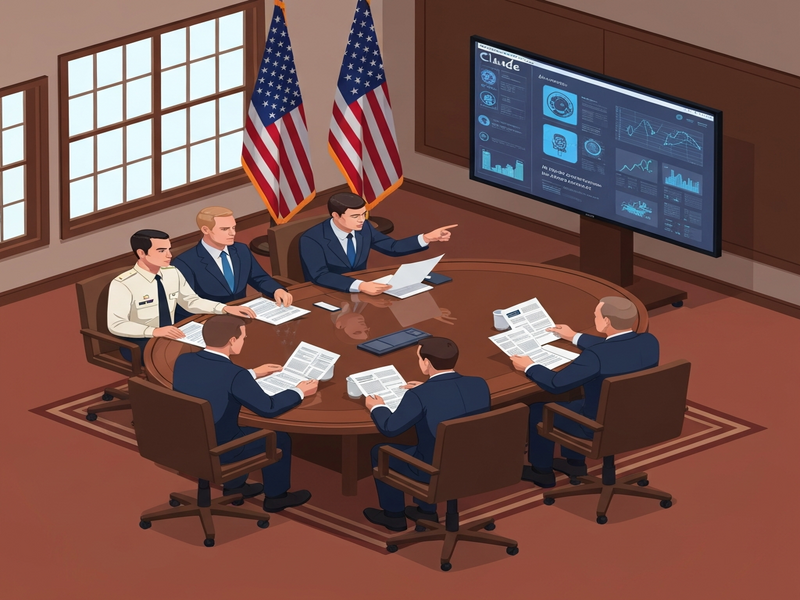
The high‑stakes encounter between senior U.S. military leaders and the AI‑safety‑focused startup Anthropic highlighted a growing clash: the Pentagon wants unfettered access to the generative‑AI model Claude for defense‑grade applications, while Anthropic insists on strict ethical guardrails that prohibit autonomous lethal use and mass‑surveillance scenarios. The meeting, held at the Pentagon’s Joint Artificial‑Intelligence Center, ended with a stark ultimatum—modify the safeguards by Friday or risk losing a multi‑hundred‑million‑dollar contract.
Background on Anthropic and Claude
Anthropic, founded in 2020 by former OpenAI researchers, positions itself as the “most safety‑forward” AI firm. Its flagship large‑language model, Claude, is marketed as a “helpful, harmless, and honest” system, built on a safety‑first training pipeline that includes constitutional AI principles and continuous red‑team testing. Unlike competitors that have already signed broad‑use agreements with the Department of Defense, Anthropic has limited Claude’s deployment to non‑lethal, non‑surveillance use cases, citing internal policies and a public commitment to AI ethics.
Who attended the Pentagon‑Anthropic meeting?
- Secretary of Defense Pete Hegseth
- Deputy Secretary of Defense Laura Cooper
- Chief Technology Officer of the DoD, Emil Michael
- Director of the Joint Artificial‑Intelligence Center, Brig. Gen. James “Jim” H. McCarthy
- Anthropic CEO Dario Amodei and Chief Safety Officer Olivia Miller
Key points of the discussion
Defense Secretary’s ultimatum
Secretary Hegseth opened the session by stating that the Department of Defense has already integrated Claude into classified analytics pipelines for threat‑assessment and mission‑planning. He warned that “if Anthropic does not align Claude’s safeguards with the operational realities of modern warfare by 5 p.m. EST Friday, we will invoke the penalty clause in the contract and re‑classify Anthropic as a supply‑chain risk.”
Anthropic CEO’s stance on safeguards
Dario Amodei responded that Anthropic’s safety framework is non‑negotiable. He emphasized that Claude’s “hard stop” on autonomous weaponization is a core component of the company’s constitutional AI approach. “We can provide the model for intelligence analysis, logistics, and simulation, but we will not enable a system that can select and fire on a target without human oversight,” Amodei told the room.
AI safeguards and ethical concerns
The disagreement centers on three technical safeguards:
- Capability gating: Claude is prevented from generating code that could be used to control weapon systems.
- Content filtering: The model blocks prompts related to mass surveillance, disinformation campaigns, or instructions for lethal autonomous behavior.
- Human‑in‑the‑loop enforcement: Every output intended for operational use must be reviewed by a qualified human analyst before deployment.
Critics argue that these guardrails could slow decision‑making in high‑tempo combat environments, while advocates warn that loosening them could create “AI‑enabled doomsday scenarios.” The Pentagon’s push for “all lawful purposes” mirrors recent agreements with OpenAI and xAI, where those firms agreed to remove most restrictions in exchange for lucrative contracts.
Industry and policy reactions
The meeting has sparked a flurry of commentary across think‑tanks, congressional committees, and private‑sector AI labs. Below are the most salient viewpoints:
- Congressional Oversight Committee: Chairman Rep. Jenna Marshall (R‑TX) called for a hearing on “AI safety versus national security,” urging the DoD to publish a transparent risk‑assessment framework.
- AI Ethics Alliance: The coalition released a statement that “any relaxation of safety guardrails must be accompanied by independent audits and real‑time monitoring.”
- Tech industry leaders: CEOs of OpenAI and Google’s DeepMind publicly welcomed the Pentagon’s “all‑lawful‑purposes” stance, arguing that “responsible AI can be both safe and mission‑critical.”
- Military analysts: A recent UBOS military‑tech briefing highlighted that autonomous weapon systems already in testing rely on “human‑on‑the‑loop” architectures, making Claude’s current safeguards compatible with existing doctrine.
Guardian’s reporting – a direct quote
“Anthropic’s refusal to loosen Claude’s safeguards has put the company at odds with a Pentagon that is desperate to embed generative AI across its war‑fighting toolkit,” the Guardian wrote. “If the deadline passes without a compromise, the contract could be terminated, sending a clear signal to the AI industry about the cost of ethical rigidity.”
What this means for the future of military‑AI partnerships
The outcome of this negotiation will likely set a precedent for how other AI firms engage with defense customers. Three scenarios are emerging:
| Scenario | Implications |
|---|---|
| Anthropic complies | Claude gains broader deployment; industry sees a shift toward looser safeguards, potentially accelerating AI weaponization. |
| Anthropic holds firm | Contract termination; other firms may seize the market share, but a clear ethical boundary is reinforced. |
| Hybrid compromise | Selective relaxation for non‑lethal use cases, preserving safety while satisfying some Pentagon needs. |
Regardless of the path chosen, the episode underscores the tension between rapid AI adoption for strategic advantage and the responsibility to prevent misuse. As the DoD continues to pour billions into AI‑enabled platforms—from unmanned aerial systems to predictive logistics—clear policy frameworks will be essential to avoid an “AI arms race” that outpaces ethical oversight.
Take action – explore more AI news and military tech
Stay informed about the evolving landscape of AI governance, defense contracts, and emerging generative‑AI tools by visiting our dedicated sections:
- UBOS AI news hub – daily updates on policy, research, and industry moves.
- UBOS military‑tech portal – deep dives into AI‑driven defense platforms.
For organizations looking to experiment with AI safely, UBOS offers a suite of tools that embed ethical guardrails by design. Explore the UBOS platform overview to see how you can build, test, and deploy AI models with built‑in compliance. Need a quick start? Check out the UBOS templates for quick start, including the AI SEO Analyzer and the AI Chatbot template. Our UBOS partner program also provides co‑marketing opportunities for firms navigating the defense‑AI space.
Whether you are a defense analyst, a policy maker, or an AI enthusiast, the Anthropic‑Pentagon standoff is a pivotal case study in balancing innovation with responsibility. Follow the story as it unfolds, and consider how your organization can contribute to a future where powerful AI serves humanity without compromising safety.
Ready to explore AI solutions that prioritize safety?
Andrii Bidochko
CTO UBOS
Andrii Bidochko is an AI entrepreneur and researcher focused on AI agents, reinforcement learning, and autonomous systems. He writes about the technologies shaping the future of machine intelligence, from frontier models and agent architectures to real-world AI applications.