

- Updated: February 24, 2026
- 6 min read
New Relic Launches No‑Code AI Agent Platform with OpenTelemetry Tools
New Relic Unveils AI Agent Platform & OpenTelemetry Tools for Enterprise Observability
New Relic’s new AI Agent Platform, combined with enhanced OpenTelemetry support, gives enterprise IT managers a no‑code, AI‑driven observability stack that can automatically detect anomalies, resolve incidents, and unify telemetry data across cloud‑native environments.
What the Announcement Means for Enterprises
On February 24, 2026 New Relic announced a no‑code AI agent platform that lets organizations build, deploy, and manage AI‑powered monitoring agents without writing a single line of code. At the same time, the company upgraded its OpenTelemetry (OTel) capabilities, allowing APM agents to ingest, process, and visualize OTel data streams alongside native New Relic telemetry. The combined offering targets the growing demand for AI‑driven monitoring and a unified observability experience.
Overview of New Relic’s AI Agent Platform
The New Relic Agentic Platform is built around three core pillars:
- Pre‑built AI agents: Ready‑to‑run bots that monitor latency spikes, error rates, and resource exhaustion.
- Drag‑and‑drop workflow builder: A visual canvas where users can chain data sources, AI models, and remediation actions.
- Model Context Protocol (MCP) integration: Enables secure, real‑time connections between AI agents and external data stores, SaaS APIs, or on‑prem databases.
Because the platform is no‑code, enterprise IT managers can assemble sophisticated monitoring pipelines in minutes. The UI follows a Tailwind‑styled component library, making the experience feel modern and responsive.
Key Features at a Glance
| Feature | Benefit |
|---|---|
| Zero‑code agent creation | Reduces reliance on specialized data‑science teams. |
| MCP‑enabled data federation | Securely pulls context from CRM, ERP, or custom DBs. |
| Built‑in anomaly detection | Detects outliers before they impact users. |
| Auto‑remediation actions | Triggers scaling, restarts, or alerts without human intervention. |
Deep Dive: Integrated OpenTelemetry Tools
OpenTelemetry has become the de‑facto standard for collecting traces, metrics, and logs across heterogeneous environments. New Relic’s latest update embeds full OTel support directly into its APM agents, eliminating the need for separate collector fleets.
Key capabilities include:
- Unified ingestion pipeline: Send OTel data to New Relic via a single endpoint; the platform normalizes it alongside native telemetry.
- Dynamic schema mapping: Automatic alignment of custom attributes to New Relic’s data model.
- Fleet‑wide collector management: Central UI to start, stop, and configure OTel collectors across cloud, on‑prem, and edge nodes.
According to Nic Benders, Chief Technology Strategist at New Relic, “Running OTel collectors is a burden for many teams. Our integrated approach turns that burden into a plug‑and‑play experience, accelerating enterprise adoption of the OTel framework.”
Why This Matters for Observability
By converging AI agents with OTel data, New Relic creates a feedback loop where AI models continuously learn from the most granular telemetry. This loop enables:
- Proactive detection of performance regressions.
- Root‑cause analysis that spans services, containers, and serverless functions.
- Self‑healing mechanisms that execute remediation scripts automatically.
Target Audience & Expected Impact
The platform is explicitly designed for enterprise IT managers, SRE teams, and technology decision‑makers who need to scale observability without expanding headcount. By abstracting the complexity of AI model training and OTel collector orchestration, New Relic promises:
- Faster time‑to‑value for monitoring initiatives.
- Reduced operational overhead and lower total cost of ownership.
- Higher confidence in SLA compliance through AI‑driven predictive alerts.
Key Benefits & Real‑World Use Cases
Below are the most compelling benefits, illustrated with concrete enterprise scenarios:
Benefit #1 – Automated Anomaly Detection
AI agents continuously analyze latency, error‑rate, and CPU‑usage streams. When a deviation exceeds a learned threshold, the agent raises a high‑priority incident before users notice any slowdown.
Benefit #2 – Self‑Healing Deployments
In a micro‑services architecture, a sudden spike in memory consumption can trigger an auto‑scale action. The AI agent calls the Kubernetes API to add pods, then verifies stability, closing the loop without human input.
Benefit #3 – Unified Telemetry Dashboard
Because OTel data lands in the same data lake as New Relic’s native metrics, teams can build a single dashboard that shows traces, logs, and AI‑generated insights side‑by‑side.
Benefit #4 – Context‑Rich Alert Enrichment
Through the Model Context Protocol, alerts are enriched with CRM customer IDs, recent ticket history, or feature‑flag status, giving on‑call engineers the full business context at the moment of alert.
Placement Note for the Generated Image
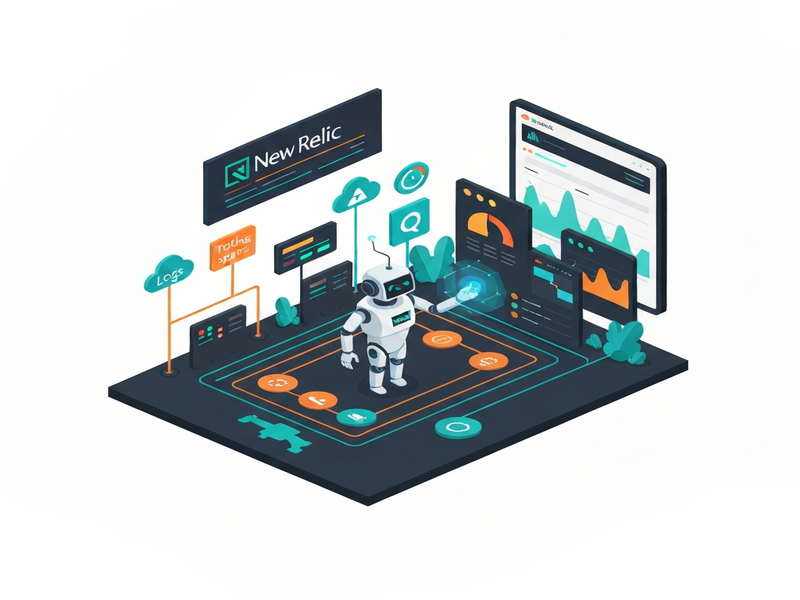
The following visual illustrates the data flow from OpenTelemetry collectors through New Relic’s AI Agentic Platform to automated remediation actions.
External Reference
For the original announcement, see the TechCrunch article that first reported the launch.
Relevant UBOS Resources
While New Relic expands its AI‑driven observability stack, UBOS AI agents provide a complementary low‑code environment for building custom monitoring bots that can be integrated with any SaaS platform, including New Relic.
For a broader view of how AI enhances system health, explore the observability solutions offered by UBOS. These resources detail best practices for combining telemetry, AI inference, and automated remediation across hybrid clouds.
How New Relic’s Offering Aligns with Industry Trends
Gartner recently labeled AI‑enabled agent platforms as “necessary infrastructure” for enterprise AI adoption. New Relic’s approach mirrors this guidance by delivering:
- Scalable, vendor‑agnostic data ingestion (via OpenTelemetry).
- Secure, policy‑driven AI execution (through MCP).
- Self‑service tooling that reduces the need for deep‑learning expertise.
Comparative Landscape
Other players such as Salesforce Agentforce and OpenAI Frontier have introduced similar capabilities, but New Relic differentiates itself by:
- Embedding OTel support directly into its APM agents, eliminating a separate collector layer.
- Offering a visual workflow studio that is fully Tailwind‑styled, making it instantly familiar to modern dev teams.
- Providing a transparent pricing model that aligns with enterprise budgets (UBOS pricing plans serve as a useful benchmark).
Implementation Checklist for IT Leaders
Before rolling out New Relic’s AI Agent Platform, consider the following steps:
- Assess telemetry sources: Identify which services already emit OpenTelemetry data.
- Define AI use cases: Prioritize anomaly detection, auto‑scaling, or alert enrichment.
- Map data governance policies: Ensure MCP connections comply with security standards.
- Pilot a single agent: Deploy a pre‑built “Latency Spike Detector” on a non‑critical service.
- Iterate and expand: Use the visual workflow studio to add remediation steps.
Conclusion: A New Era of AI‑Driven Observability
New Relic’s AI Agent Platform, paired with robust OpenTelemetry integration, marks a decisive shift toward AI‑driven monitoring that is both accessible and enterprise‑grade. By removing the code barrier, unifying telemetry, and providing secure context‑aware agents, the solution empowers IT managers to move from reactive firefighting to proactive, self‑healing operations.
For organizations already exploring AI‑enhanced observability, the platform offers a clear path forward—especially when combined with complementary tools like UBOS AI agents and the broader observability suite. As the industry converges on AI agents as essential infrastructure, early adopters will gain a competitive edge in reliability, cost efficiency, and customer satisfaction.
Andrii Bidochko
CTO UBOS
Andrii Bidochko is an AI entrepreneur and researcher focused on AI agents, reinforcement learning, and autonomous systems. He writes about the technologies shaping the future of machine intelligence, from frontier models and agent architectures to real-world AI applications.