

- Updated: February 23, 2026
- 5 min read
Donut Labs’ Solid‑State Battery Achieves Ultra‑Fast Charging in Independent Test
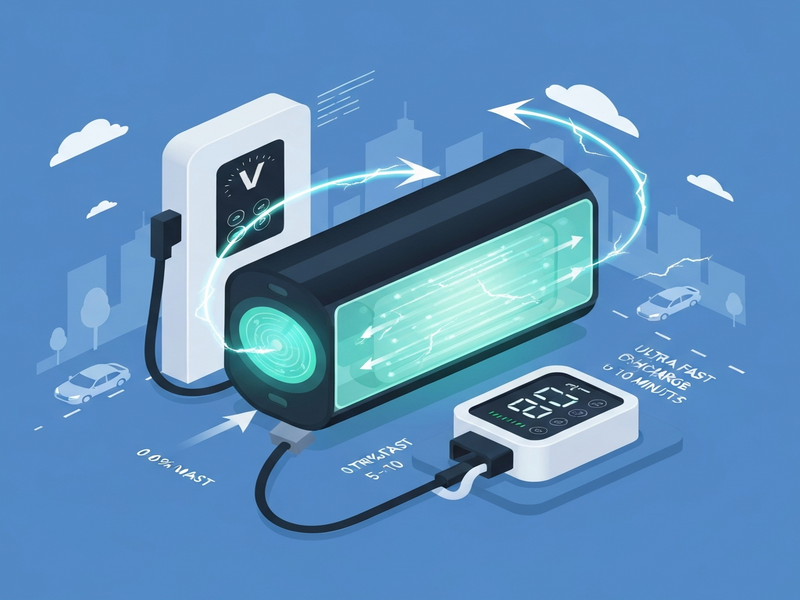
Donut Labs’ solid‑state battery can charge from 0 % to 80 % in under 5‑10 minutes while maintaining almost 100 % of its capacity, offering a game‑changing solution for rapid EV charging.
Independent Test Confirms Lightning‑Fast Charging
The Finnish research institute VTT Technical Research Centre of Finland performed the first independent evaluation of Donut Labs’ “Solid State Battery V1.” In a series of controlled experiments the pack achieved:
- 0 % → 80 % state‑of‑charge (SOC) in ≈ 4.5 minutes at a 11 C charge rate.
- 0 % → 80 % SOC in ≈ 9.5 minutes at a 5 C charge rate.
- Full 100 % SOC in just over 12 minutes under the 11 C scenario.
- Energy retention of 99‑100 % after each rapid‑charge cycle.
Notably, the tests were conducted with passive cooling only—no active liquid‑cooling system was attached—demonstrating the battery’s intrinsic thermal stability.
Why Solid‑State Beats Conventional Lithium‑Ion
Traditional lithium‑ion cells rely on liquid electrolytes that are flammable, temperature‑sensitive, and limit charge speed. Solid‑state batteries replace the liquid with a dry, inorganic electrolyte that offers:
- Higher energy density – up to 400 Wh kg⁻¹, roughly 30‑50 % more than today’s best lithium‑ion packs.
- Reduced risk of thermal runaway – the solid electrolyte does not ignite, even when temperatures approach 90 °C.
- Faster ion transport – enables ultra‑high C‑rates without the degradation seen in liquid systems.
- Longer cycle life – Donut Labs claims >100 000 cycles, dwarfing the 1 500‑3 000 cycles typical of current EV batteries.
The technology also eliminates the need for heavy compression mechanisms that many competing solid‑state designs require, simplifying pack architecture and cutting manufacturing costs.
What This Means for Charging Networks and EV Owners
Infrastructure Savings
Current fast‑charging stations (150‑250 kW) require robust power delivery, active cooling, and expensive real‑estate to accommodate long dwell times. A battery that can safely accept 5‑11 C rates with passive cooling could:
- Reduce station footprint by up to 40 %.
- Lower electricity demand spikes, easing grid integration.
- Enable “gas‑station‑like” 5‑minute top‑ups, dramatically improving user convenience.
Market Opportunities
Automakers that adopt Donut Labs’ pack could differentiate their models with a refuel‑in‑minutes experience, accelerating EV adoption among consumers who still cite charging time as a barrier. Fleet operators, especially in logistics and ride‑hailing, stand to gain massive productivity boosts.
Potential Applications Across the EV Ecosystem
| Sector | Benefit | Relevant UBOS Solution |
|---|---|---|
| Passenger EVs | 5‑minute “top‑up” replaces 30‑40‑minute stops | UBOS electric‑vehicles page |
| Commercial Fleets | Higher vehicle utilization, lower downtime | Enterprise AI platform by UBOS |
| Charging‑Station Operators | Reduced hardware costs, smaller footprints | UBOS charging technology overview |
| Battery‑Manufacturing Start‑ups | Simplified pack design, lower compression needs | UBOS for startups |
Industry Reaction
“Unlike other solid‑state batteries that need high compressive pressures and elaborate cooling, the Donut Battery operates safely with passive cooling, dramatically simplifying pack architecture and cost structure.” – Ville Piippo, CTO, Donut Labs
The takeaway is clear: if Donut Labs can scale this chemistry, the EV market could see a paradigm shift from “charging as a chore” to “charging as a quick pit stop,” reshaping consumer expectations and infrastructure planning alike.
Read the Full Test Report
For a detailed breakdown of the VTT methodology and raw data, see the original coverage on The Verge.
UBOS: Enabling the Next Generation of EV Apps
UBOS provides a low‑code platform overview that lets developers stitch together battery‑monitoring dashboards, predictive maintenance AI, and real‑time charging‑station orchestration without writing extensive code. Some relevant modules include:
- Workflow automation studio – automate alerts when a pack reaches 80 % SOC.
- Web app editor on UBOS – build customer‑facing “Find a 5‑minute charger near you” portals.
- AI marketing agents – personalize promotions for drivers who regularly use rapid‑charge stations.
By integrating Donut Labs’ battery data into UBOS’ template marketplace, OEMs can launch new EV services in weeks rather than months.
Ready‑Made Templates to Accelerate Adoption
AI SEO Analyzer
Optimize your charging‑station website for local search and capture the “fast‑charge near me” queries.
AI YouTube Comment Analysis
Gauge consumer sentiment on new rapid‑charging pilots directly from video feedback.
AI Article Copywriter
Generate blog posts that explain solid‑state benefits to non‑technical audiences.
AI Video Generator
Create short explainer videos showing a 5‑minute charge in action.
Cost Outlook and Timeline
While Donut Labs has not disclosed unit pricing, the elimination of active cooling and compression hardware suggests a potential 15‑25 % cost reduction versus premium lithium‑ion packs. Industry analysts project pilot deployments in 2027, with volume production slated for 2029‑2030.
Companies interested in early integration can explore the UBOS partner program to receive technical support, co‑marketing, and joint‑go‑to‑market strategies.
Conclusion: A Fast‑Charging Future Is Within Reach
Donut Labs’ solid‑state battery demonstrates that ultra‑fast charging does not have to come at the expense of safety or longevity. By delivering 0‑80 % SOC in under ten minutes with passive cooling, the technology addresses the most persistent pain point for EV adoption—charging time. As infrastructure providers, automakers, and software platforms like UBOS align around this breakthrough, the EV ecosystem is poised for a rapid‑charge renaissance that could finally make electric vehicles as convenient as gasoline cars.
Andrii Bidochko
CTO UBOS
Andrii Bidochko is an AI entrepreneur and researcher focused on AI agents, reinforcement learning, and autonomous systems. He writes about the technologies shaping the future of machine intelligence, from frontier models and agent architectures to real-world AI applications.