

- Updated: February 23, 2026
- 6 min read
Joann Fabrics vs Best Buy: Retail Failure and Business Strategy Insights
Joann Fabrics failed because leveraged‑buyout debt and poor governance drained cash flow, whereas Best Buy survived by stabilizing operations, price‑matching Amazon, and turning its stores into vendor‑paid showrooms.
Introduction: The Tale of Two Retail Giants
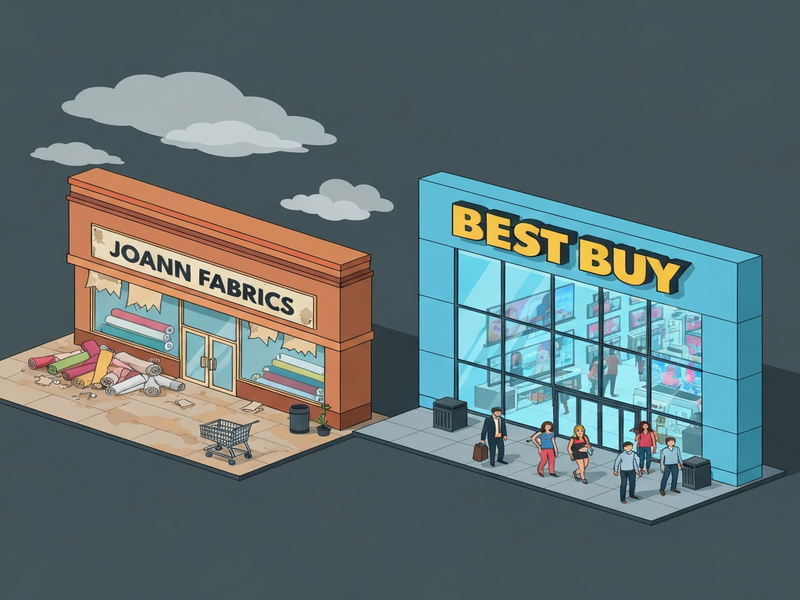
In early 2026 the retail landscape still echoes the stark contrast between Joann Fabrics and Best Buy. While Joann’s 800‑plus stores vanished by May 2025, Best Buy continues to attract shoppers with competent in‑store experiences. The divergence offers a textbook case for retail investors, business analysts, and e‑commerce strategists seeking to understand why some chains crumble and others endure.
For a full chronology of Joann’s downfall, see the original investigative piece at Governance FYI.
Why Joann Fabrics Struggled
1. Governance Breakdown
Joann’s board became a revolving door after the 2011 leveraged‑buyout (LBO) by Leonard Green & Partners. Frequent CEO turnover—nine CEOs in thirteen years—prevented a coherent long‑term strategy. Governance experts note that “continuous leadership churn erodes institutional memory and weakens accountability” (source: About UBOS).
2. Debt Overhang from Private‑Equity
The LBO loaded Joann with >$1 billion of debt and $5 million annual management fees. Interest payments regularly exceeded $100 million, siphoning cash that should have funded inventory, staff training, and technology upgrades. When rates rose in 2022‑23, the debt service ballooned, leaving the chain unable to restock shelves or maintain cutting counters—core differentiators for a craft retailer.
3. Operational Cuts That Killed the Experience
To meet debt obligations, Joann slashed labor. Knowledgeable floor staff vanished, leading to “bare shelves, skeleton crews, and fabric bolts in disarray,” as former employees described. The loss of skilled cutters directly reduced foot traffic and loyalty, pushing customers toward Hobby Lobby and online alternatives.
4. Missed Digital Investment
While competitors experimented with omnichannel tools, Joann’s cash constraints forced a “wait‑and‑see” approach. The result was a weak e‑commerce platform that could not compete with Amazon’s 4 % share of total U.S. retail sales or with niche marketplaces like Etsy.
How Best Buy Survived
1. Strategic Price‑Matching
In 2012, new CEO Hubert Joly instituted aggressive price‑matching against Amazon. By aligning online prices with brick‑and‑mortar offers, Best Buy removed the “showrooming” penalty that had previously driven shoppers to purchase online after in‑store research.
2. Store‑Within‑Store Model
Best Buy turned its physical footprint into a revenue‑generating asset by inviting vendors—Apple, Samsung, Microsoft—to create dedicated mini‑stores. These partnerships turned retail space into a paid marketing channel, offsetting operating costs and deepening vendor relationships.
3. Cost Discipline Without Debt‑Suffocation
Best Buy’s public‑company structure allowed it to retain cash flow for reinvestment. Joly’s $1 billion cost‑cut program focused on supply‑chain efficiency and non‑core business exits, not on draining cash for debt service. This disciplined approach kept the balance sheet healthy while funding store upgrades.
4. Stable Leadership and Culture
From 2012 to 2019, Best Buy enjoyed consistent leadership, enabling a multi‑year turnaround plan. The company also cultivated a culture of “customer‑first” service, which helped retain loyal shoppers even as online competition intensified.
Market Competition Beyond Amazon
Both Joann and Best Buy operated in a retail ecosystem reshaped by three forces:
- Oversupply of Physical Space: Mall construction outpaced population growth, creating excess square footage that pressured rent and inventory costs.
- Shifting Consumer Preferences: Millennials and Gen Z favor experiences and convenience, demanding seamless omnichannel options.
- Financial Engineering: Leveraged buyouts have become a common exit strategy, often leaving retailers with unsustainable debt loads.
While Amazon’s “effect” captures headlines, the real story is how retailers adapt—or fail—to these broader dynamics. For instance, Walmart leveraged its 4,700 stores as fulfillment hubs, growing its e‑commerce share to ~18 % in 2024 (Technology Impact).
Future Outlook: Lessons for Investors and Strategists
1. Scrutinize Ownership Structure
Companies with heavy LBO debt are vulnerable to interest‑rate spikes and cash‑flow squeezes. Investors should prioritize balance‑sheet health over short‑term earnings boosts.
2. Value Governance and Leadership Continuity
Stable, accountable boards and CEOs who can execute multi‑year plans are critical. The contrast between Joann’s revolving‑door leadership and Best Buy’s steady helm illustrates this point clearly.
3. Embrace Technology as an Enabler, Not a Panacea
Digital tools—AI‑driven analytics, workflow automation, and omnichannel platforms—can boost efficiency, but they must be funded. The Workflow automation studio on UBOS, for example, helps retailers streamline inventory and staffing without massive CAPEX.
4. Leverage AI for Competitive Edge
AI agents can personalize marketing, optimize pricing, and generate content at scale. Explore UBOS’s AI marketing agents or the UBOS templates for quick start such as the AI SEO Analyzer to stay ahead of the curve.
Actionable Takeaways for Retail Leaders
- Conduct a debt‑capacity stress test annually; aim for debt‑to‑EBITDA < 3 ×.
- Invest in staff training and in‑store expertise to differentiate from pure‑play e‑commerce.
- Adopt a price‑matching policy or a transparent price‑guarantee to neutralize showrooming.
- Partner with AI platforms (e.g., Enterprise AI platform by UBOS) to automate inventory forecasting.
- Maintain a public‑company governance framework or, if private, enforce independent board oversight.
Related UBOS Resources for Retail Transformation
Explore these UBOS solutions to future‑proof your retail operation:
- UBOS homepage – central hub for AI‑driven business tools.
- UBOS platform overview – learn how modular AI components integrate with legacy systems.
- UBOS partner program – collaborate with AI experts to co‑create retail solutions.
- UBOS pricing plans – flexible subscription models for SMBs and enterprises.
- UBOS portfolio examples – case studies of retailers who boosted margins with AI.
- UBOS for startups – rapid prototyping of AI‑enabled storefronts.
- UBOS solutions for SMBs – affordable automation for regional chains.
- Web app editor on UBOS – build custom dashboards without code.
- AI Article Copywriter – generate product descriptions at scale.
- AI YouTube Comment Analysis tool – gauge brand sentiment across video platforms.
- ChatGPT and Telegram integration – create real‑time support bots.
Conclusion: The Core Difference Is Capital Discipline
Joann Fabrics’ liquidation illustrates how leveraged‑buyout debt and fragmented governance can turn a cash‑flow‑positive retailer into a liability. Best Buy’s resilience, by contrast, stems from disciplined capital allocation, strategic vendor partnerships, and a stable leadership team. For investors and strategists, the lesson is clear: capital structure and governance matter more than the mere presence of e‑commerce competition.
Call to Action
If you’re a retail executive or investor looking to safeguard your portfolio against the pitfalls that doomed Joann, explore how UBOS’s AI suite can reinforce your balance sheet, streamline operations, and deliver a differentiated in‑store experience. Contact UBOS today for a free consultation.
Andrii Bidochko
CTO UBOS
Andrii Bidochko is an AI entrepreneur and researcher focused on AI agents, reinforcement learning, and autonomous systems. He writes about the technologies shaping the future of machine intelligence, from frontier models and agent architectures to real-world AI applications.