

- Updated: February 23, 2026
- 7 min read
AI Struggles with PDF Parsing: New Breakthroughs and Industry Impact
AI PDF parsing remains one of the most stubborn challenges in document AI, with even state‑of‑the‑art models struggling to reliably extract structured data from the ubiquitous PDF format.
AI PDF Parsing: The Unseen Bottleneck in Modern Document Intelligence
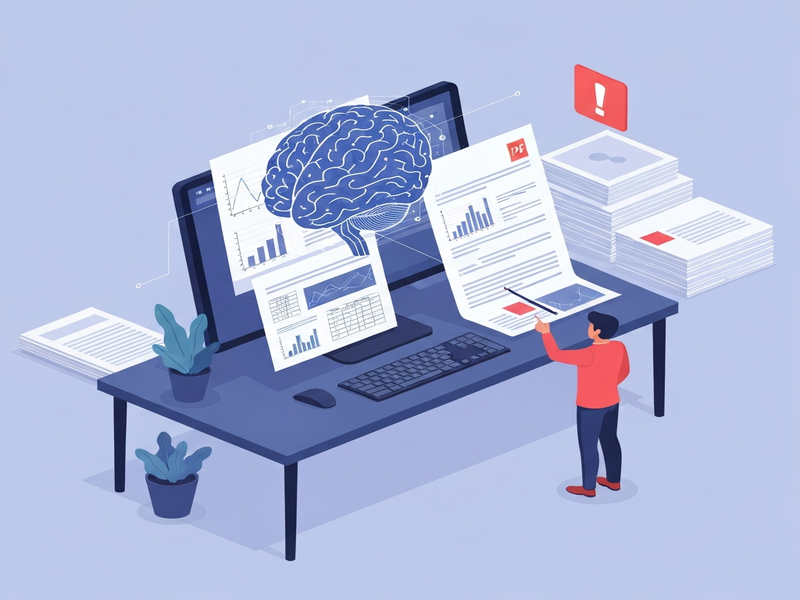
PDFs dominate the world of digital documents, yet their visual‑first design makes them notoriously hard for machines to read. Recent investigations by The Verge expose how even the most advanced large language models (LLMs) stumble over tables, footnotes, and multi‑column layouts. This article dissects the technical roadblocks, highlights breakthrough projects such as Reducto, Hugging Face, and the Allen Institute, and shows why solving PDF parsing is critical for AI‑driven enterprises.
Why AI Struggles with PDFs
Understanding the root causes helps developers design better pipelines. The challenges can be grouped into three MECE categories:
1. Structural Complexity
- PDFs store content as drawing commands (character codes, coordinates, vector graphics) rather than logical text flow.
- Multi‑column articles, nested tables, and embedded images break the linear reading order that LLMs expect.
- Footnotes, captions, and headers are often rendered as separate layers, confusing OCR pipelines.
2. Data Scarcity for Training
- Most public corpora (Common Crawl, Wikipedia) are HTML‑based; PDFs represent a tiny fraction of training data.
- High‑quality, human‑annotated PDF datasets are expensive to produce, limiting supervised fine‑tuning.
- Consequently, models default to “summarize‑the‑document” behavior instead of precise extraction.
3. Probabilistic Hallucinations
- LLMs generate the most likely token sequence, which can invent text when the visual input is ambiguous.
- In legal or engineering contexts, a single hallucinated number can cause costly errors.
- Detecting and correcting hallucinations adds another processing layer, increasing latency and compute cost.
These obstacles explain why a simple “upload‑PDF‑to‑ChatGPT” workflow still produces unreliable results.
Recent Breakthroughs in PDF Parsing
Several research labs and startups have begun to treat PDFs as a first‑class data source rather than an afterthought.
Reducto’s Multi‑Model Pipeline
Reducto combines a page segmentation model with specialist sub‑models for tables, charts, and footnotes. By first classifying each visual region, the system routes content to the most appropriate extractor, dramatically reducing cross‑region errors. The company reports up to 92% accuracy on complex financial statements, a leap from the typical 70% range.
Allen Institute’s olmOCR
The Allen Institute released olmOCR, a vision‑language model trained on 100,000 diverse PDFs, including scientific papers, patents, and historical archives. Its training objective explicitly penalizes mis‑aligned headers, enabling the model to distinguish a table’s header row from body rows with 96% precision.
Hugging Face’s Massive PDF Corpus
Hugging Face harvested 1.3 billion PDFs from the Common Crawl, then filtered them into “easy” and “hard” subsets. The hard subset was processed with a customized version of olmOCR (named RolmOCR</em). The resulting token dump—estimated at three trillion high‑quality tokens—has already powered several next‑generation multilingual models.
These initiatives share a common theme: divide‑and‑conquer. By breaking a PDF into semantic blocks before applying language understanding, they sidestep the “one‑size‑fits‑all” limitation of generic OCR.
Real‑World Impact and Use‑Cases
When PDF parsing becomes reliable, entire industries can automate workflows that currently rely on manual data entry.
Legal & Compliance
Law firms can ingest millions of contracts, automatically extracting clauses, dates, and jurisdiction information. This reduces review time from weeks to hours and enables AI‑driven risk scoring.
Finance & Auditing
Financial analysts can turn quarterly reports, balance sheets, and earnings call transcripts into structured tables for instant comparative analysis. Reducto’s chart‑to‑spreadsheet conversion is already used by several hedge funds to accelerate quantitative research.
Healthcare Records
Medical institutions still receive scanned lab results and radiology reports as PDFs. Accurate parsing allows AI to populate electronic health records (EHRs) without manual transcription, improving patient care and billing accuracy.
Government Transparency
Public agencies release policy documents, environmental impact statements, and census data in PDF form. Automated extraction makes these datasets searchable, supporting civic tech projects and open‑data initiatives.
For SaaS providers, integrating a robust PDF parser can become a differentiator. UBOS, for example, offers a Workflow automation studio that can chain a PDF‑parsing micro‑service with downstream analytics, all without writing code.
Expert Insight
“PDFs were never designed for machines. Treating them as visual scenes and applying specialized vision‑language models is the only path to true reliability,” says Luca Soldaini, senior researcher at the Allen Institute for AI. “We’ve moved from ‘good enough for demos’ to production‑grade accuracy, but the long tail of exotic layouts still demands continuous innovation.”
Future Outlook: From “Unsexy Failure” to Core Capability
Three trends will shape the next wave of PDF intelligence:
- Hybrid Retrieval‑Augmented Generation (RAG): Future LLMs will query a dedicated PDF index, retrieve exact spans, and then generate answers, eliminating hallucinations.
- Self‑Supervised Layout Learning: Models will learn to infer document structure from raw pixels without human annotations, dramatically expanding training data.
- Edge‑Optimized Parsers: With the rise of on‑device AI (e.g., Apple’s Neural Engine), secure PDF parsing can happen locally, preserving privacy for sensitive contracts.
As these capabilities mature, the PDF will transition from a “static snapshot” to a “live data source” that powers real‑time dashboards, AI assistants, and autonomous agents.
Take Action: Accelerate Your Document AI with UBOS
If you’re ready to embed cutting‑edge PDF parsing into your products, UBOS provides a suite of ready‑made integrations and templates:
- Start with the UBOS templates for quick start and spin up a PDF‑to‑JSON pipeline in minutes.
- Leverage the AI News Hub to stay updated on the latest breakthroughs.
- Explore the AI SEO Analyzer to ensure your newly parsed content is search‑engine ready.
- Use the AI Article Copywriter to automatically generate summaries from extracted text.
- Deploy a voice‑enabled assistant with the ElevenLabs AI voice integration for hands‑free document review.
- Connect your workflow to Chroma DB integration for semantic search over parsed content.
- For startups, the UBOS for startups program offers discounted pricing and dedicated support.
- SMBs can benefit from UBOS solutions for SMBs, which include pre‑built PDF ingestion modules.
- Enterprise teams looking for scale should evaluate the Enterprise AI platform by UBOS, which provides multi‑tenant security and SLA guarantees.
- Developers can experiment with the Web app editor on UBOS to prototype custom UI for document review.
- Automation enthusiasts will love the Workflow automation studio, where you can chain PDF parsing, data validation, and downstream analytics.
- Check the UBOS pricing plans to find a tier that matches your volume needs.
- Browse the UBOS portfolio examples for real‑world case studies.
- Learn how AI agents can boost marketing with AI marketing agents.
- Join the UBOS partner program to co‑sell PDF‑enhanced solutions.
- Explore the UBOS platform overview for a holistic view of all AI services.
- For a quick demo, try the AI Video Generator that can turn extracted text into narrated videos.
- Need a chatbot that can answer questions directly from PDFs? Deploy the AI Chatbot template in minutes.
By integrating these tools, you’ll turn the PDF from a bottleneck into a strategic asset, unlocking faster insights and new revenue streams.
Conclusion
AI PDF parsing is no longer a niche curiosity; it is a prerequisite for any organization that wants to harness the full power of its document archives. The convergence of specialized vision‑language models, massive curated PDF corpora, and modular SaaS platforms like UBOS is rapidly turning this “unsexy failure” into a reliable, production‑grade capability. Stay ahead of the curve by adopting the latest parsing pipelines today, and watch your data pipelines become faster, cleaner, and more intelligent.
Read the original Verge investigation here.
Andrii Bidochko
CTO UBOS
Andrii Bidochko is an AI entrepreneur and researcher focused on AI agents, reinforcement learning, and autonomous systems. He writes about the technologies shaping the future of machine intelligence, from frontier models and agent architectures to real-world AI applications.