

- Updated: February 21, 2026
- 5 min read
Claws: Andrej Karpathy Unveils New AI Agent Layer
Claws are a fresh layer of AI agents that sit on top of existing LLM agents, adding orchestration, persistence, and advanced tool‑calling capabilities.
Andrej Karpathy’s recent discussion has sparked excitement across the AI community, positioning Claws as the next evolutionary step in the artificial‑intelligence stack.
Why the AI world is buzzing about “Claws”
On 21 February 2026, Andrej Karpathy posted a concise yet thought‑provoking thread that introduced the term “Claws” to describe a new generation of agentic systems. In his mini‑essay, Karpathy likened Claws to the way LLM agents extended plain language models, arguing that Claws now extend those agents with a richer scheduling layer, persistent state, and container‑based execution.
For technology enthusiasts and AI professionals, this development signals a shift from single‑shot LLM interactions toward multi‑step, autonomous workflows that can run on personal hardware, communicate via messaging protocols, and maintain context over long periods.
Read the original article here for Karpathy’s full commentary.
What exactly are “Claws”?
In the simplest terms, a Claw is an AI agent that orchestrates other agents. While an LLM agent can interpret a prompt and call a tool, a Claw adds a supervisory layer that:
- Schedules recurring tasks and background jobs.
- Persists state across sessions, enabling long‑term projects.
- Runs each sub‑agent inside isolated containers for security and reproducibility.
- Communicates through lightweight messaging protocols (e.g., Telegram, MQTT).
This architecture mirrors the evolution from monolithic applications to micro‑services, but with the added nuance of generative AI at every node.
Andrej Karpathy’s key takeaways
Karpathy’s thread highlighted three core insights:
- Terminology matters. “Claw” is becoming a term of art for open‑source, personal‑hardware‑friendly agent systems.
- Modularity is king. By keeping the core engine under 4,000 lines of code, projects like NanoClaw stay auditable and flexible.
- Community momentum. A growing ecosystem—nanobot, zeroclaw, ironclaw, picoclaw—demonstrates rapid adoption.
Karpathy also noted the playful emoji 🦞 that now represents the whole category, underscoring the cultural impact of the concept.
Deep dive: NanoClaw and its siblings
Among the first implementations, NanoClaw stands out for its lean design. Its ~4,000‑line core fits comfortably in a developer’s mental model, making debugging and extension straightforward.
Key features of NanoClaw include:
- Container‑first execution model, ensuring each sub‑agent runs in isolation.
- Built‑in Chroma DB integration for vector‑based memory.
- Native support for OpenAI ChatGPT integration, allowing seamless LLM calls.
- Optional ElevenLabs AI voice integration for spoken feedback.
Other emerging Claw projects—ZeroClaw, IronClaw, and Picoclaw—share the same container‑centric philosophy while targeting niche use‑cases such as edge‑device orchestration or low‑latency voice assistants.
Why Claws matter in today’s AI landscape
The AI industry is currently transitioning from “one‑off” LLM queries to agentic pipelines. Companies are demanding:
- Scalable automation that can run continuously without human oversight.
- Secure, auditable execution environments for compliance‑heavy sectors.
- Cross‑tool orchestration that bridges LLMs, databases, and external APIs.
Claws answer these needs by providing a structured, container‑based layer that can be deployed on‑premise or in the cloud. This aligns perfectly with the rise of Enterprise AI platforms that promise end‑to‑end governance.
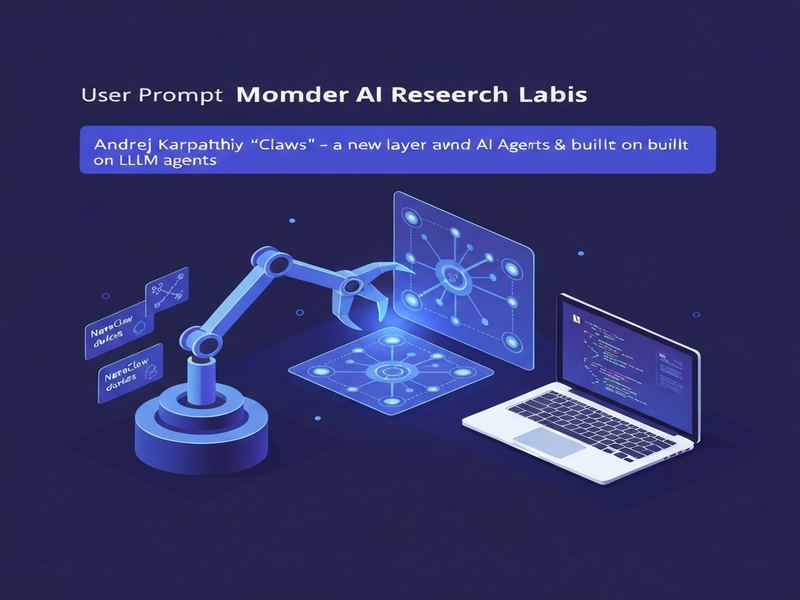
Figure: A visual representation of the Claw layer orchestrating multiple LLM agents within isolated containers.
How UBOS empowers developers building Claws
UBOS offers a suite of tools that make constructing, testing, and deploying Claws faster and more reliable:
- UBOS platform overview provides a unified dashboard for container orchestration and agent monitoring.
- The Web app editor on UBOS lets you prototype Claw workflows with drag‑and‑drop UI components.
- With the Workflow automation studio, you can define recurring tasks, set triggers, and visualize execution graphs.
- For startups, the UBOS for startups program offers credits and mentorship to accelerate time‑to‑market.
- SMBs benefit from UBOS solutions for SMBs, which bundle essential integrations at a predictable cost.
- Explore the UBOS templates for quick start—including the AI SEO Analyzer and AI Article Copywriter—to jump‑start Claw‑based services.
- Leverage the AI marketing agents to automatically generate campaign copy, schedule posts, and analyze performance.
- Integrate messaging channels with the Telegram integration on UBOS or combine it with ChatGPT and Telegram integration for real‑time user interaction.
- Monetize your Claw solutions through the UBOS partner program, which offers revenue sharing and co‑marketing.
- Transparent pricing is available on the UBOS pricing plans page, ensuring you can scale without surprise costs.
By combining these capabilities, developers can focus on the unique logic of their Claw while UBOS handles the heavy lifting of deployment, security, and observability.
Conclusion: The claw is out, and it’s reshaping AI orchestration
Andrej Karpathy’s introduction of “Claws” marks a pivotal moment in the AI evolution. By adding a persistent, container‑based orchestration layer on top of LLM agents, Claws enable truly autonomous systems that can run at scale, maintain context, and interact with the real world through secure messaging channels.
For AI professionals seeking to stay ahead, experimenting with Claw frameworks—starting with GPT‑Powered Telegram Bot or the AI Chatbot template—offers a low‑risk entry point.
Ready to build the next generation of autonomous agents? Visit the UBOS homepage to explore the full platform, or dive straight into the UBOS portfolio examples for inspiration.
Start building your Claw today and turn multi‑step AI workflows into a competitive advantage.