

- Updated: February 19, 2026
- 7 min read
YouTube Launches Conversational AI Assistant for Smart TVs
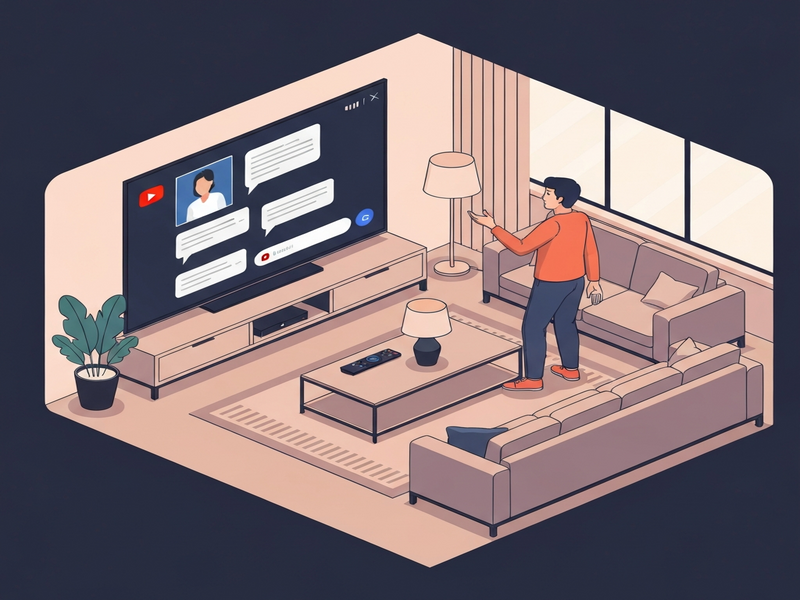
YouTube has rolled out a conversational AI feature for smart TVs, allowing viewers to ask questions about the video they are watching in real‑time using an “Ask” button on the screen.
The move marks the latest step in the race to bring AI‑driven interactivity to the living‑room. The experiment, first reported by TechCrunch, expands YouTube’s conversational AI from mobile and web to the biggest screen in most homes – the smart TV.
Overview of YouTube’s Conversational AI Test on Smart TVs
YouTube’s conversational AI, originally launched in 2024 for mobile browsers, now appears as an experimental overlay on select smart‑TV platforms, gaming consoles, and streaming devices. Users who meet the eligibility criteria (over 18, English, Hindi, Spanish, Portuguese, or Korean language settings) can see an “Ask” icon in the lower‑right corner of the video player. A single click summons a voice‑enabled assistant that can answer contextual questions without pausing playback.
According to a Nielsen report from April 2025, YouTube accounts for 12.4 % of total television audience time in the United States, outpacing traditional streaming giants. This growing TV footprint makes the AI expansion a strategic play to deepen engagement and keep viewers within the YouTube ecosystem.
How the Feature Works
The “Ask” Button and Voice Interaction
When the “Ask” button is pressed, a translucent overlay appears with a microphone icon. Users can either tap one of the suggested questions (e.g., “What ingredients are in this recipe?”) or speak a custom query using the TV remote’s built‑in mic. The AI processes the request in the cloud and returns a concise answer on screen, often accompanied by a short video clip or a link to related content.
Seamless Content Discovery
The assistant can also surface related videos, playlists, or product links, effectively turning a passive viewing session into an interactive discovery experience. For example, while watching a cooking tutorial, a viewer can ask, “How many grams of flour do I need?” and instantly receive the measurement without leaving the video.
- Instant answers without pausing playback.
- Multi‑language support for global audiences.
- Context‑aware suggestions based on video metadata.
- Integration with YouTube’s recommendation engine for follow‑up content.
Target Audience and Potential Impact on Viewing Habits
The primary audience comprises tech‑savvy households, streaming enthusiasts, and families that already use smart TVs as their main entertainment hub. By embedding an AI assistant directly into the viewing experience, YouTube aims to:
- Reduce friction when searching for supplemental information.
- Increase watch time by keeping users engaged with on‑screen answers.
- Drive higher ad revenue through contextual product placements.
- Gather richer interaction data to refine recommendation algorithms.
Early internal testing suggests that users who engage with the AI spend up to 18 % longer on a video session compared to those who do not. If the experiment scales, it could reshape how households interact with video content, turning passive consumption into an active dialogue.
How YouTube Stacks Up Against Competing AI Initiatives
YouTube is not the only player adding conversational AI to the living‑room. Below is a quick comparison of the most notable rivals:
| Platform | AI Feature | Key Strengths |
|---|---|---|
| Amazon Fire TV | Alexa+ voice assistant | Deep integration with smart‑home ecosystem, extensive third‑party skill library. |
| Roku | Roku AI voice | Open‑ended queries about movies, simple setup, broad device compatibility. |
| Netflix | AI‑enhanced search (beta) | Focus on personalized content discovery, strong recommendation engine. |
| YouTube (new) | Conversational AI on smart TVs | Context‑aware answers tied directly to video content, multi‑language support, seamless integration with YouTube’s massive library. |
While Amazon and Roku focus on general voice commands, YouTube’s approach is uniquely tied to the video’s metadata, delivering answers that are directly relevant to what the viewer is watching. This granularity could become a decisive advantage as creators and advertisers look for more precise engagement metrics.
Industry Insight
“YouTube’s expansion of conversational AI to the living‑room signals a shift from passive streaming to interactive media consumption. The ability to ask context‑specific questions without leaving the video could redefine how we think about search and discovery on TV,” says a senior analyst at a leading market research firm.
What This Means for the Future of AI‑Powered Home Entertainment
The experiment underscores three broader trends:
- Contextual AI will become the norm: Users expect answers that are directly linked to the content they are consuming.
- Voice‑first interfaces will dominate the TV experience: Remote controls are evolving into microphones, and manufacturers are building better acoustic hardware.
- Data‑driven personalization will deepen: Each interaction feeds back into recommendation engines, creating a virtuous cycle of relevance.
Companies that can quickly prototype, test, and iterate on AI‑driven features will gain a competitive edge. That’s where platforms like UBOS platform overview come into play, offering a low‑code environment to build, deploy, and scale AI‑enhanced applications across devices—including smart TVs.
Leveraging UBOS to Create Your Own Conversational AI TV Apps
If you’re a developer, startup, or SMB looking to ride the wave of AI‑enabled entertainment, UBOS provides the tools you need:
- Web app editor on UBOS lets you design responsive interfaces that adapt to TV screens.
- Workflow automation studio can orchestrate API calls to OpenAI or other LLM providers.
- OpenAI ChatGPT integration offers out‑of‑the‑box language understanding.
- Chroma DB integration provides vector search for fast, context‑aware retrieval.
- ChatGPT and Telegram integration can be repurposed for remote control commands.
To accelerate development, explore ready‑made templates in the UBOS templates for quick start. For a conversational AI use case, the AI Chatbot template provides a pre‑configured dialogue flow that can be adapted for TV remote interactions.
For creators focused on content generation, the AI Video Generator and AI SEO Analyzer can help optimize video metadata, making AI‑driven discovery even more effective.
Business Opportunities for Brands and Advertisers
Brands can embed shoppable links directly into AI responses, turning a casual question (“What brand of headphones is this?”) into an instant purchase path. This creates a new ad inventory that is both contextual and non‑intrusive.
Moreover, the data collected from AI interactions—question types, frequency, sentiment—offers a fresh source of audience insights. Marketers can feed this data into AI marketing agents to automate campaign adjustments in real time.
Looking Ahead: From Experiment to Standard Feature
If the pilot proves successful, YouTube is likely to roll the feature out to a broader audience, add more languages, and integrate deeper with Google Assistant. The next logical step would be a multimodal experience where the AI can not only answer questions but also generate on‑the‑fly subtitles, translations, or even short highlight reels based on user prompts.
For developers, this evolution means a growing ecosystem of APIs and SDKs to tap into. Platforms like UBOS are already positioning themselves as the bridge between raw LLM capabilities and consumer‑ready TV applications, ensuring that innovators can move from prototype to production without reinventing the wheel each time.
Take the Next Step
Curious how conversational AI can transform your product or service? Explore the UBOS partner program to collaborate with our AI experts, or dive straight into the UBOS pricing plans to get started today.
Whether you’re a startup, an SMB, or an enterprise, the tools are now available to build the next generation of interactive TV experiences.
Meta Description Suggestions
- Discover how YouTube’s new conversational AI on smart TVs transforms home entertainment with real‑time voice interaction.
- Learn the mechanics of YouTube’s “Ask” button, its impact on viewing habits, and how it compares to Amazon Alexa+, Roku AI, and Netflix AI.
- Explore how UBOS enables developers to build similar AI‑powered TV apps using low‑code tools and ready‑made templates.