

- Updated: February 19, 2026
- 6 min read
Elixir’s BEAM: The Ideal Foundation for Scalable AI Agent Orchestration – UBOS News
Elixir/BEAM provides a superior foundation for AI agent orchestrators because its lightweight processes, built‑in supervision trees, and hot code swapping deliver unmatched concurrency, fault tolerance, and zero‑downtime updates compared to Python or Node.js.
Introduction – A Fresh Look at the Debate
In a recent original article, George Guimarães argued that the telecom‑born actor model of Erlang/Elixir is the natural fit for today’s AI agent workloads. The discussion sparked a wave of interest among technology decision‑makers, AI engineers, and developers who are evaluating platforms for large‑scale, fault‑tolerant AI systems. This article expands on that argument, showing why the BEAM runtime outperforms the more popular Python and Node.js stacks when you need to orchestrate thousands of concurrent AI agents.
Why Concurrency Matters for AI Agents
AI agents differ from classic web requests. A single user interaction can involve:
- Multiple round‑trips to a Large Language Model (LLM) – each lasting several seconds.
- Streaming token handling, tool invocations, and database look‑ups.
- Long‑lived WebSocket or HTTP/2 connections that stay open for the duration of the conversation.
When you multiply this pattern by 10 000 concurrent users, the system must keep thousands of “open conversations” alive without exhausting memory or CPU. Traditional thread‑per‑request servers (e.g., Rails, Django) choke under this load because each thread consumes megabytes of memory and blocks on I/O.
Elixir’s BEAM was engineered for exactly this scenario: handling millions of simultaneous telephone calls, each lasting minutes, with sub‑kilobyte processes. The same principles apply to AI agents, which are essentially long‑running conversational sessions.
Elixir/BEAM Strengths: Lightweight Processes, Supervision Trees, Hot Code Swapping
1. Lightweight Processes (≈2 KB each)
Each BEAM process has its own heap, garbage collector, and scheduler slice. Because a process is only a few kilobytes, you can spawn millions without stressing the OS. The runtime pre‑emptively schedules every 4 000 reductions, guaranteeing that no single process can monopolize the CPU.
2. Supervision Trees & Fault Isolation
OTP (Open Telecom Platform) provides a declarative way to define supervisors that automatically restart crashed children. If an individual agent encounters a timeout, malformed JSON, or an unexpected LLM response, the process simply crashes; the supervisor restarts it in a clean state while the rest of the system continues uninterrupted.
3. Hot Code Swapping
BEAM can load new code into a running system without stopping it. Active conversations finish their current turn with the old version and automatically start using the new logic on the next message. No “maintenance window” is required, eliminating the dreaded “please hold while we update the switch” scenario that plagues Python or Node.js deployments.
4. Built‑in Distributed Messaging
Processes can communicate across nodes transparently. The same :global registry, process groups (:pg), and ETS tables work across a cluster, letting you scale horizontally without adding external message brokers.
Python & Node.js: Where They Fall Short
Both ecosystems have made great strides with asyncio (Python) and the event loop (Node.js). However, three fundamental gaps remain:
| Feature | Elixir/BEAM | Python (asyncio) | Node.js |
|---|---|---|---|
| Process Isolation | Per‑process memory, crash‑only affects that process | Coroutines share the same memory; a single exception can crash the whole event loop | Single‑threaded event loop; CPU‑heavy work blocks all agents |
| Scheduling | Pre‑emptive, reduction‑based | Co‑operative; a badly behaved coroutine can starve others | Co‑operative; heavy sync code blocks the loop |
| Garbage Collection | Per‑process, incremental, no stop‑the‑world pauses | Global GC pauses affect all coroutines | Global GC pauses affect all connections |
| Hot Code Reload | Native support, zero downtime | Requires process restart or complex blue‑green deployment | No native hot swapping; usually requires container restart |
| Distributed Messaging | Built‑in node‑to‑node messaging, global registry | External brokers (Redis, RabbitMQ) needed | External brokers or custom clustering required |
Because AI agents need isolation, fast scheduling, and seamless upgrades, the BEAM’s native capabilities translate directly into lower latency, higher reliability, and simpler codebases.
Practical Implications for Building AI Agent Orchestrators
When you design an orchestrator on top of Elixir/BEAM, the following concrete benefits emerge:
- Scalable Concurrency Out‑of‑the‑Box – You can launch 10 000+ concurrent agents on a single VM without custom thread‑pool tuning.
- Zero‑Downtime Feature Rollouts – Deploy a new prompt or tool integration via hot code swapping; active sessions continue uninterrupted.
- Self‑Healing Architecture – Supervision trees automatically restart flaky agents, reducing manual error‑handling code.
- Transparent Horizontal Scaling – Adding a new node to the cluster instantly expands capacity; agents discover each other via the built‑in registry.
- Predictable Resource Footprint – Each process consumes ~2 KB, making capacity planning straightforward.
These advantages align perfectly with the needs of modern AI workloads such as:
- Multi‑agent commerce platforms that negotiate, price, and fulfill orders in real time.
- Customer‑support bots that maintain context across dozens of API calls per conversation.
- Research assistants that orchestrate parallel web‑search, summarization, and citation generation.
Illustration: BEAM vs. Python/Node.js for AI Orchestration
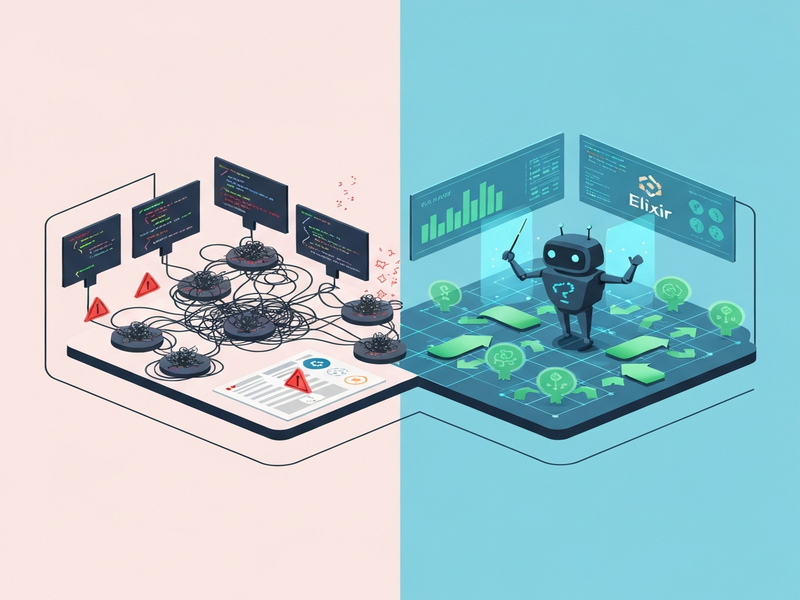
The diagram visualizes how BEAM’s lightweight processes, supervision trees, and hot code swapping create a resilient pipeline compared to the single‑threaded event loop of Node.js or the coroutine model of Python.
Deep‑Dive Resources on UBOS
UBOS leverages the BEAM to deliver production‑grade AI solutions. Explore these pages to see the concepts in action:
- UBOS platform overview – A walkthrough of the underlying BEAM‑based architecture.
- AI agent orchestrator – How UBOS builds fault‑tolerant orchestrators using supervision trees.
- Workflow automation studio – Visual design of multi‑agent pipelines that run on the BEAM.
- Enterprise AI platform by UBOS – Scaling agent fleets across data centers with zero‑downtime upgrades.
- UBOS pricing plans – Cost‑effective options for startups and SMBs looking to adopt BEAM‑powered AI.
Conclusion – Choose the Runtime That Was Built for Conversations
If your roadmap includes thousands of concurrent AI agents, long‑running dialogues, and the need for continuous, zero‑downtime improvements, the BEAM runtime gives you a battle‑tested foundation that Python and Node.js simply cannot match without extensive engineering overhead.
Adopting Elixir/BEAM means you inherit:
- Native, lightweight concurrency that scales horizontally.
- Automatic fault recovery through supervision trees.
- Hot code swapping for uninterrupted feature rollouts.
- Built‑in distributed messaging for seamless clustering.
These capabilities translate directly into faster time‑to‑market, lower operational risk, and a smoother developer experience—critical factors for any AI‑first product.
“When you need an orchestrator that can survive the chaos of LLM responses, the BEAM is the only runtime that lets you let it crash and keep the show running.” – About UBOS
Ready to future‑proof your AI agent infrastructure? Visit the UBOS homepage and explore how the BEAM can power your next generation of intelligent agents.
Andrii Bidochko
CTO UBOS
Andrii Bidochko is an AI entrepreneur and researcher focused on AI agents, reinforcement learning, and autonomous systems. He writes about the technologies shaping the future of machine intelligence, from frontier models and agent architectures to real-world AI applications.